Showing posts with label 2015 Contenders. Show all posts

Sunday, February 1, 2015

2015 Contenders: If it Rains Pancakes, by Brian P. Cleary

If it Rains Pancakes is an interesting hybrid volume: part book about poetry, part book of poetry. It begins with an introduction to what a haiku is, followed by several examples of the form. This process is then repeated for the lantern, another Japanese-derived poetic form.

If I were teaching a poetry class or unit, particularly for elementary school children, I think I'd love If it Rains Pancakes. The explanations of the forms are simple and clear, and Brian P. Cleary's poems that follow show how flexible each form is. In such a setting, this book would be perfect.

As a "contribution to literature," I'm not sure the book is quite as effective. Some of the poems are certainly gems -- "The Mind," with its clever take on memory, was my favorite, and one I think deserves to be anthologized. Others are perhaps less creative, if certainly serviceable. I did think that, taken as as a literary work, If it Rains Pancakes wasn't on the same level as Santa Clauses or Winter Bees, two other volumes of poetry that we've looked at recently.

I will also confess that I was a bit bothered by the fact that every poem in the haiku section is given a title -- not something as unobtrusive as the dates that accompany each poem in Santa Clauses, but a title that states the theme or setting of the piece. Very few published haiku have titles, and in fact, the prominent haiku-themed poetry journals look highly askance on the practice. (Modern Haiku strongly discourages titles, for instance, and Haiku Journal won't even accept submissions with titles.) It's a small issue, to be sure, but it felt like an important one to me.

There's a possibility that If it Rains Pancakes will make this year's Notables list; it's among their final nominations, and I'm curious to see if it makes that last cut. I doubt it will show up in the Newbery committee's selections though.


Published in May by Millbrook / Lerner 


Saturday, January 31, 2015

2015 Contenders: The Right Word, by Jen Bryant

Although the earliest work that could be considered a thesaurus was written almost two millennia ago (On Synonyms, a volume written by Philo of Byblos, who died in 141), the first truly modern thesaurus didn't appear until until 1852, when Peter Mark Roget's Thesaurus of English Words and Phrases was first published. Nowadays, it's hard to find a person who hasn't used a thesaurus in some form -- and yet Roget himself is a little-discussed figure in popular circles.

Full disclosure: at ALA Annual last year in Las Vegas, Rachael and I scored an invitation to a dinner that Eerdmans was hosting in celebration of Jen Bryant, Melissa Sweet, and the forthcoming release of The Right Word. I got a chance to talk to both of them at length, and they're the most wonderful people that you could hope to meet. In fact, Melissa Sweet took it upon herself to make each of us name badges, each of which contained a small fragment from a 19th-century edition of Roget's Thesaurus. Mine is hanging proudly on my cubicle wall now, and it makes me smile every time I see it.


So yes, I'm very much predisposed to like The Right Word. But even when I try to look at it with more objective eyes, I come away from it thinking that this really is an excellent book. The Right Word begins in Roget's childhood, and traces his life from there. It includes information about his many endeavors -- Roget wasn't just a thesaurus writer, but a polymath who also published important works on natural history, medicine, electricity, and optical illusions. However, the book manages to keep its center by referring back to Roget's near-obsessive list-keeping, which began when he was only eight years old, and which culminated in the publication of the Thesaurus.

Indeed, the main problem with The Right Word from a Newbery perspective is similar to the problem with El Deafo: the text and the illustrations blend together to the point that analyzing just the text is almost impossible. The dialogue bubbles -- which are not designed to be read as part of the main text -- add layer upon layer of detail to the story, and Melissa Sweet's illustrations include both drawings and collages of Roget's various lists. Even the typesetting, which includes several passages with only a word or two on each line, serves to reinforce the theme of Roget's passion for order. Simply reading The Right Word aloud doesn't do it justice, and I don't know that the Newbery committee will be able to consider it in a way that would really allow its considerable strengths to shine.

I have, however, seen The Right Word show up on several Mock Caldecott lists, and the Sibert committee may well find a lot to love here as well. I hope it wins something; it's a brilliantly-designed book that sheds a great deal of light on its quirky, important subject.


Published in September by Eerdmans

Friday, January 30, 2015

2015 Contenders: Winter Bees, by Joyce Sidman

After last year's unorthodox but effective What the Heart Knows, Joyce Sidman returns to familiar territory with Winter Bees & Other Poems of the Cold. As in her 2011 Newbery Honor book, Dark Emperor & Other Poems of the Night, Sidman produces a series of nature poems around a common theme, and pairs each one with a prose nonfiction note that elaborates on the poem in question's subject.

The book starts with "Dream of the Tundra Swan," a stunning tour de force of alliteration, assonance, and startling imagery. It's probably one of the fifteen or twenty best poems I've ever read for children; it's that good. I'm not familiar with very many books for children that come out of the gate as strongly, and the piece raises the expectations for the book sky-high.

Perhaps it's inevitable then that the remainder of the volume doesn't quite live up to that initial salvo. The book jacket indicates that "Dream of the Tundra Swan" was the first poem Sidman wrote for the collection, and that initial burst of inspiration turned out not to be entirely sustainable. Interestingly, the second-best poem in the book might well be the very next one, "Snake's Lullaby," which, if it isn't at that level, at least comes close in its incisive description of hibernating garter snakes.

That's not to say that the rest of the book is a failure by any means. Sidman is a highly-skilled poet, and her work never dips below the level of solid craftsmanship. But Winter Bees is so obviously front-loaded that the concluding impression doesn't match the initial hopes that it raises -- especially since it doesn't have a final piece that ties everything together, like Dark Emperor did.

It might have been better to finish the book with the best poem, but the schema that Sidman has chosen doesn't allow her to do that. The sequencing at least loosely follows the rhythm of the season, with the first few poems being about the onset of winter, while the last few concern its end. That's certainly a legitimate choice -- and one that's similar to the one Sidman used in Dark Emperor -- but it does place some serious constraints on her ability to move individual pieces around for maximum impact.

This maybe makes it sound like I enjoyed Winter Bees less than I did. It's an excellent book, and one that solidifies Sidman's place in the uppermost echelon of American children's poets. "Dream of the Tundra Swan" ought to be showing up in anthologies for generations to come. I'm not sure the book as a whole is as consistent as Dark Emperor, however, and given that that one was kind of a left-field honor book, I don't know that Winter Bees will duplicate its awards success.


Published in November by HMH.

Wednesday, January 28, 2015

2015 Contenders: Santa Clauses, by Bob Raczka

Santa Clauses is a slim volume of 25 haiku -- one for each of the days in December leading up to Christmas. The entire book is written in character, with Santa himself as the speaker of each poem. Some of the pieces deal with preparations for the big Christmas Eve trek, while others focus on the Clauses' domestic life.

This could be the description of either a great book or a terrible one, depending on the execution. To Bob Raczka's credit, Santa Clauses ends up as the former. It's a cozy, sparkling book, one that exudes the warmth and good cheer one hopes for during the holiday season.

There's almost no poetic form easier to write in English than haiku -- and very few where writing a great one is as difficult. It's an unforgiving form, in which every word is critically important, and there's essentially no margin for error. And yet I don't think there's a bad poem in Santa Clauses, while there are several excellent ones. Raczka's eye for small but beautiful images is a keen one, and his choice not to make the entire book about Santa's "public" life pays great dividends. Poems such as "December 8th," about seeing one's shadow in the moonlight, or "December 16th," where the images of hardening icicles and baking cookies come together, transcend the framework of the book to become universal.

I'll be honest and say that I didn't expect much from Santa Clauses before reading it; the concept sounded overly cutesy, and haiku so often fail. But after finishing it, I almost couldn't wait for next December, when I can pull the book out and read it to my daughter. Additionally, Chuck Groenink's detailed illustrations have a wonderful interplay with the text; it has the feel of something I'll think of in twenty years as a holiday classic.

That doesn't mean it has a shot at the Newbery, however. We've talked at length before about how hard it is for poetry to win the medal, and there's no precedent for Christmas poetry being recognized. Indeed, although many books in the Newbery canon contain a Christmas scene, I think the only "pure" Christmas book of any kind ever to be recognized is Nicholas: A Manhattan Christmas Story, which honored way back in 1925, and is now remembered largely as a footnote in the career of its author, legendary children's librarian Anne Carroll Moore. As good as Santa Clauses is, I doubt it will break through to the Newbery rolls.


Published in December by Carolrhoda Books / Lerner

Tuesday, January 20, 2015

2015 Contenders: Leontyne Price: Voice of a Century, by Carole Boston Weatherford

Leontyne Price: Voice of a Century is a spare, poetic biography of the woman who would eventually become (according to a BBC Music critic's poll) the greatest American soprano ever to record. As remarkable a feat as that is in and of itself, the fact that Leontyne Price was a black woman from Mississippi, born in 1927, raised the degree of difficulty exponentially. This book carefully emphasizes the magnitude of Price's achievements and her indomitably sunny spirit, while also mentioning the many people who aided her along her way.

Voice of a Century is the kind of biography that only provides a brief overview of its subject's career. Indeed, it essentially ends with Price's spectacular star turn in the Metropolitan Opera's production of Il Trovatore in 1961, when almost a quarter-century of her operatic career was still in front of her. This means that most of her Grammy Awards, her Emmy Award, her Presidential Medal of Freedom, her Kennedy Center Honors, and her National Medal of Arts all fall outside of the book's time frame. In its structure, if not particularly in its content, it reminded me of last year's You Never Heard of Willie Mays?!

Nonetheless, Voice of a Century does an excellent job of chronicling Price's rise to prominence. Carole Boston Weatherford's prose is conversational without being talky, and indeed, reads in places very much like a prose poem. Readers who enjoyed Pam Muñoz Ryan and Brian Selznick's Sibert Honor book When Marian Sang might well enjoy Voice of a Century, especially since Weatherford repeatedly makes clear how much of a debt Price owed to Marian Anderson.


Raul Colón's lovely illustrations add a great deal to the book, though the Newbery committee won't be able to consider them. In honesty, I'm not sure that much Newbery love is going to come for Voice of a Century -- as we've discussed before in this space, short, heavily-illustrated biographical nonfiction tends not to show up in the Newbery rolls, regardless of how well-written it may be. 

The Sibert, however, has been much more open to these kinds of books (see: Balloons over Broadway, A Splash of Red, Ballet for Martha, and of course, When Marian Sang), and if Voice of a Century is to be recognized, that's probably the most likely place. I hope it wins something -- it's an excellent book, and I really enjoyed reading it.


Published in December by Alfred A. Knopf / Random House

Friday, January 16, 2015

2015 Contenders: Eyes Wide Open, by Paul Fleischman

Environmental issues, challenges, and disasters seem to occupy an ever-increasing percentage of the news. Clearly, we have problems, and Paul Fleischman wants to make sure that we are able to understand, analyze, and maybe even solve them.

Eyes Wide Open is a sharp, well-researched, and at times fiery book with two clear objectives: helping its readers to know what current environmental issues are, and making sure those readers have the critical thinking skills to separate fact from opinion. Fleischman talks about global warming, fracking, and renewable energy, but he also spends time discussing rhetorical strategies, cognitive defense mechanisms, and how studies and reports can be affected by who funds them. New information about the environment is always becoming available, and Fleischman wants his readers to able to evaluate it intelligently.

This means that Fleischman doesn't have a lot of patience with those whom he sees as obfuscating the truth, and he isn't shy about saying so. He explicitly mentions Republican denial of climate change, and even uses the famous quote from Stephen Colbert: "Reality has a well-known liberal bias." His tone -- cheerful, but insistent and unafraid -- reminded me of pop-science heroes like Bill Nye and Neil DeGrasse Tyson. Fans of those thinkers will probably love Eyes Wide Open, even if it's hard for me to imagine that this book won't be challenged in at least one library somewhere.

Fleischman is equally clear that he doesn't intend for his book to be read on its own. It includes a dizzying number of links to other sources of information, and a formidable bibliography. Towards the end of the book, he even discusses some of the assumptions that he held when he began writing the book, and how, while his sources and research confirmed some, they disproved others. "Stay open to the facts, wherever they are," Fleischman says, and in some ways, that's the thesis of his book.

Paul Fleischman has, of course, won the Newbery already (Joyful Noise, 1989 award). It's unlikely to me that Eyes Wide Open will net him a second medal; not only does nonfiction rarely win the Newbery, but Eyes Wide Open is more informational than narrative, which indicates to me that it's not a top contender for a "literary" award. I'm curious to see if it draws any attention from the Sibert committee though.


Published in September by Candlewick


Tuesday, January 6, 2015

2015 Contenders: Saving Lucas Biggs, by Marisa de los Santos and David Teague

Margaret O'Malley's father, a corporate whistleblower, has been sentenced to death, wrongfully convicted of arson and murder. The trial judge, Lucas Biggs, is not only known for his harshness, but is also in the hip pocket of the Victory Corporation -- the very same company that Mr. O'Malley had taken on. Although the conviction and sentence are obviously travesties of justice, it appears that there is no way for Mr. O'Malley to escape.

However, Margaret has a secret weapon. Young people in her family, for uncounted generations, have had the ability to travel through time. They are strictly prohibited from using this ability, but with her father's life at stake, that prohibition begins to mean less to Margaret. But even if she manages to enter the past, there's still one problem: "history resists." Margaret may want to change the past, but the past may not want to be changed.

This is the setup for a lovely book, full of memorable characters and evocative prose. The promotional materials describe Saving Lucas Biggs as "When You Reach Me meets Savvy"; I also noted echoes of A Wrinkle in Time and The Water Castle. Those are some big literary shoes, and Saving Lucas Biggs tries its very hardest to fill them.

It doesn't entirely make it, I don't think -- the plot, especially in the last quarter, when some last-minute interventions make the structure come slightly loose, doesn't have the Swiss-watch precision of When You Reach Me; the climactic moments don't possess the pure force of those in A Wrinkle in Time; and the idea of a young girl with a special and unusual gift isn't as revelatory here as it was in Savvy. However, those are some of the most seminal books of American children's literature, and not quite matching them hardly makes a book a failure. Indeed, I think Saving Lucas Biggs is noticeably superior to The Water Castle, particularly in the way it ties the events of the two time periods together, and readers of this blog may remember that I liked TWC a lot. 

Marisa de los Santos has written several adult bestsellers, and David Teague wrote Franklin's Big Dreams, a picture book that got a starred review from Booklist back in 2010. This, however, represents both authors' first foray into middle-grade literature. Saving Lucas Biggs is a remarkably assured and tonally consistent novel, one I would probably have attributed to authors with more middle-grade experience than that.

In a year that features an overwhelming favorite (Brown Girl Dreaming) and several strong dark horses (Caminar, The Family Romanov, The Night Gardener, and Revolution, at the very least), the field may simply be too crowded for the Newbery committee to find room for Saving Lucas Biggs. I don't think I'd put it in my top three or four -- the competition is simply too fierce -- but it's definitely a book I'm glad to have read.


Published in May by HarperCollins

Tuesday, December 23, 2014

2015 Contenders: Space Taxi: Archie Takes Flight, by Wendy Mass and Michael Brawer

Today, Archie Morningstar turns eight years, eight months, and eight days old. It's also Take Your Kid to Work Day, and Archie is finally old enough to ride along with his father, a night shift taxi driver. Archie is very excited, but -- as the title of the book makes clear -- his father isn't an ordinary driver, and his vehicle isn't an ordinary taxi.

Space Taxi: Archie Takes Flight is billed as the first in a new series, and its thin plot is largely setup for the forthcoming installments. It was fun and offbeat, in a Daniel Pinkwater-lite for second graders kind of way, and I enjoyed the time I spent with it. It felt like the book would be an easy sell to a certain brand of reluctant reader, and that's always nice to see. I also liked the surprisingly prosaic use to which the mysterious item that Archie's grandfather gave him is put.

The novel doesn't excel in any of the Newbery criteria, however -- even compared only to some of the more "pop" books we've covered this year, the characters and setting are only loosely developed, and don't measure up to Nanny X or The Vanishing Coin. Space Taxi is pleasant, and I can see the series developing a real following, but it's not going to be a serious contender for any of the ALSC awards.


Published in April by Little, Brown Books

Tuesday, November 25, 2014

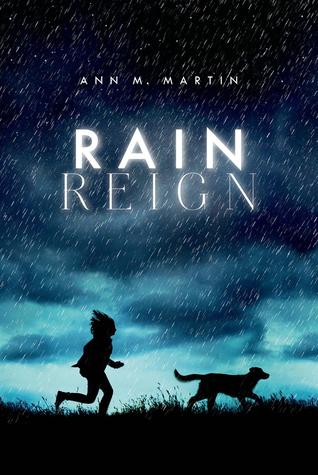
2015 Contenders: Rain Reign, by Ann M. Martin

I feel like it's starting to become a tired trope, on this blog, for me to say, "I really wanted to hate this book, but I ended up liking it." Of course, that tired trope itself is based on my own weariness with certain children's literature tropes that feel tired and worn out. Which ones does this book include? Autism, a missing mother, a neglectful father, a lost dog, and some weird childhood obsessions (homophones, prime numbers, and rules, in this case).

You already know that I liked it anyway, though, so I guess Ann Martin must have breathed some new life into those elements. Her protagonist, Rose Howard, ends up feeling like a real kid, and her relationship with her overwhelmed, borderline-abusive father rings sadly true as well. Rose (and can I just mention here that I'm really glad she doesn't have some whimsical name like Prunella) (of course, that wouldn't be a homophone) has "an official diagnosis of high-functioning autism," and the book jacket states that she suffers from OCD as well, though that is never spelled out within the text. Rose struggles at home and at school, clinging to her list of homophones, her routines, and her rules in order to feel safe. When her dog Rain disappears during a storm, however, everything in her life is called into question.

One thing I appreciate about Rose, as a character, is that she is genuinely irritating. The audio version of the book makes that especially clear, as the listener must wait patiently for her to spell every homophone she runs across. This is a refreshing antidote to some of the "magical autistic kids" that we've seen in the past, who are filled with preternatural wisdom and a distinct lack of human failings. Not so Rose. It's all too obvious why the people around her get fed up with her incessant homophones, her blurting out of prime numbers, and her tendency to stand up on buses and shout about THAT DRIVER WHO DIDN'T USE THEIR DIRECTION INDICATOR.

(On second thought, I often feel like doing that last one myself, but you know what I mean.)

Yes, Rose is a real kid, but I am less convinced about whether she reflects a real understanding of autism and/or Obsessive Compulsive Disorder. As Sam pointed out, some of her mannerisms feel a bit like TV Autism (Rain Man, etc.). I do not feel qualified to comment further, but the portrayal of the disorders made me uneasy.

I am also unconvinced that her personal growth in the second act of the story comes about naturally. With the help of her uncle, she hatches a plan to find Rain, and calls around to every animal shelter in the area to ask about her dog. She also helps console another child whose family property was devastated by the storm. It's not that I think Rose couldn't get there eventually, but I don't think Martin shows us a gradual enough build-up to these successes.

This is all making it sound like I didn't like the book after all, but I promise I did. The characters are well-drawn, the prose is well-crafted, and the themes are well-realized. This is all displayed most notably in the third act of the book, where Rose has to reconcile her love for Rain with her compulsion to obey the rules. The ramifications of this choice resonate into the final pages of the book with great beauty and sadness, enough so that the final, homophone-filled line of the story seems both triumphant and inevitable.

Published in October by Feiwel & Friends.


Wednesday, November 19, 2014

2015 Contenders: Gracefully Grayson, by Ami Polonsky

Twice within the last year or two, while attending a library conference, I attended a presentation about children's books that deal with LGBTQ themes. In both cases, after discussions about picture books and YA novels, someone asked about middle-grade novels. Both times, the presenters -- experts in their field -- didn't have much to say. There's Tim Federle's first and second books about Nate Foster, Jennifer Gennari's My Mixed-Up, Berry Blue Summer, and...probably some others? The list of titles was vanishingly brief; authors and publishers have largely shied away from including the topic.

There are signs, however, that this taboo is beginning to be less powerful. This year alone, we've seen the second Nate book, The Misadventures of the Family Fletcher, and Ami Polonsky's debut novel, Gracefully Grayson, whose main character is a twelve-year-old struggling to carry the secret that, though biologically male, she internally identifies as female.

Although children's books have included plot-driven instances of cross-dressing at least since Huck Finn was skulking around in girls' clothing, I'm at a loss to think of another middle-grade novel featuring a main character who is transgender. Tellingly, Wikipedia's "List of books featuring transgender persons" only has four titles on it; three YA novels, and a 2012 picture book called The Adventures of Tulip, Birthday Wish Fairy. I could be forgetting or overlooking something -- and if I am, please let me know in the comments! -- but in large part, Gracefully Grayson is sailing in uncharted waters.

It does my heart good, then, to note that Polonsky's novel handles its material so well. Its main characters are vibrant and clearly drawn, its prose spare and often elegant, and its sense of place -- the Chicago area as fall creeps into the dark Midwestern winter -- is highly evocative. Although it's true that this is a story of a transgender "boy" taking a chance by trying out for the female lead role in the school play, and in the process, coming to terms with her own identity, it felt less to me like that sterile description, and more just like Grayson's personal story. I found the text refreshingly engaged with telling a particular narrative that belonged to a specific character, rather than some kind of quasi-political or archetypal myth. 

That's not to say that the book is without flaws. The plot uses some extremely familiar tropes: the school play as a key event, the orphaned protagonist, the letters from the dead mother, the death of a grandmother. Although I feel like these elements are sometimes used in a subversive manner, sometimes they're just cliches. Some of the secondary characters don't have a lot of depth, and some of the dialogue that the adults in particular have comes across as a tad soap-operaesque. However, I didn't find these flaws overwhelming, and I enjoyed spending time in this book's world.

I think the chances of Gracefully Grayson winning the Newbery are remote, given the strength of competition this year. However, I'm more than a little curious to see what the Stonewall committee thinks of it, and I'll be eagerly following Ami Polonsky's career from here on out.


Publication in November by Disney/Hyperion 


**Note:  Given the evolution of Grayson's sense of identity within the novel itself, figuring out which pronouns &c. to use while writing this review was really challenging for me. I tried my very best, and used the book jacket description for help, but I'm not an expert, and I apologize in advance if I didn't get it right.

Thursday, November 6, 2014

2015 Contenders: The Key That Swallowed Joey Pigza, by Jack Gantos

In the fifth -- and, according to the book's own dust jacket, the final -- installment of the Joey Pigza series, Joey is facing his most difficult set of circumstances yet. His mother is in the hospital, and so Joey suddenly finds himself as the sole caretaker for his baby brother, Carter Junior. Joey will need to control himself, take care of his brother, and deal with the lurking threat of his father -- who, depending on how you think of it, is either far too absent or nowhere near absent enough.

This is the second Gantos book that we've looked at this year, and it shares some notable similarities with the other title, Rotten Ralph's Rotten Family. Both are entries in long-running series, and both push their series into a darker, more painful place than it had previously gone.

It's not as if the Joey Pigza books have been sweetness and light, but The Key that Swallowed Joey Pigza still hits new levels of grimness for the world of Gantos's "wired" hero. Olivia, Joey's blind quasi-girlfriend, makes a reappearance, and gets a gut-wrenching monologue about her interior landscape, a black world dominated by an unopenable black box. The descriptions of Joey's house, with its piles of rotting food and dead roaches, are positively nauseating. Similarly, Joey's dad, who is constantly lurking in the shadows, his face scarred to unrecognizability by botched plastic surgery, seems imported from a slasher film. You could describe Key as a horror comedy, but, to me at least, the comedy seemed to be sublimated to the horror. Abbot and Costello Meet Frankenstein this ain't.

That's not to say that Key isn't firmly a middle-grade novel. It has an upbeat resolution, and although the book raises large questions, it doesn't lose itself in them. At 154 pages, it's lean and (relatively) straightforward. This isn't a case of a series moving from J to YA halfway through, in the manner of Harry Potter, and I don't think there's any question of it being eligible for the Newbery.

Will it win? I think it's an exceptional book -- Joey's narration may well be the strongest and most consistent voice in any children's title published this year -- but I still have my doubts. Gantos has won the Newbery before, of course, and taken an honor for another of the Pigza books (Joey Pigza Loses Control, 2001 Honor), but the Newbery has only been awarded to a title this far into a series once (when The High King, also the fifth in its series, took the 1969 medal). I think there are eligible books this year that would be easier to build consensus around, though that's a really tough thing to predict without actually being on the committee. However, in my personal opinion, Key is challenging but rewarding, and one of the very best titles of the year. I'd love to see it on Newbery Day.


Published in September by Farrar Straus Giroux

Tuesday, October 28, 2014

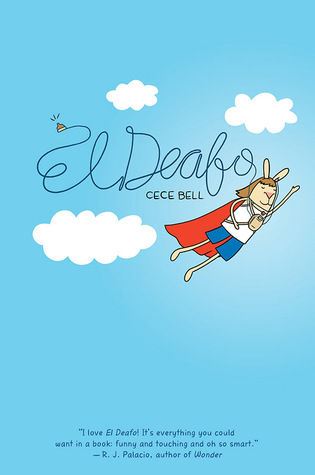
2015 Contenders: El Deafo, by Cece Bell

El Deafo! Pretty much everyone I know has given it five stars on Goodreads, and I don't want to brag, but the people I know are wicked smart. Is it really that good? Yep. In this "golden age of graphic novel memoirs," Cece Bell's story of growing up "severely to profoundly" deaf stands out as an especially distinguished artistic achievement. 

Bell contracted meningitis when she was four years old, and lost most of her hearing as a result. With the help of some powerful hearing aids, she was able to participate in the hearing world. El Deafo chronicles the first ten years of her life, as she wrestles with her feelings of isolation and shame at being the odd girl out. But describing the novel that way really misrepresents its tone, which is poignant, yes, but also laugh-out-loud funny in many places. It's also deeply perceptive about the social nuances of elementary school, and the frustrations, sorrows, and triumphs of making friends at that age.

But what about Newbery? Nina Lindsay writes thoughtfully about the way the criteria apply to El Deafo, noting, "I do not believe that these criteria tell us that the text must carry the entirety of the plot, characters, setting and style.  Only that we must find those elements distinguished within the text…at least whichever elements are pertinent to the text."

That's fair, and I think, in a book like Penny and Her Marble, it can work. I don't think it works here, though, for one crucial reason: in many panels, the text is inseparable from the illustrations. That is, the text itself has visual qualities, and when you render it as plain text, you take away a large chunk of the meaning. Consider the page on the right, where Cece sneakily turns off her hearing aids to drown out her new friend's bedtime chatter. Bell represents the muffling of the friend's voice by depicting it in fainter ink - a technique which she uses (with great effectiveness) throughout the book. In a panel like that, the text is a visual object, and I don't think we can consider it as text anymore. This kind of visual storytelling is part of what makes a book like El Deafo so distinguished, but it also makes it impossible, for me anyway, to consider the text separately from the illustrations.

I think we're still learning how to discuss and evaluate emerging media for children. Will our awards criteria keep up? The ALSC awards are notoriously slow to change, and I think that's a good thing, for the most part. I do hope there is a place for El Deafo in this year's awards pantheon, though.

Published in September by Harry Abrams

Wednesday, October 22, 2014

2015 Contenders: Nanny X, by Madelyn Rosenberg

Alison Pringle and her younger brother Jake aren't very excited that their mother is going back to work. They're definitely not excited to be getting a nanny, especially one who insists on being called Nanny X, and who sends them to school with peanut butter and anchovy sandwiches.

However, Alison and Jake are in for a surprise when, after a save-the-park meeting goes bad, they discover that Nanny X actually works for the legendary N.A.P -- the Nanny Action Patrol. Now the three of them, plus Alison and Jake's baby sister Eliza and their dog Yeti, must stop a dastardly undercover crime ring that threatens their friends, their town, and possibly even their lives.

Madelyn Rosenberg's previous book was 2013's Canary in the Coal Mine. I liked that book, but I loved Nanny X. It's a rollicking, funny novel that, at a brief 112 pages, doesn't overstay its welcome. It's the kind of thing that I loved when I was a child, and I think it would be an easy sell to kids who like mysteries, adventure, and/or self-aware humor.

Historically, the Newbery is highly resistant to humorous books, and even recent winners with a high comedy factor (think Dead End in Norvelt or Flora & Ulysses) have had a level of thematic complexity that Nanny X doesn't attempt. Essentially, Nanny X is the kidlit equivalent of a really good popcorn flick -- one that won't win any Oscars, but that will be enjoyed by (hopefully) many people. And, even though we pay so much attention to awards here, that's a worthy achievement in and of itself.


Published in August by Holiday House

Friday, October 17, 2014

2015 Contenders: The Meaning of Maggie, by Megan Jean Sovern


Maggie Mayfield, a precocious sixth grader, is given a beautiful journal for her birthday - the perfect gift for an aspiring memoirist and future President of the United States! Maggie dutifully records her year: a year, it turns out, that sees her father slowly lose his faculties to multiple sclerosis. Maggie keenly observes her family dynamics while pushing herself academically and emotionally through the trials and triumphs that await her.

Maggie is a bit like a younger version of Jaclyn Moriarty’s titular character in The Murder of Bindy Mackenzie. She is an extraordinary know-it-all, a sassy lass who insinuates herself into situations without a shred of self-awareness, one whose embarrassing lack of social cues simultaneously rewards and punishes her. She’s winning her umpteenth consecutive Student of the Month award while flopping spectacularly at physical education. This is a kid who elicits cheers and groans, often within a single paragraph.

Sovern is a first-time author, and The Meaning of Maggie is reportedly a fictionalized memoir. This closeness to the source material is what initially makes the novel intriguing and enjoyable, but also what ultimately buckles the proceedings entirely.

Maggie’s narration is consistently enjoyable. As the youngest sister, she paints energetic portraits of her older siblings. Layla, the eldest, is too cool to be even vaguely aware of Maggie’s existence, and Tiffany, the shrill middle sister, approaches caricature-like status, especially in Maggie’s snarky, hilarious footnotes. “When Layla was little Dad called her Layla Hayla because he thought she was the bee’s knees. He calls me “Mags” because it sounds cool and he calls Tiffany “Tiffany” because if you call her anything else, she loses her mind” (p. 55).

As the family comes to terms with Dad’s “sleepy” limbs, Maggie’s observations become heartbreaking. She seems innocent of, even removed from, the situation’s gravity, and the family’s interactions between and among each other resonate with a sad, heavy hope. Small, simple revelations paint a family in crisis, even if Maggie remains completely and curiously unaware. Maggie’s slow understanding of the severity of her father’s condition serves as the book’s emotional crossroads, and Sovern handles the awakening with grace. Sovern’s treatment of multiple sclerosis is thoughtful, compassionate, and immediate. It’s a beautiful portrait of a family dealing with the unthinkable.

Reviewers, both for professional publications and on Goodreads, have indicated that the novel’s time period (the late 1980s) seemed flimsy and awkward. It certainly isn’t fully realized nor is it integral to the story, and Sovern unfortunately stumbles with several anachronisms. I was Maggie’s age in 1988, and, to my recollection, remember almost no discussion of medical marijuana; nor do I recall girls being referred to as “hotties." I’m fairly certain, too, that the use of full-stops as emphasis (like. doing. this.) is a more recent literary device, and that most 11-year-olds would not have employed such techniques in their journals.

Maggie, too, is a strangely inconsistent character, even when her musings are hilarious. This is a child who reads voraciously and is academically superior to her peers, yet doesn’t know what a spleen is. She’s childish and mawkish on some pages and way-beyond-her-years on others. The “precious” quotient is through the roof, and not in the way puppies are precious. More in the way that hipsters who enjoy pickling foods are precious.

Despite these flaws, the book is enjoyable and, in my school library, it has circulated like crazy. My students, especially the girls, love it, and I can understand why it is so dear to them. Maggie is a sparkplug of a character, and her wittiness will appeal to many young readers. The Meaning of Maggie, in terms of Newbery-ness, lacks any distinguishing quality, and will likely be but a blip on the radar come awards season. Although its treatment of multiple sclerosis is sensitive and uplifting, I doubt, too, that it will nab a Schneider Family Book Award (which, if I were to bet, will go to Lisa Graff’s delightful Absolutely Almost).

Sorry, Maggie. My students love you, but I don’t think the Newbery committee will.


Published in May by Chronicle Books 


*****


Today's guest reviewer is Joe Prince, Librarian at Marshall Middle School, and Chair of the North Allegheny (PA) School District Library Department. Check out his 6th Grade Mock Newbery -- it's great!

Thursday, October 16, 2014

2015 Contenders: The Family Romanov, by Candace Fleming

I have to make a confession. Though we diligently try to include at least one work of nonfiction in our Mock Newbery discussions, in my heart of hearts I rarely find it as distinguished as the fiction and poetry it's up against. There have been some very well-crafted works of narrative nonfiction in the past ten years, but, to my mind, none of them has displayed the alchemical combination of plot, character, setting, style, and theme that distinguishes the best fiction.

Until now. The Family Romanov: Murder, Rebellion, and the Fall of Imperial Russia is the first work of non-fiction that I would seriously defend as a Newbery frontrunner*. It would be difficult for me to say anything that was left unsaid by its six starred reviews, but I'll add my voice to the chorus of approval.

It seems to me that it must be very difficult to write clearly about the Romanovs; a century after their deaths, most portrayals are either fairy tales and (literal) hagiography, or demonic caricature. By shifting her narrative point of view between the claustrophobic lives of the Tsar and his family, and events "outside the palace walls," Fleming deftly walks the tightrope between these two extremes. We are privy to both tender moments between Nicholas and Alexandra and instances of their shocking callousness and indifference to the suffering of the Russian people. What emerges is a portrait of a flawed, sad, arrogant, but ultimately human set of characters.

Plot also presents a challenge in narrative nonfiction (especially when the foregone conclusion is well-known to most readers), but Fleming builds suspense through the use of expert pacing. She also immerses the reader in the setting with vivid details and primary sources - diaries, letters, memoirs - that remind of us what was at stake for every stratus of Russian society. Stylistically, she uses irony to wonderful/tragic effect - in one chapter, Nicholas plays dominoes and sips tea as Petrograd falls to mobs of hungry peasants.

I'll be recommending this one to Sam for our final Mock Newbery reading list, and I'll come to the table prepared to defend it. Whether or not our participants elect it Maryland's choice for the most distinguished contribution to American's children's literature though, I have little doubt that they will find it, along with Booklist (and me), "compulsively readable."

*Caveat: I never did get around to reading Bomb.

Published in July by Schwartz and Wade.

Wednesday, October 15, 2014

2015 Contenders: The Port Chicago 50, by Steve Sheinkin

On July 17, 1944, a pair of explosions rocked the Port Chicago Naval Magazine in California. Approximately two short tons of munitions that were being loaded onto a cargo vessel accidentally detonated. The resulting blasts completely destroyed the entire loading area, sunk both ships that were docked there, killed 320 people, and injured another 390. It was the worst non-combat military disaster of World War II in the United States.

In The Port Chicago 50, Steve Sheinkin examines the conditions at Port Chicago before the catastrophe. Segregation was still the order of the day, and so all of the sailors actually doing the loading were black. They were treated poorly, given almost no training, and ordered to work with little regard for safety. Sheinkin then details the accident (insofar as is possible, given that every eyewitness was killed), and its aftermath. Specifically, he describes how, given that no changes were made in safety policies or procedures, many of the surviving sailors refused to go back to work. Some eventually did return to the job, but fifty did not, and were court-martialed for mutiny in the single largest trial in American military history. Despite the blatant racism and unfairness of the proceedings, all fifty were convicted and jailed. However, their mistreatment became a national story, and though they were never exonerated, their courage inspired many Civil Rights reforms.

Sheinkin is one of the very best juvenile nonfiction writers working today, and The Port Chicago 50 is a great showcase for his talent. It reads like a gripping thriller, but is well-documented and carefully reasoned. The book reminded me in many ways of Tanya Lee Stone's Courage Has No Color, which also covered the struggles of black service members during WWII. However, even though Stone's book was wonderful (and it made the 2014 Notables list and was a Finalist for the YALSA Award for Excellence in Nonfiction, so I'm not the only person who thought so), Sheinkin's is better -- the writing is sharper, and the imagery more vivid.

That said, it's not quite as impressive as Bomb!, for the simple reason that it's less ambitious. Where Bomb! was a brilliantly-executed three-part fugue, The Port Chicago 50 has a more singular focus (though it does discuss developments in other places, such as the offices of the Secretary of the Navy and the NAACP). The Port Chicago 50 is, however, a much more tightly-constructed book than Sheinkin's effort from last year, Lincoln's Grave Robbers, which tried to maintain a Bomb!-like level of intricacy without having as many stories to tell. Here, Sheinkin's approach is a good fit for the material that he uses, even if it's less involved.

I'm not sure The Port Chicago 50 will make an appearance in the Newbery rolls -- it's not the magnum opus that Bomb! was, and there is stiff nonfiction competition from Brown Girl Dreaming and The Family Romanov, among others. It wouldn't surprise me at all if this nets a Sibert or a Sibert Honor, however.


Published in January by Roaring Brook / Macmillan

Thursday, October 9, 2014

2015 Contenders: Brown Girl Dreaming, by Jacqueline Woodson

Brown Girl Dreaming is a memoir of Jacqueline Woodson's childhood, told in a sequence of poems. It begins at her birth in Ohio, covers her move to South Carolina, and another, later move to Brooklyn. The time period coincides with the heart of the Civil Rights Movement, and the tensions between Black and White, North and South, Secular and Sacred, and Old and New are notes that repeat in different combinations as the book moves forward.

What Brown Girl Dreaming does well, it does very well. Woodson's eye for arresting detail is on full display here -- the color of the dirt, the sound of playground rhymes, the taste of lemon chiffon ice cream. Her personal voice too is very strong; throughout the book, I had a firm sense of just who Woodson was as a child. The other characters are also well-drawn and described. Everyone in the book felt real, something that not even all memoirs accomplish.

I was less sold on the technical aspects of the book. Many of the more personal moments were in beautiful poetry, but the political aspects -- and, oddly enough, the parts about Woodson discovering her desire to become a writer -- felt prosy and a bit shopworn, hitting themes that have come up over and over again in children's literature of the past decade without seeming to add a particularly fresh perspective. Similarly, sometimes the line breaks worked marvelously, but sometimes I felt like they were inserted simply because the line was getting too long. And I'd echo the complaint that came up in discussions over at Heavy Medal, that the titles on the individual poems interrupt the flow of the book without adding much thematically or tonally.


Each individual poem is a sort of a vignette, and I'm unconvinced that this kaleidoscope approach works --- too many of them don't work to advance the narrative, which led me to question the editing. However, this was also a complaint that I had about No Crystal Stair, and most readers didn't agree with me then, so my opinion should perhaps be taken with a grain of salt.

Actually, No Crystal Stair isn't a bad point of comparison in general for Brown Girl Dreaming. BGD is being touted in many circles as the Newbery front-runner, and No Crystal Stair was also a highly-reviewed book (and one that ended up winning the Boston Globe-Horn Book award). I didn't like either of them nearly as much as the general consensus, and in both cases, my main criticisms were structural. It may simply be the case that, as with that previous title, I'm not necessarily the right reader for the book, and so my review shouldn't be given all that much weight.

Because the critical consensus for Brown Girl Dreaming has been so overwhelmingly positive, it's likely this will be one of the titles we choose for our Maryland Mock Newbery. I'm excited to hear the discussions about it, and I hope that listening to and participating in those discussions will help me further refine my opinions of this title.


Published in September by Nancy Paulsen Books / Penguin

Wednesday, September 24, 2014

2015 Contenders: Rotten Ralph's Rotten Family, by Jack Gantos

Being as Newbery-focused as we are around For Those About To Mock, we tend to think of Jack Gantos for Joey Pigza and the Norvelt books. However, Gantos started his career as a picture book author, and he's returned to Rotten Ralph time and time again for almost four decades now.

As is true of many popular picture book series, Ralph's later adventures have expanded to easy readers. In Rotten Ralph's Rotten Family, a suddenly introspective Ralph returns to his childhood home and family to try and discover the root of his rottenness. His memories of his younger years are decidedly rose-colored, but he quickly discovers that they may not be altogether accurate.

It's somehow fitting that, with Gantos at the helm, a lighthearted tale about a mischievous feline quickly takes a sharp turn into Cat Hands On Misery To Cat. The story has a moral, but that moral (essentially, "it's possible to rise above one's abusive childhood") is both highly unusual and abnormally dark in a genre that's pitched to six-year-olds. That it works at all is a testament to Gantos's dexterity and skill as a writer. Still, anyone who thought that the dream sequence in Penny and Her Marble was a bit bleak is probably going to be horrified by Rotten Ralph's Rotten Family.

What makes Gantos great, however, is his ability to blend the surreal and the all-too-real into a concoction that goes down smoothly despite lacking any excess sugar at all -- sort of like Roald Dahl if Dahl viewed humanity with affection instead of detestation. As such, Gantos fans will likely find Rotten Family right up their alley. I think it's too left-field to win the Geisel, much less the Newbery, but it's not as if Gantos needs any more awards for his books to find the readers that they deserve.


Published in March by Farrar Straus Giroux

Thursday, September 11, 2014

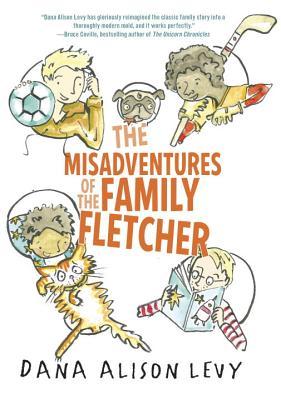
2015 Contenders: The Misadventures of the Family Fletcher, by Dana Alison Levy

Back in 2005, Jeanne Birdsall did such a good job of updating the traditional "family novel" that her effort, The Penderwicks, won the National Book Award for Young People. I am, *ahem*, kind of a Penderwicks fan, but I have to give some credence to one of the most common critiques of the series: that in attempting to establish a "timeless" tone, Birdsall actually fails to create an accurate portrait of the modern world. There are cell phones and computers in Penderwickia, but they are rarely used. The sisters never play video games. I don't think they even mention tv.

Not so with the Fletchers, of Dana Alison Levy's debut novel, The Misadventures of the Family Fletcher. The Fletchers text and email (sometimes with hilarious results). They say "dude," and "sick," and "awesome," and occasionally other, less printable words* (they all contribute to a "rude word jar" when they slip up).

They are a thoroughly modern family in composition and background as well: two dads and four adopted sons (two white, one African-American, one Indian). Levy deliberately downplays the diversity of the family - letting their traits and backgrounds emerge naturally in the course of the narrative - and in doing so she makes her focus clear. This is primarily a family story, in the classic mode of All-Of-A-Kind Family, Little Women, and Ginger Pye, and the Fletchers just happen to reflect what a family might look like in the 21st century.

In her own Goodreads review of the book, Levy says, "I'll be honest, I am a sucker for `comfort food' books - you know, books you can curl up with and feel like the world is an okay place for a little while," and that is exactly what you should expect from the Fletchers: comfort. Everyone in their little Massachusetts (I think? Possibly Maine?) town seems cool with the whole gay parenting thing, and the boys worry more about being ostracized for their thespian leanings than their racial backgrounds. Is that a flaw in the book? I would argue that it's not, because one, it's reflective of the genre, and two, isn't this what we mean with the whole "we need diverse books" campaign? That we need books about all kinds of diverse characters leading all kinds of lives?

I have to admit, though, that this book is precisely my cup of tea, so I'm biased. If I were on the Newbery Committee, it would definitely be a contender for one of my nominations - great characters, lots of humor, multiple well-realized settings, etc. Once we reached the discussion stage, I'm sure one of my other committee members would help me see it through less rosy lenses.

Since I'm just armchair quarterbacking, though, I'll just sit here and bask in the Fletchers' glow (until one of you'un comes to tell me otherwise).


*And can I just say how happy that makes me? Granted, the Penderwick paterfamilias deals with the chaos of the household by retreating to his office as often as possible, but even so, you can't tell me that having four children in the house would not result in the parent(s) screaming profanity at least once a week. I mean, I only have one child, and if I had a rude word jar in my house, its earnings would probably outpace my 401K.

Thursday, September 4, 2014

2015 Contenders - The Night Gardener, by Jonathan Auxier

As vagabond Irish immigrants in nineteenth-century England, Molly and Kip don't have a lot of employment options. That's why they're headed to the cursed "sour woods," against the advice of everyone they meet, to take up employment as domestic servants. When they arrive, it's pretty clear to the reader that the advice was sound: the house is creepy, the family appears to be suffering from some kind of wasting disease, and the whole estate is dominated by a giant, menacing tree that is actually growing into the house. As I said, though: no options. So they stay. And bad things happen.

I should like this book, and I do, I guess. I just don't love it (I started it back in April, put it down, and just recently picked it up and finished it), and I'm not really sure why. I'll try to lay it out in practical terms.


Pros


  • The setting is well-realized, at least insofar as the house and its environs are concerned. The author achieves a nebulous sense of wrongness about everything in the sour woods. 
  • The characters have some depth and complexity. Molly and Kip, as well as the members of the Windsor family, achieve some believable personal growth during the course of the narrative. Secondary characters, particularly Hazel the storyteller, added color (though the two ruffians were kind of stock).
  • Style? I don't think it was distinguished, but neither was it clunky. 
  • The tone and pacing combine to give the story a genuinely frightening edge, the likes of which we don't see often enough in juvenile fiction. The night gardener himself is a scary bastard. 

Cons


  • It's another book about the power of story. Look, I believe in the power of story. I tell stories semi-professionally. I am trained in personal story facilitation. But the "power of story" theme is wearing seriously thin with me. It's right up there with the "librarian as savior" picture books that seem to be published on an annual basis. I am in the choir, folks! There's no need to preach in this direction.
  • To put the above in Newbery terms: theme. I don't think Auxier's thematic touch is light enough. As an example: when Molly brings Kip back from near-death with a story, there were some eyes rolling in this reader's head. 

It's a good book, and I will recommend it to readers of Bellairs, Aiken, and Gaiman, but I don't think it's a great book, nor the most distinguished J Fiction I've read this year.

Published in May by Harry Abrams.