Hurricane Katrina was the sixth-deadliest natural disaster in the history of the United States. Even that fact possibly understates the significance of Katrina to modern history; three of the events with more fatalities happened during the 19th century (the 1889 storm that led to the Johnstown Flood, the 1893 Cheniere Caminada Hurricane, and the 1900 Galveston Hurricane), and the other two (the 1906 Great San Francisco Earthquake and Fire, and the 1928 Okeechobee Hurricane) took place during the Teddy Roosevelt and Calvin Coolidge administrations, respectively. Americans had certainly experienced mass tragedies related to war and terrorism, but no natural disaster on the scale of Katrina had occurred in the US in living memory -- or in the modern media age.
We now have ten years of perspective on Katrina, and dozens of books have been written on the subject, including titles we've reviewed here. Drowned City belongs in the very top tier of those books, and may be the best of those written with a juvenile audience in mind. It briefly but effectively sets the stage -- important, given that much of its readership is too young to remember Katrina -- and then brilliantly describes conditions inside the ruined city, as well as the responses to the tragedy, which ranged from the heroic to the unforgivably incompetent.
All of this is done in spare, poignant language; this is a book that shows, rather than tells. The few lines of dialogue are taken directly from primary sources and news reports, all noted in the carefully cited back matter. Although we can tell where Brown's sympathies as an author lie, he holds back from using words that blame, preferring instead to let his readers come to their own conclusions.
Of course, Drowned City is a nonfiction "graphic novel," and so the interplay between the words and the images is where much of the book's meaning is created. The body language of Brown's figures perfectly captures the range of emotions surrounding Katrina, and his stark wide-screen drawings of the utter devastation that followed the storm pack a visceral punch. Brown does not shy away from the hard realities of his subject; although it's all tasteful, and I maintain that the book is certainly appropriate for a middle-school reader, Drowned City includes pictures of storefronts being looted, corpses floating in the flooded streets, and people trying to break out of their attics before the water rises high enough to drown them.
Up until the last couple years, I would have assumed that Drowned City was too visual an experience to show up in the Newbery rolls; after Flora & Ulysses and El Deafo, I'm less sure. I do hope the Sibert committee notices how carefully Brown has used his sources, and how clearly he presents his information.
Published in August by HMH Books for Young Readers
Showing posts with label Graphic Novels. Show all posts
Wednesday, November 4, 2015
Tuesday, October 28, 2014
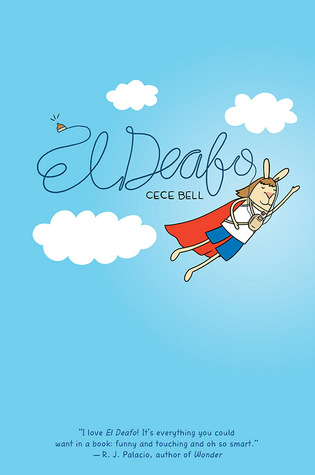
2015 Contenders: El Deafo, by Cece Bell
El Deafo! Pretty much everyone I know has given it five stars on Goodreads, and I don't want to brag, but the people I know are wicked smart. Is it really that good? Yep. In this "golden age of graphic novel memoirs," Cece Bell's story of growing up "severely to profoundly" deaf stands out as an especially distinguished artistic achievement.
Bell contracted meningitis when she was four years old, and lost most of her hearing as a result. With the help of some powerful hearing aids, she was able to participate in the hearing world. El Deafo chronicles the first ten years of her life, as she wrestles with her feelings of isolation and shame at being the odd girl out. But describing the novel that way really misrepresents its tone, which is poignant, yes, but also laugh-out-loud funny in many places. It's also deeply perceptive about the social nuances of elementary school, and the frustrations, sorrows, and triumphs of making friends at that age.
But what about Newbery? Nina Lindsay writes thoughtfully about the way the criteria apply to El Deafo, noting, "I do not believe that these criteria tell us that the text must carry the entirety of the plot, characters, setting and style. Only that we must find those elements distinguished within the text…at least whichever elements are pertinent to the text."
That's fair, and I think, in a book like Penny and Her Marble, it can work. I don't think it works here, though, for one crucial reason: in many panels, the text is inseparable from the illustrations. That is, the text itself has visual qualities, and when you render it as plain text, you take away a large chunk of the meaning. Consider the page on the right, where Cece sneakily turns off her hearing aids to drown out her new friend's bedtime chatter. Bell represents the muffling of the friend's voice by depicting it in fainter ink - a technique which she uses (with great effectiveness) throughout the book. In a panel like that, the text is a visual object, and I don't think we can consider it as text anymore. This kind of visual storytelling is part of what makes a book like El Deafo so distinguished, but it also makes it impossible, for me anyway, to consider the text separately from the illustrations.
I think we're still learning how to discuss and evaluate emerging media for children. Will our awards criteria keep up? The ALSC awards are notoriously slow to change, and I think that's a good thing, for the most part. I do hope there is a place for El Deafo in this year's awards pantheon, though.
Published in September by Harry Abrams
Bell contracted meningitis when she was four years old, and lost most of her hearing as a result. With the help of some powerful hearing aids, she was able to participate in the hearing world. El Deafo chronicles the first ten years of her life, as she wrestles with her feelings of isolation and shame at being the odd girl out. But describing the novel that way really misrepresents its tone, which is poignant, yes, but also laugh-out-loud funny in many places. It's also deeply perceptive about the social nuances of elementary school, and the frustrations, sorrows, and triumphs of making friends at that age.
But what about Newbery? Nina Lindsay writes thoughtfully about the way the criteria apply to El Deafo, noting, "I do not believe that these criteria tell us that the text must carry the entirety of the plot, characters, setting and style. Only that we must find those elements distinguished within the text…at least whichever elements are pertinent to the text."
I think we're still learning how to discuss and evaluate emerging media for children. Will our awards criteria keep up? The ALSC awards are notoriously slow to change, and I think that's a good thing, for the most part. I do hope there is a place for El Deafo in this year's awards pantheon, though.
Published in September by Harry Abrams
Subscribe to:
Posts (Atom)