Showing posts with label 2014 Contenders. Show all posts

Tuesday, July 15, 2014

Digressions: Seeing Red, by Kathryn Erskine

Note: I wrote this entire post after having listened to the audiobook of Seeing Red. I did not realize  (until I double checked the publication dates) that the print version was published in 2013, rendering the entire discussion moot for our 2015 Mock Newbery purposes. 

As it turns out, the novel was ignored by all of the YMA committees. It did receive a starred review in Booklist, but it was otherwise a blip on the literary radar. Nevertheless, Recorded Books chose to record an audiobook version of it. I assume that's due to the author's National Book Award winner status, but really, who knows? I've been on this committee for six months now, and while some of the book-to-audiobook choices are obvious, some are still mystifying. And it's only getting weirder as it becomes cheaper for audio publishers to put out digital-only titles. Onward!

___

In a lengthy author's note at the end of Seeing Red, Kathryn Erskine explains (among other things) the reasoning behind her protagonist's name:

"Finally, Red’s last name is Porter for two reasons. Pullman Porters
were early leaders in the civil rights movement, successfully creating
a union and organizing events leading up to and including the March
on Washington in 1963. I wanted to pay tribute to them. Also, a
porter is a person who carries burdens and, symbolically, all of us are
like Red, carrying the burden of our history and the responsibility for
our current society." 

(http://www.usborne.com/downloads/teachers-notes/seeing-red-authors-note.pdf)

A noble sentiment, to be sure. But man, is that a heavy burden (no pun intended) for one kid to carry, and that kind of front-loaded symbolism is my biggest issue with this novel.

To back up... Red Porter is living in a small town in Virginia in the early 1970's. There are racial tensions in his town, but Red's family has never, of course, perpetrated any racial injustice. His recently deceased father was a kind of saintly Atticus Finch figure, and the whole family is having trouble adjusting - financially and emotionally - in the wake of that unexpected death. Of course, history is not always what it seems, and Red is going to have to adjust his view of his family and his town many times before he grows into his new status as the "man of the house."

There's also a young, progressive anti-war teacher; a Klan-like organization; an idealistic lawyer; a simple-but-wise man; an old alcoholic who beats his kids; and a strong black woman. There is, in short, a whole lot of history packed into this novel (which weighs in at a hefty 352 pages). The four page author's note makes it explicit that Seeing Red is Erskine's attempt to deal with some of the injustices she saw while growing up. Again, that's a worthy goal! But it doesn't make for an effective novel. The didacticism weighs down the plot, and the transparent symbolism of the characters makes this feel more like allegory than realistic fiction. 

Seeing Red is not a complete failure, of course. Erskine effectively evokes the atmosphere of a small town in the seventies (I lived in one, for a few years anyway). Her prose is accomplished as well (as can be expected from a National Book Award winner).


Thursday, January 16, 2014

2014 Contenders: "The President Has Been Shot!", by James L. Swanson

The plan was for my review of Prisoner 88 to be my last one of 2014 Newbery contenders. However, I looked back at my Mid-Year Predictions post, and noticed that I'd never gotten around to reading "The President Has Been Shot!",  even though it was on my list of books that I felt like I ought to make sure and read before the YMAs.

Now that I've finished it, I have to say that this is probably the most impressive nonfiction book for older readers that I picked up this year. In clear, vivid language, Swanson takes us through the lives of John F. Kennedy and Lee Harvey Oswald, up to the moment where they violently intersect, and through its aftermath. Much like last year's Bomb, President reads more like a thriller than a standard nonfiction book, and is the better for it.

The criticisms I do have of the book are fairly minor. The section on JFK's life and career are less nuanced than I might have liked, but given that Swanson had highly limited space, it might be as good as it can be. The book also maintains a laser-like focus on its two subjects (and, to some extent, on Jackie Kennedy and Lyndon Johnson in the aftermath of the assassination), to the point that, although it mentions that Governor John Connally was also shot, the text neglects to inform us that Connally recovered from his wounds.

James L. Swanson has written two previous books for youth, Chasing Lincoln's Killer, and Bloody Times. Both of those got excellent reviews, but neither was eligible for the Newbery, as both were adaptations of Swanson's adult titles (Manhunt and Bloody Crimes, respectively). President also has an adult counterpart, End of Days. However, whether by design or by chance, President seems to have been published the month before End of Days, a bit of chronological trickery that I think may render it Newbery-eligible, since, at the time it was published, it was an "original work."

Assuming that the Newbery Committe also considers President eligible, I think this book has the best shot of any nonfiction title this year of showing up in the Newbery list. I don't think it's actually the best nonfiction title of the year -- that's still On a Beam of Light -- but it's easier to take the text of President on its own merits than that of OABOL. That said, I think the likelihood is still that no nonfiction titles show up in the Newbery rolls this year.

We'll find out in a week and a half!


Published in September by Scholastic

Wednesday, January 8, 2014

2014 Contenders: Prisoner 88, by Leah Pileggi

As Prisoner 88 opens, it's May of 1885, and Jake Oliver Evans has been convicted of manslaughter. He's on his way to the Idaho Territorial Penitentiary, where he will serve a five-year sentence for his crime. All of this has befallen Jake at the ripe old age of ten.

This novel, which marks Leah Pileggi's debut, takes a true event as its starting point -- a ten-year-old actually was sent to the I.T.P. in 1885 on a manslaughter conviction. The rest of the story, however, is strictly fictional. The book does an excellent job of capturing the setting -- the grim, claustrophobic interior of a late 19th-century prison, in which Jake is perhaps the ultimate fish out of water.

The characters, however, are mostly stock types, and even Jake doesn't have much more than two dimensions. A lot of time is spent on Jake's struggles in learning to read, but the payoff didn't seem to me to be worth the subplot. Most of the plot, really, is fairly thin, and the events leading up to the book's action climax seemed more than a little  forced to me.

I wish there was more depth to Prisoner 88, because the setting is so unusual. I can't think of very many other children's books set almost entirely inside a prison that aren't either fantasy novels or WWII internment camp types. I'd love to read more of Leah Pileggi's work, and I think one has to consider this a debut that shows some promise. I just can't see it showing up on Newbery day.


Published in July by Charlesbridge

Thursday, January 2, 2014

2014 Contenders: Clementine and the Spring Trip, by Sara Pennypacker

Clementine and the Spring Trip is the sixth book featuring Clementine and her family, marking author Sara Pennypacker's return to the series after last year's stand-alone Summer of the Gypsy Moths. The novel is centered around Clementine's school visit to Plimoth Plantation, which requires our third-grade heroine to ride the olfactory disaster that is Bus Seven, and to deal with the fourth-graders' restrictive rules about making noise while eating.

There's nothing in the Newbery criteria one way or the other about books that are part of a series. In practice, however, series that produce Newbery winners are usually recognized in some way fairly early in the sequence. The two highest-number series books that have ever won the Newbery, The Grey King (1976 award, 4th book in the series) and The High King (1969 award, 5th book in the series), both belonged to series that had won Honors for their second books (The Dark is Rising and The Black Cauldron, respectively). Recent committees haven't shown much interest in sequels in general; since 1985, the only winners that weren't either a stand-alone or the first in a series have been A Year Down Yonder (2001 award) and Criss Cross (2006 award), both of which were the second books in their respective sequences.

Precedents, of course, are made to be broken, and as the disclaimer at the end of so many investment commercials reminds us, past performance is not an indicator of future results. However, considered simply on its own merits, I don't think Clementine and the Spring Trip reaches the level of this year's top contenders. Clementine, of course, is a classic character, and her family is also sharply drawn, but I don't think all the supporting characters are fully three-dimensional. Really, the book that Spring Trip reminds me the most of this year is The Year of Billy Miller. Like that book, Spring Trip excels in its descriptions of its main character and family, as well as home and school. Both novels, however, seem to me to be less crisp beyond those tight circles, in a way that isn't true of The Real Boy or The Center of Everything.

This doesn't mean I didn't really enjoy Clementine and the Spring Trip -- it's a charming, clever read, and I like the way that the ending ties together all of the threads that have been introduced throughout the book. I hope it makes the Notables list this year. I don't think it's quite Newbery material though.


Published in March by Hyperion / Disney

Friday, December 20, 2013

2014 Contenders: Counting by 7s, by Holly Goldberg Sloan

Counting by 7s is the story of Willow Chance, a precocious 12-year-old whose parents are killed in an automobile accident. It details the aftermath of this tragedy, and Willow's attempts to build a new life and a new home with a cast of other people who don't quite fit in.

The book is getting a fair amount of awards buzz, and a lot of reviewers have really positive things to say about it. Having finished it, however, I find myself unpersuaded.

The biggest problem I had is with Willow herself. I didn't believe in her for a second -- she reads like the kind of genius you see on a TV show rather than one you might actually encounter in real life. She effortlessly learns and recalls information about gardening, zoology, epidemiology, dermatology, beekeeping, astrophysics, computer hardware, legal agreements, spatial design, astronomy, network hacking, modernist poetry, and multiple foreign languages (Spanish, Latin, Vietnamese), to the point that even Marilyn Vos Savant might be hard-pressed to keep up. She aces a test that apparently not a single other child in the state of California has gotten perfect, and yet she hasn't so much as skipped a grade. As middle school prodigies go, she's slightly less realistic than Susan and Mary Test, and significantly more problematic than Early Auden, whom I've already complained about at length.

That might work if it were played for laughs, or if it were in some kind of larger-than-life tall tale, but Counting by 7s is ostensibly contemporary fiction with no fantastic elements. Willow's character kept jarring me out of that world with her impossibility.

This is even more true because the facts in the book have moments where they veer away from the truth significantly. Willow has a story she tells (and references repeatedly) about the flock of green-rumped parrots that lived by her house. However, the book is set in Bakersfield, California, and according to the Official California Bird Records, there has never been a recorded sighting of a green-rumped parrot (or parrotlet, which is what it's usually called) in California, much less a flock of them moving into someone's backyard. If she's an expert in zoology at the level at which she is presented -- and, especially since the book shifts constantly between first and third person narration, there's no reason to view Willow as an unreliable narrator -- that seems like the sort of mistake she wouldn't make.

Counting by 7s has a heartwarming plot, and the sentence-level writing is quite good, if presented in a somewhat stilted cadence. But, in the end, I'm not convinced about this one at all.


Published in August by Dial Books for Young Readers

Wednesday, December 11, 2013

2014 Contenders: Salt, by Helen Frost

Whenever I pick up a verse novel, the first thing that goes through my head is the question, "why this story in this format?" That is, what is it about this story or these characters that makes the author feel like verse would work better than prose to communicate the narrative?

Sometimes, there's a good answer. In The Wild Book, the narrator has tried writing in poetry as a way to help her dyslexia. In The One and Only Ivan (which, while not a full-on verse novel, has certain verse novel elements), the clipped, understated narration is meant to help show what it's like inside a gorilla's head.

More often, however, I can't find an answer that satisfies me. And that was probably my biggest complaint about Salt -- that I was never able to answer that question to my satisfaction. True, it allows for the book to switch quickly between its protagonists, but that's something that can be done in pure prose form too, and I think it might have benefited from that approach.

I also felt like the brief nature of all the scenes meant that the characterization wasn't particularly deep. We get a fairly good feel for James and Anikwa, the narrators, but the secondary characters end up painted in very broad strokes. Even with James and Anikwa, I felt like the characterization didn't have enough nuance for their conflict halfway through the book to really feel natural.

A lot of the language is beautiful -- anyone who loved Step Gently Out last year knows that Helen Frost is highly skilled with imagery. I'm not sure I felt like all the line breaks were purposeful enough, however, and I don't think that giving all of Anikwa's poems a specific shape on the page (one that's sort of like three stacked balls) helped with that challenge.

I did enjoy the setting -- the war of 1812 isn't a popular choice for children's books, and the portion of the conflict that didn't take place around the Chesapeake Bay even less so. I did feel like I'd spent some time in an interesting place after I'd finished the book.

The setting, however, was the only facet of the book that I felt was truly distinguished. That might be enough to get Salt on the notables list, but I'd be very surprised if it showed up in the Newbery announcement.


Published in July by Farrar Straus Giroux

Friday, December 6, 2013

2014 Contenders: Locomotive, by Brian Floca

Locomotive is another of our Morris Seminar books, and a very good one it is, too. It's by Brian Floca, who has already won two Sibert Honors as author and illustrator of Lightship (2008) and Moonshot (2010), as well as a third for his illustrations for Jan Greenberg and Sandra Johnson's Ballet for Martha (2011). His fascination with transportation continues here, in an evocative free-verse description of a trans-continental railway journey as it was in 1869.

As we've been mentioning in recent days, the strongest nonfiction of the year seems (in our collective opinion) to be concentrated in the picture book section. Locomotive is another title that deserves to be in the mix with Brave Girl, A Splash of Red, and On a Beam of Light. Interestingly, however, I think it's not as good a Newbery candidate as some of the others, because of the relationship between the text and the illustrations.

One of the ways that Floca creates continuity in Locomotive is by putting words that describe sounds in markedly different fonts from the rest of the text. This works beautifully in the context of the book as a whole, but it's a strategy that's more design than pure text. Much the same could be said of Floca's choice to put some of the lines uttered by the railway workers in speech bubbles. The line between text and illustrations gets very blurry in Locomotive, and although that's fine for the Sibert, it makes Newbery consideration highly problematic.

As a book, I like On a Beam of Light a little better than Locomotive, but I recognize that that's essentially an issue of personal taste -- I like science-y subjects, and I prefer Jennifer Berne's understated prose to Floca's whooshing, onomatopoetic poetry -- rather than any kind of pure critical judgement. However, I think On a Beam of Light does objectively fit the Newbery criteria better, mostly because there's simply more left once one removes the illustrations from consideration.

In reality, the Newbery is probably a pipe dream for both books. However, I'm starting to get really, really curious about this year's Sibert results, where Locomotive could easily carry the day.


Published in September by Atheneum.

Thursday, December 5, 2013

2014 Contenders: Imprisoned: The Betrayal of Japanese Americans during World War II, by Martin W. Sandler

This is a solid book about a topic that's seldom given the attention it deserves: the imprisonment of Japanese-Americans during World War II. If I were reviewing it in detail, I would pay close attention to the way it's organized, indexed, etc.

I am not reviewing it in detail. I have been out of the office (traveling, dealing with my sickness, and then dealing with my kid's sickness) for a week and a half. I have Sam's permission to write a Short Grouchy Review (patent pending) of this one. In fact, I am going to deploy bullet points.

  • The prose is adequate, but that's all. I noted that the prose in Courage Has No Color was not up to Tanya Lee Stone's usual standard, but it's still noticeably better than the prose in this book. 
  • I mentally took away organization points for the ineffective way the full-spread sidebars were integrated into the text. I hate when I have to stop mid-sentence and decide whether to read a sidebar or mark it with my thumb and return to it later. 
  • Content-wise, it was quite comprehensive, giving ample attention to the historical background (Japanese immigration and resulting persecution) and the redress movement and ongoing ramifications. The link to 9/11 and persecution of American Muslims and Sikhs was especially welcome. 
I'm giving it four stars on Goodreads, but for someone with my reading habits (seeking out the best children's books published in any given year), there is a lot of room within that fourth star. This is a low four, compared to the mid-to-high star I gave Courage Has No Color.

Neither of them are going to win the Newbery, and, as Sam mentioned today, I'm kind of hoping that the Sibert goes to a nonfiction picture book this year. Brave Girl and A Splash of Red are both great choices, Sam loved On a Beam of Light, and I haven't been able to get my hands on The Mad Potter yet, but I'm a big fan of any Greenberg/Jordan collaboration.

Published in May by Walker Childrens

2014 Contenders: On a Beam of Light, by Jennifer Berne

Here it is -- the one that I feel is unequivocally the best nonfiction title of the year, the one that can stand with last year's best efforts, and that I'd love to see receive some serious Newbery discussion.

That last part isn't likely to happen, alas, because On a Beam of Light is not only a nonfiction title, but a picture book as well. Yet the book takes the life of Albert Einstein, a figure whose achievements aren't all that easy to explain to a child, and uses them as a framework for some of the most perceptive prose of the year. My favorite passage is on the page from which the book takes its title:

"And in his mind, right then and there, Albert was no longer on his bicycle, no longer on the country road...he was racing through space on a beam of light."

Reading lines like that, I'm on that beam of light as well.

It's not, of course, relevant to the Newbery discussion, but the illustrations by Vladimir Radunsky are the perfect counterpoint to the text, full of whimsy, poignance, and huge washes of negative space. That sort of thing is relevant to the Sibert committee, however, and Rachael and I were wondering today if this might indeed be a year when the Sibert winner is drawn from the ranks of the picture book nonfiction (as in 2012, when Balloons Over Broadway took the medal).

On a Beam of Light is one of our discussion titles for the Morris Seminar in January, and I can't wait to see what the other participants think of it. I also can't wait to talk about how much I love it!


Published in April by Chronicle Books

Wednesday, December 4, 2013

2014 Contenders: The Tapir Scientist, by Sy Montgomery

How do you go about studying an animal that a) is critical to the health of its environment, but b) is shy, nocturnal, and lives in a snarl of tangled bushes, omnipresent mosquitoes and ticks, and suffocating heat and humidity? In The Tapir Scientist, Sy Montgomery and photographer Nic Bishop get to find out firsthand, as they accompany biologist Pati Medici and her team out into the field to study the elusive tapir, the largest mammal native to South America.

As an informational text, The Tapir Scientist generally succeeds. It does a great job of showing what life on a field expedition is like: the tedium, the difficult working conditions, the disappointments -- and then the thrill of encountering a majestic animal face to face, and learning information that could help ensure its survival. It also details the place of the tapir in its natural ecosystem, and explains how the lives of the animals intersect with the people who live in the same place. Sy Montgomery is always good for an above-average book -- we loved her Temple Grandin last year -- and The Tapir Scientist certainly is that.

It's instructive, however, to compare The Tapir Scientist with something like Moonbird, another book featuring an author working with scientists in the field. In Moonbird, Phillip Hoose turned the story of a bird into a rumination on the relationship between the human and natural worlds, both honoring and transcending his ostensible subject. I don't think The Tapir Scientist achieves that level of sophistication and depth, or even really approaches it.

I'm also not entirely sold on the design of the book. Nic Bishop is a first-class photographer, and his images are excellent; I think they're often not placed in the best position respective to the text, however. The font choice also seems odd -- I had to stare at the sidebar-style sections for a while to convince myself that they weren't actually printed in Comic Sans, just something uncomfortably reminiscent of it -- and, although most of the important words are defined in the text, there's no end glossary.

In the end, The Tapir Scientist is absolutely a recommend-for-purchase title, at least in this one man's opinion. I don't expect any Sibert love for it, however, and I don't think the Newbery committee will be at all swayed in the book's direction.


Published in July by Houghton Mifflin Books for Children

Friday, November 22, 2013

2014 Contenders: If You Want to See a Whale, by Julie Fogliano

Every year, a picture book or two gets bandied about in the (online, publicly visible) Newbery discussions. Last year gave us Each Kindness and Step Gently Out. This year, we've had Africa Is My Home (assuming you take it as a picture book, rather than a heavily-illustrated work of short fiction); the other title that I've seen crop up in the most discussions is probably If You Want to See a Whale.

In a way, it's academic exercise, discussing these picture books. No "traditional" picture book has ever won the Newbery (though that's an assertion that assumes you agree with me on how to categorize A Visit to William Blake's Inn [1982 winner], which I think of as an illustrated collection of poetry rather than a picture book, and which is filed in the 811s in our local library system, but which did win a Caldecott Honor). The Honors list isn't much better -- aside from another poetry book, Dark Emperor (2011 Honor), the only picture books I can find are Wanda Gág's Millions of Cats (1929 Honor) and The ABC Bunny (1934 Honor), from the pre-Caldecott days. (If you can think of one I missed, leave a comment!)

And yet I feel like it's an important discussion to continue having. Even without the iconic illustrations, the texts of Goodnight Moon and Where the Wild Things Are and Horton Hears a Who are, I would argue, key parts of American children's literature. It's very hard to talk about picture books without considering the illustrations -- it feels kind of like trying to evaluate a symphony without ever mentioning the string section -- but the ones that fall within the Newbery range (which is the overwhelming majority of them) deserve our attention nonetheless.

With all that said, it seems to me that the text of If You Want to See a Whale does several things extremely well, and a few things maybe not as well. The sound of the book when read aloud is fantastic -- Julie Fogliano has a keen ear for alliteration and assonance, and lines such as the ones in which she describes clouds "in the sky that's spread out, side to side" are a joy just to say. The ending of the book in the text is also beautifully ambiguous, fading out on the lines "and wait... / and wait... / and wait..." The last of illustrator Erin E. Stead's pictures shows the whale quest coming to a successful end, but it does so wordlessly -- although she's given us a tidy ending, Fogliano as author has declined to do so.

The main thing that bothered me -- and maybe it's just from sitting through too many Creative Writing workshops back in college -- was the book's unwillingness to fully commit to its central conceit. I know that the book isn't really about whale-watching at all, but a metaphor is best when it works on both the literal and figurative levels. A window isn't helpful for watching for whales (or at least, nowhere near as helpful as being outside), and if you're on a beach or in a boat, roses and bugs aren't likely distractions. 

This doesn't mean that If You Want to See a Whale isn't a delight, but I do think it means that it's not Newbery material. When Rachael reviewed Each Kindness last year, she talked about the intense difficulty of writing a short text. One flawed line in a 300-page novel might pass by unnoticed; the same isn't true of a poem of 52 lines, several of which are only two or three words long. Surviving the scrutiny that such a short text invites is an incredibly high bar, and I'm unconvinced that Whale clears it.


Published in May by Roaring Book Press

Thursday, November 21, 2013

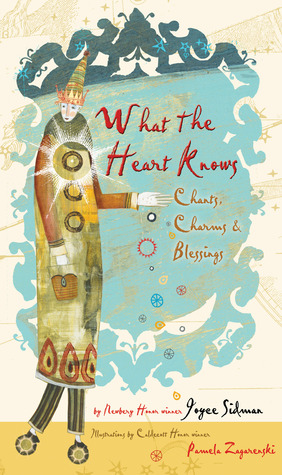
2014 Contenders: What the Heart Knows, by Joyce Sidman

Joyce Sidman's newest book of poetry is a strange beast indeed. The subtitle is "Chants, Charms & Blessings," and in her note to readers, Sidman talks about how humans have always "used language to try to influence the world," and encourages readers to make poems of their own and "chant them, in your own voice." She divides her book into four parts: Chants & Charms, Spells & Invocations, Laments & Remembrances, and Praise Songs & Blessings. The result is something like a poetic Book of Common Prayer (or Book of Shadows), with all of the elevated diction and heightened emotion such a mode requires. Both the subject matter and tone are widely varied among the individual poems, soaring from lost socks to the slippery nature of time, and then swooping back down to ugly sweaters, all the in the space of three pages.

I don't believe I've ever had cause to mention my religious background on this blog, or in any of my writing about children's books. In the interest of making clear the kind of reader I am, though, I think it's only fair to say that I have been a solitary Pagan, a high church Episcopalian, an enthusiastic half-Jew, a Unitarian-Universalist, and a quasi-Buddhist in my life. Like the titular character in Life of Pi, I'm spiritually profligate - I just love a good prayer. And even outside of overt spirituality, I've built my entire life around the idea that words can shape reality. This book basically speaks directly to my heart.

Even as a biased reader, though, I think it's fair to say that this is a magnificent collection of poetry. Sidman is the Kevin Henkes of children's poets: I don't know any serious children's poet who speaks so respectfully to their readers. The best poetry is always about more than what it's about, and Sidman achieves that more often than not in this collection, turning ordinary objects into metaphors for loss, transience, and comfort. She does not restrict herself to the tangible, though - occasionally the poems enter the realm of pure surrealism, as in "Song in a Strange Land," which plays out like a fever dream.

What the Heart Knows is not only distinguished thematically, though. The poems are also characterized by  razor-sharp imagery, as in "Blessing on the Smell of Dog": "May his scent seep through / perfumed shampoos / like the rich tang of mud in spring." The sound of the words themselves is deeply satisfying as well, filled with the repetition, alliteration, and insistent rhythms that characterize the tradition of sacred poetry. The fact that these are secular prayers only adds to their power, solemnizing the topics we usually dismiss.

Other reviewers have pointed out that the poems are not perfectly equal in quality, and that's fair, but there's very little filler, in my opinion. Nina also questioned whether the illustrations distract from the poetry, and I think that is actually a good question - I was so focused on the text that I barely noticed the illustrations at all. It's possible that the book would be even more effective with a simpler design. There is the age question as well - this is really aimed higher than Sidman's usual middle-grade age range, but surely not too high for the Newbery. 

Overall, it's a gorgeous piece of work - definitely in my top five books of the year - and I do hope it gets some love on Newbery day. 

Published in October by HMH Books for Young Readers

Tuesday, November 19, 2013

2014 Contenders: Eruption!, by Elizabeth Rusch

Last year was a true banner year for children's nonfiction, featuring such exceptional titles as Moonbird, Temple Grandin, Hope and Tears, Titanic: Voices from the Disaster, We've Got a Job, Abraham Lincoln & Frederick Douglass, and, of course, Bomb. That's an amazing list of books right there, and the fact that they came out in the same twelve-month period is nothing short of astonishing.

I guess it's not a huge surprise that this year's crop of nonfiction has generally paled in comparison. Some of that is just the vagaries of publishing -- Phillip Hoose and Gwyneth Swain, for instance, didn't have a book out this year, and Deborah Hopkinson's new one was historical fiction. Steve Sheinkin and Russell Freedman did have new ones out -- but though both books were certainly good, the general consensus seems to be that they don't quite hit the heights of their titles from last year. In fact, though I've enjoyed several nonfiction books this year (Courage Has No Color and Collector of Skies in particular), I'm not sure there's a single one that I'd put in the same category as the seven titles I listed in the first paragraph.

However, Eruption! has been getting a fair amount of good press, with Jonathan Hunt over at Heavy Medal even touting it as "arguably my favorite nonfiction title of the year." As such, I felt like I had to pick it up, and I was immediately sucked into the story of the brave and resourceful scientists of the Volcano Disaster Assistance Program. The book focuses on two of the VDAP's greatest triumphs -- their studies of Mount Pinatubo in 1991, and Mount Merapi in 2010. In both cases, the VDAP scientists accurately predicted major eruptions a few days before they occurred, enabling evacuations that saved tens of thousands of lives. Elizabeth Rusch's sentence-level writing is engaging, and I thought she did very well at bringing the reader right into the middle of the action.

I have some questions, however, about places where the style -- and, more especially, the editing -- seemed to get in the way of the Presentation of Information item in the Newbery criteria. For instance, the text mentions the technical word "fumaroles" twice, once in a chart on page 10, and in the main text on page 11, without either defining the word or explicitly referring the reader to the glossary in the back. However, when the word appears in the main text on page 15, it's defined within the sentence -- and then defined again, using almost the exact same words, on page 21. Additionally, on page 63, the text lists the name of a village as Dusun Petung, but the photo caption simply calls it Petung. The map on page 8 also misspells the name of Mount Rainier. Those are small points, to be sure, but in an informational text, I don't think we can just ignore them.

When I finished Eruption!, I was glad to have read it, and I felt like I'd learned a lot about an organization I'd never before even heard of. I don't think, however, that it has that je ne sais quoi that the best of last year's titles did, and I find the sloppy editing troubling. I'd recommend in a heartbeat that any public library purchase Eruption! for their collections, but I don't think it's a serious Newbery contender, and I still think Courage Has No Color would be a better Sibert selection.


Published in June by Houghton Mifflin

Wednesday, October 30, 2013

2014 Contenders: From Norvelt to Nowhere, by Jack Gantos

When last we left Jack Gantos (the character, not the author), the mystery of the murders of the Original Norvelters had been solved, his ever-bleeding nose had been repaired, and he'd even managed to talk some temporary sense into his father. However, once Jack's mother sends him on a trip to accompany the curmudgeonly Miss Volker to Eleanor Roosevelt's grave, everything rapidly deteriorates again. Jack and Miss Volker end up on a journey to Florida -- a journey filled with Classics Illustrated comic books, harpoons, and the vintage Gantos sense of an entire universe spiraling out of the control of a hapless, befuddled narrator.

The last book that Gantos (the author) wrote was, of course, Dead End in Norvelt, which took the 2012 Newbery. I actually think that Nowhere is a stronger book than Dead End -- it's funnier, more emotionally complex, and more thematically deep. There aren't too many sequels to Newbery books that manage to top the original, but I think Nowhere may well be one.

Paradoxically, I also think it's much less likely to win. The 2012 award year was, as we've mentioned before, a really odd one, and Dead End in Norvelt is very much an outlier in the Newbery canon. It's a humorous mystery that won an award that only infrequently goes to mysteries, and almost never goes to something funny. It also represented the longest time between an author's debut and winning the Newbery.

This was partly because the list of 2012 contenders wasn't very deep, and the titles that attracted the most attention were so divisive that it might have been impossible to build consensus around any of them (see: Okay for Now, Breadcrumbs, Junonia). I don't feel like that's the case this year, and I think that's what it would take for another Gantos novel that works in genres and styles that rarely show up in the Newbery to take home the medal.

Additionally, despite the fact that the Newbery criteria state quite clearly that each book is to be considered on its own, without reference to any of an author's other works, there's no precedent for two books in the same series winning the top prize. We've seen, within a series, one book win the Newbery and then another one honor (e.g., Dicey's Song [1983 winner] and A Solitary Blue [1984 honor]); a book take an honor and then another one win (The Dark is Rising [1974 honor] and The Grey King [1976 winner]; The Black Cauldron [1966 honor] and The High King [1969 winner]); and several books in the same series be given honors (all five of Laura Ingalls Wilder's honor titles); but never two winners from the same set. It's possible that someday, we'll see it happen, but I just don't see the Norvelt books as being the ones to break that barrier.

Anyone who enjoyed Dead End will likely also enjoy Nowhere, and I think it's an excellent novel. Just don't put all your money on it winning the Newbery.


Published in September by Farrar Straus Giroux / MacMillan

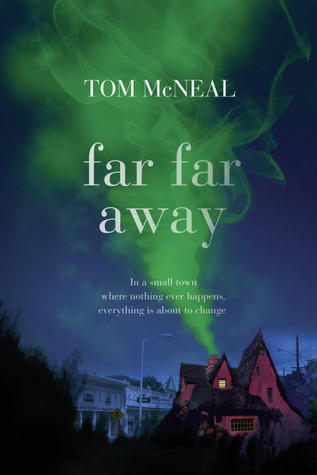
2014 Contenders: Far Far Away, by Tom McNeal

Far Far Away is the story, as the narrator tells us at the outset, of a boy, a girl, and a ghost. The ghost, who is also the narrator, happens to be the spirit of Jacob Grimm, one half of the famous Grimm brothers. The boy is clairaudient - able to hear spirits - and the girl is an ebullient mischief-maker. Their story, and the story of their fairy-tale-ish town, Never Better, would be an idyllic one, if it were not for one additional character: the sinister Finder of Occasions. It is also this character's presence that calls into question whether the book falls within the prescribed Newbery age grange. When he makes his move, the story grows very dark indeed.

What do the Newbery criteria have to say about age-appropriateness?

2. A “contribution to American literature for children” shall be a book for which children are an intended potential audience. The book displays respect for children’s understandings, abilities, and appreciations. Children are defined as persons of ages up to and including fourteen, and books for this entire age range are to be considered. 

Many books fall obviously inside or outside the "up to and including fourteen" range. The Year of Billy Miller is in. Looking for Alaska is out (forgive the old example - I haven't read any YA this year, unless you count the title currently under discussion). Some books are more difficult to categorize. Age of protagonist can be a indicator, but not always - Hattie Ever After feels like a solid middle grade book, despite the fact that Hattie is seventeen or eighteen. Violence and/or sexual content can also catapult a book out of the Newbery range. If all else fails, you can fall back on a rule of thumb I think I first read on the child_lit listserv: a true children's book always ends on a hopeful note.

So how does Far Far Away measure up? Jeremy and Ginger, the main child characters, are fifteen - a little older than the Newbery range, but children do "read up." There's no sexual content more prurient than a chaste kiss on the lips. And the violence, while present, is more suggestive than graphic. Finally, the ending is categorically happy and hopeful, as befits the fairy tale structure.

BUT.

For its last third, just before the happy ending, the book turns into a true horror novel. There's no bloodshed or brute violence, but things grow uncomfortably dark. Darker than we imagine our Newbery books to be. As dark as real life can get, in fact.

At first that section made me say, "Welp, definitely not a Newbery contender!" And obviously, I won't be handing it to my seven-year-old. But I thought back to what I was reading when I was thirteen and fourteen, and you know what? Those were the years when I discovered Stephen King. I was reading The Shining, Misery, Carrie, etc. And I wasn't the only one. We were also passing around Flowers in the Attic in those days, and whatever V.C. Andrews lacked in literary quality she definitely made up for in pure creepiness. And, heck, in school we were reading Guy de Maupassant and Poe. For all their historical distance, those guys still pack a creepy punch.

Can we really say that Far Far Away is less appropriate for fourteen-year-olds than Maupassant and Poe? When we're supposed to be considering books for the entire age range?

I have a feeling that Far Far Away will make people too uncomfortable to get any Newbery love, but I would argue that it does fall within the Newbery range. And yes, by the way, it is distinguished - in character, in setting, in theme, in style, but probably most of all in plot. I can't think of another book this year that so effectively and methodically tightened the suspense noose. And when the trap was finally sprung, the payoff was dark - yes - but deliciously effective.  

Published in June by Knopf Books for Young Readers

Monday, October 28, 2013

2014 Contenders: Africa is My Home, by Monica Edinger

Full disclosure: the About to Mock ranch is very much a Monica Edinger fan club. We love her blog (if by some odd chance, you read us and not her, you should rectify that immediately), we eagerly devour her reviews in The Horn Book and The New York Times, and we're very grateful for her support in our own book discussion endeavors. We think she's awesome, and so I can't help but have that in my mind as I'm reading her work.

Africa is My Home is the fictionalized story of Sarah Margru Kinson, one of a handful of children who happened to be aboard the slave ship Amistad, of Supreme Court and Steven Spielberg fame. It follows her from her childhood in what is now Sierra Leone, through her experiences aboard the ship and in America, and on into her adult life. It's a fascinating read that sheds light on a little-known part of a famous story.

Indeed, though Africa is My Home is a short, heavily illustrated book with a single narrator, the book I was reminded of while reading it was No Crystal Stair. Both books discuss lesser-known figures involved in famous events, and interestingly, in both cases, the author attempted to write the book as straight nonfiction first before realizing that the paucity of firsthand data made that impossible.

I think Africa is the better of the two books, partly because it maintains its focus so well (which was my complaint about No Crystal Stair, though I was really the only one complaining, so take that for what it's worth). But Africa also breaks into poetry occasionally -- poetry that truly sings. Those passages are, in my opinion, the best part of the book, to the point that what I really want now is to read a book of Edinger's poetry. I'd put good money on it being awesome.

The one quibble I had with the book has to do with its being narrated in the first person by Sarah -- but a version of Sarah who is fully grown and looking back on the events of the narrative. This allows for the inclusion of facts and interpretations of events that a child wouldn't necessarily know or comprehend, but I felt like that temporal distance made the book lose some emotional immediacy. It's not a huge issue, but especially given that there's no such emotional gap in the poetic bits, it was something I noticed.

Although it can't be taken into account for Newbery purposes, this is also a truly beautiful-looking book. The illustrations are by Robert Byrd (Good Masters! Sweet Ladies!, Electric Ben), who captures the feel of 19th-century broadsides and maps while still imparting his signature style. It's a great pairing with the text, and the editors of the book should be commended for that.

The Newbery committee historically is very unfriendly to "picture books" -- even comparatively long ones with lots of text -- and if Africa were somehow to win, I think it might be the shortest winner since maybe Sarah, Plain and Tall (1986). That doesn't feel likely to me this year, but if Africa doesn't make the notables list, you'll definitely be able to color me surprised.*


*As a side note, it's worth noting that, although Byrd has illustrated both a Newbery winner and a Prinz honor book, he's never received any Caldecott love. I'm categorically not a Caldecott expert, but I'd really like to see Byrd recognized there.


Published in October by Candlewick

Wednesday, October 9, 2013

2014 Contenders: Twerp, by Mark Goldblatt

Aren't we supposed to be doing our Second Takes right now, you ask? Why yes, yes we are. But I already had this one on my desk, and now that I've finished reading it, I can't help but want to talk about it.

I have to confess that it took me a long time to get around to reading Twerp. We got an ARC of it ages ago, but neither Rachael nor I felt very enthusiastic about reading it. It wasn't until About To Mock reader Destinee tweeted to us that we should take a look at it that I retrieved it from the shelf, and it wasn't until I'd carried it around in my bag for three weeks or so that I even cracked the cover.

I think part of my reticence was that the language on the back cover of the ARC frames the novel as an anti-bullying message novel. My tepid feelings about Wonder weren't really a secret, and yet that was still one of the best books of its type that I've seen. This didn't seem like all that promising of a haystack to go needle-searching in.

Who knows, maybe the anti-bullying marketing will be successful in bringing Twerp some extra sales. However, the novel is much more complex than that. It's a detailed snapshot of New York City in the 1960s, a thoughtful examination of the awkwardness and fitfulness of first crushes, and an incisive look at what makes otherwise good people do terrible things. Although bullying certainly is a key theme, it's not even close to the only thing going on in the book.

I found the characters believable, especially Julian Twerski, the book's narrator. Also highly effective is the book's structure; it's set up as a lengthy writing assignment that Julian is doing for his sixth-grade English teacher. His teacher wants him to talk about the bullying incident that Julian was involved in, but Julian isn't that keen to discuss it. As a result, the book circles around and around, coming always closer, but never quite hitting the central plot point until the very end of the novel. It's an excellent way to keep the suspense up, and it doesn't -- to me at least -- feel inauthentic.

The end result is a surprisingly strong novel that deals honestly and truthfully with moral complications. Is it better than The Real Boy or Zebra Forest? I don't think it quite is, but it's very solidly in the next tier, and it's definitely worth consideration.


Published in May by Random House.

Friday, September 13, 2013

2014 Contenders: Flora and Ulysses: The Illuminated Adventures, by Kate DiCamillo


16052012Last spring, Jack Gantos and I were hangin’ out, shootin’ the breeze*, and talking about which new kids’ books we liked. He said that he really liked Mr. and Mrs. Bunny –Detectives Extraordinaire, partly because Horvath’s animals are smart. He remarked that just because your characters are animals doesn’t mean that they have to be dull-witted. I think he actually used a funnier word than that, but it’s been too long and I don’t remember what it was. If you see him around, ask him about stupid animal stories. 

Anyway, I think that’s what turns a lot of people off about talking animal stories – they associate the genre with cutesiness, preciousness, and simpleminded characters. That stereotype has a basis in reality, of course, especially in picture books. There are some authors who seem to think that if your story stinks, moving it to the animal kingdom will disguise the smell. 
 
Needless to say, Polly Horvath doesn’t fall into that trap, and neither does Kate DiCamillo. I thought of Horvath’s bunnies when I was reading DiCamillo’s newest, Flora and Ulysses, because the two books share a certain sensibility. As the Horn Book review of Mr. and Mrs. Bunny advised, “Look not for logic; this is a romp.” That advice holds true for Flora and Ulysses, whose plot is set into motion when a giant, multi-terrain vacuum cleaner sucks up an ordinary squirrel. Ulysses the squirrel, when resuscitated by Flora, retains extraordinary non-squirrellish powers (mainly flying, understanding human speech, and typing).

It is in the content of Ulysses’s typed compositions, however, that the novel diverges from the “madcap romp” genre. This wouldn’t be a Kate DiCamillo novel if it didn’t whack you in the head with pure beauty when you’re least expecting it. So what does a squirrel write, in DiCamillo’s world, when awakened from his dumb animal nature and presented with a typewriter? Why, he looks around at the trees and sky he loves, and at his new friend, and he writes poetry : “I love your round head / the brilliant green / the watching blue, / these letters, / this world, you.”

And then, because this is still a comic novel, he adds a postscript: “I am very, very hungry.” 

Until that poem appeared, I thought this novel was just okay, but that’s just so exactly the kind of poem a newly reverent squirrel would write that, once again, I found that Kate DiCamillo had totally pwned my heart.

I think this one may have a hard time at the Newbery table. It has those gorgeous DiCamillo moments – Ulysses’ poems, Flora’s struggles with her feelings, her father’s loneliness and awkwardness… But it’s also a comedy, and it doesn’t have the kind of character development you see in, say, The Year of Billy Miller. In Flora and Ulysses, the characters are cartoonish, and I think that’s an appropriate stylistic choice here, but it may count against them when it’s time to vote. Then, too, I’m not sure the sentence-level writing is all that special, for the most part, when compared to Billy Miller or Hokey Pokey. Neither are the settings. Thematically, it shines, but that may not be enough. 

And I should mention the illustrations. These are the “illuminated” adventures of Flora and Ulysses, meaning that some of the plot is advanced by comic strips drawn by K.G. Campbell. They tie in thematically with Flora’s interest in comics and superheroes, but they mean that the book could fall into the same liminal space occupied by Brian Selznick, though not to the same extent.

In any case, I like it a whole lot, and I think Jack Gantos would too.


*Okay, fine. He was here for an author visit and we were waiting for a class to arrive. 

Publication in September by Candlewick Press

Friday, September 6, 2013

2014 Contenders: Beholding Bee, by Kimberly Newton Fusco

So there's a book out this year that's set during World War II. Its protagonist is a girl who lives with a caretaker; said caretaker is older than her, but not by that much. When circumstances conspire to take the caretaker figure away, our main character is led onward by a ghostly presence, which may just help her find her forever home. Which book am I describing?

All right, pencils down. Did you say Gingersnap? If so, then you're correct. But if you answered Beholding Bee, the most recent title from Kimberly Newton Fusco...then you're also correct.

It's not as if we haven't had two oddly similar books come out in the same year before -- just last year, this was part of our discussion around Glory Be and The Lions of Little Rock. However, the weirdly specific plot points that Gingersnap and Beholding Bee share genuinely took me aback. The books were published only a month apart, by different imprints (though of the same publisher), so it's not a case of plagiarism or anything -- just a bizarre, bizarre coincidence.

At any rate, in much the same way that the similarities between them threw into sharp relief how much better Lions was than Glory Be, the forced comparison makes it obvious how much superior Beholding Bee is to Gingersnap. Where the characters in Gingersnap were flat and ill-defined, those in Beholding Bee are presented in much sharper focus. And, perhaps most importantly, the fact that Beholding Bee is twice as long as Gingersnap means that the ideas get a much fuller treatment in the former, as opposed to the latter book's maddening lack of detail.

 
*SPOILERS*

This doesn't mean that all the plot threads are tied up by the end of the book. Although the supernatural elements come to a natural conclusion, and Bee has made great progress in coming to terms with the facial birthmark that has brought her so much social difficulty, several other strands are left hanging. We don't get to see Bobby's much-discussed return, we don't know what happens to Ruth Ellen's father (who seems to be missing in action somewhere in Europe), and we don't get to see the end of the standoff between Bee and the school bully, Francine. If I had to guess, I'd wager that Fusco is planning to return to this set of characters, and has thus left herself enough room for the sequel(s). I have no problem with that, but it's worth noting that a reader who expects a neat ending will be disappointed.

I quite liked Beholding Bee, and I'd love to see what happens next in the story. As I look at the Newbery criteria, however, I can think of other contenders that are a bit stronger in theme (Penny and Her Marble), presentation of information (Courage Has No Color), plot (The Water Castle), characters (The Hidden Summer), setting (Zebra Forest), and style (The Real Boy). As such, I wouldn't put Beholding Bee in my top tier of contenders, but not because it's a weak title -- just because others are especially strong.


Published in February by Alfred A. Knopf / Random House

Tuesday, September 3, 2013

2014 Contenders: Barbed Wire Baseball, by Marissa Moss

The mass internment of Japanese Americans (and others, including those of German, Italian, and Hungarian descent) during World War II is a low point in the history of the USA. One of the thousands sent to the internment camps was Kenichi Zenimura, a brilliant baseball player and manager whose career had included playing in and organizing barnstorming tours with the likes of Babe Ruth, Lou Gehrig, and Biz Mackey.

Barbed Wire Baseball spends a few pages on Zenimura's early life, but most of the book takes place during his internment. In the harsh desert landscape of the Gila River (Arizona) camp, Zenimura decided to help the other prisoners (who included his wife and two sons) in the way he knew best -- by building a baseball field. It wasn't just any field either, as the book goes to great lengths to show the care and love that Zenimura showered on the facility, which included a carefully manicured infield, grass landscaping, and bleachers for the spectators.

It's an inspiring story, no doubt about it, especially when you take into account some of the information in the appendix, which indicates that Zenimura was able to create a 32-team league within the camp, and also notes that both of Zenimura's sons went on to play professionally in Japan. (In a poetic touch, both played their careers for the team based in Hiroshima.)

The book's text makes some choices I'm not sure I agree with, however. Throughout, it only refers to Zenimura as "Zeni," to the point that it's only by reading the appendix that the reader can even find out the full name of the story's main character. I'm also not sure the decision to include so few details about Zenimura's pre-internment career -- and to confine all information about his life after the first game played on the field at Gila River to a couple pages in the appendix -- serves the subject particularly well. The man meant so much to his sport that he earned the nickname "The Father of Japanese American Baseball," and even if the picture book treatment necessitates brevity, the focus of Barbed Wire Baseball is so narrow that I'm not sure readers will come away understanding Zenimura's importance.

Barbed Wire Baseball is a joy to look at. I love Yuko Shimizu's illustrations, which, astoundingly, are the first she's ever done for a picture book -- I hope we see more from her in the coming years. The book fills a valuable niche, and, quibbles aside, will at least merit consideration from the Notables committee. I think it's clearly a lesser work than the similarly-structured You Never Heard of Willie Mays?!, however, and since I didn't posit any Newbery love for that one, I highly doubt we'll see any for Barbed Wire Baseball.


Published in April by Abrams.