Showing posts with label 2018 Contenders. Show all posts

Monday, December 11, 2017

2018 Contenders: Patina, by Jason Reynolds


One of the perennial questions that comes up in Newbery discussions is whether or not a given book "stands alone" -- that is, can the reader easily find their way into and out of it without having already read a book that comes before it, or needing to read another that comes afterward.

To be clear, there's nothing in the Newbery criteria that require a winner to stand alone. Indeed, the committee has, on occasion, given the gold medal to books that almost certainly don't. (The High King [1969] is probably the most obvious, but arguments can also be made about The Grey King [1976] and Dicey's Song [1983] at least.) It's something of a rarity, however.

All of this brings us to Patina, the second novel in Jason Reynolds' Track series. It follows 2016's Ghost, which I had missed, and will be followed by Sunny, which is scheduled to be published in April of next year. (One assumes that, at the very least, Lu will follow at some point thereafter.) At any rate, I approached Patina without having any background knowledge of the series, and for what it's worth, I found it difficult when separated from the rest of its series.

The Track books each follow one of the four new runners on the Defenders track team. Patina Jones, the title character of Patina, is trying to prepare to run a relay race for the first time, while also dealing with many challenges off the track. Her mother is largely disabled, and so Patina and her younger sister, Maddy, are living with their uncle and aunt. Patina, who is black, is attending a new school, an upper-class, heavily white, private academy; it's a vastly different place from her previous, more integrated, public school. She's trying to take care of herself, while at the same time looking out for her younger sister, and the pressure wears on her.

I was able to catch up to the story eventually, but the first chapter especially left me feeling ungrounded; it was full of characters I felt like I should already know, in a setting that felt like it should have been familiar. And (spoiler alert!) the novel ends with Patina running the last leg of her relay, sprinting for the finish line, and then...well, I don't know. There's no conclusion at all -- it's a pure cliffhanger, which one assumes will be resolved in the next book.

Patina has plenty of good points -- the characterization and voice, especially, are clear and strong. The pacing seemed off to me, but it's possible that problem might disappear in the context of the whole series. But make no mistake: this book demands to be read in concert with the others. I found it difficult indeed to evaluate in a vacuum. If I had to guess, the fact that Patina doesn't stand alone will probably keep it off the Newbery podium this year; I'll be curious to see how my opinion of it changes, however, when I read the whole series.


Published in August by Atheneum / Simon & Schuster

Monday, November 20, 2017

2018 Contenders: See You in the Cosmos, by Jack Cheng

Alex Petroski is an 11-year-old boy from Colorado who loves astronomy, rocketry, and cosmology in general. He has a rocket that he hopes to launch at the Southwest High-Altitude Rocket Festival; his goal is to get the rocket into outer space, where it will carry his "golden iPod" out into the universe, just like the "golden records" carried by the Voyager 1 and Voyager 2 probes. Although his father is dead, his mother is clearly suffering from mental health problems, and his older brother is far away in Los Angeles, Alex heads off to the festival alone, planning to meet up with some of his friends from an online rocketry forum on his way there. His journey ends up taking him not only to the festival, but much further afield as well. Through it all, Alex continues to record to his iPod, and these narrations form the text of this quasi-epistolary novel.

See You in the Cosmos has received some stellar reviews, and I've heard Newbery buzz around it as well. In some senses, I can see why. Many of the supporting characters feel real and well-developed -- I'm thinking here especially of Ronnie and Terra -- and the book hits some heavy themes, especially in its second half, with an admirable open-heartedness. However, I'm not entirely sold on the novel, largely due to Alex himself, whom I was never able to fully believe in.

Alex is OBSESSED, in an all-caps kind of way, with Carl Sagan. He's intimately familiar with the original Cosmos, has seen Contact some uncountable number of times, and even owns a Sagan-style sweater. Heck, his dog's name is actually Carl Sagan. When Alex refers to Sagan, he often calls him "my hero." This isn't a passing fancy; this is integral to Alex's character and identity.

And...I just had a hard time buying it. The novel is clearly contemporary -- it's full of references to Snapchat, Yelp, and Google maps. As such, Alex would have been born in 2006 or so. And yet, the original Cosmos aired in 1980; Sagan died in 1996, and Contact came out in 1997. Alex's fixation on Sagan would have been like me being 11 and refusing to stop talking about George Gamow. I was a weird, weird kid with some off-the-wall interests, and that would have been a bridge too far even for me.

I could maybe have believed it if Alex's hero was, say, Neil DeGrasse Tyson; my stepdaughter is 11, and she not only knows who Tyson is, but likes him well enough to have expressed a desire to read his books. But, although Alex does mention Tyson once (in the context of Cosmos), that scene just reminded me of Martin Prince's opinions on Ray Bradbury:


Perhaps time has made me cynical. Perhaps there's some kid out there who could legitimately serve as a model for Alex. But I note with some unease when adult authors give child characters anachronistic interests, be they Carl Sagan, Heloise's Hints, or knowing the exact time that a network TV show airs, as if on-demand had never been invented. It usually feels to me like the authors are breaking the illusion of the fictional world they're creating, interrupting my willing suspension of disbelief. I couldn't help but compare Alex unfavorably to someone like Joey Pigza, who's much more easily recognizable as a real kid. (This is especially true since The Key That Swallowed Joey Pigza deals with many of the same deep themes as See You in the Cosmos). 

However, in other ways, Alex is deeply authentic. (His paragraph-long run-on sentences, in particular, sound exactly like conversations I've had with kids that age.) Indeed, the prose itself is exemplary, and as I mentioned at the start of this review, there's a lot to like about the novel. If it's easier for you to believe in Alex's love of Sagan, you may well enjoy this book much more than I did. But this is one where, although I see why people adore it, I can't necessarily bring myself to love it myself.


Published in February by Dial/Penguin

Wednesday, August 30, 2017

2018 Contenders: Landscape with Invisible Hand, by M.T. Anderson

So, as it turns out, we were neither abducted by aliens, nor decided to decamp to some off-the-grid cabin far away from the blogosphere. Rather, a gigantic library software project has been the only thing we've had time to think about this summer, and we're just now managing to emerge, squinting, into the sunlight again. So to speak.

But enough about me. Much more interesting than my essay about How I Spent My Summer Non-Vacation is the latest M.T. Anderson book, Landscape with Invisible Hand. It's a story narrated by Adam Costello, a teenage artist living in a near-future Rhode Island. An alien race called the vuvv have made contact with Earth, bringing amazing technology, lifesaving medicine -- and completely destroying the human economy. The vast majority of jobs are now obsolete, and while a few rich people live in floating cities among the clouds, most humans live in misery, struggling to find anything to eat, drinking contaminated water, and threatening each other with physical violence over part-time food court jobs, for which there are dozens, even hundreds, of applicants.

Landscape with Invisible Hand, from its mocking, Adam Smith-referencing title to its final period, functions as a blistering satire of modern America. The vuvv are patronizing colonialists, self-congratulatory about their efforts on behalf of humanity, but either blind or indifferent to the immense suffering their arrival has inflicted. Despite the fact that there are nowhere near enough jobs remaining, humanity's leaders and rich elites blame the suffering of the majority on the majority's sloth and greed, refusing to do anything that might actually help the situation. Most art and music consists of shameless attempts to please the vuvv, whose concept of human culture is built out of  the detritus of the 1950s -- warmed-over doo-wop, uninspired still-life paintings, rockabilly clothes. Even the novel's ending casts some serious shade on the very concept of the "American Dream."

This being an M.T. Anderson book, Landscape does also have a bruised, but beating heart. Even the most odious of the core characters is recognizably human, and Adam's unbreakable desire for meaning and beauty manage to carry him through even the lowest points of the plot. I don't want to give it away here, but his monologue at the end of the chapter titled "A Small Town Under the Stars" is possibly the emotionally moving thing I've read this year.

Really, Landscape is a YA novel; I doubt it has any chance of showing up in the Newbery rolls, if only because its careful deployment of f-bombs would render all the pearl-clutching about the use of "scrotum" in The Higher Power of Lucky charmingly quaint. But the publisher's guidelines say the book is for ages 12 and up, and the Newbery is supposed to be for books for readers up to 14. I do think Landscape qualifies under the letter of the law, and it's a good enough book that, if I were on the committee, I'd urge everyone to give it a very close look.


Publication in September by Candlewick

Wednesday, June 28, 2017

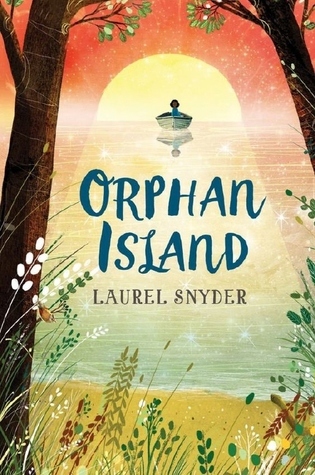
2018 Contenders: Orphan Island, by Laurel Snyder


"Nine on an island, orphans all / any more the sky might fall." 


Sometimes you finish a book and you're not sure whether you've just read the best book of the year or witnessed a train wreck. It seems to happen more and more often to me. I feel like I should be getting more confident in my critical assessments as I get older, but instead I increasingly find myself going, "Huh! That sure was a book!" or, "Okay, I guess that's the kind of thing we're publishing these days?"

25753092Orphan Island is a hell of a thing. The premise is simple: nine children (each one year apart in age) live on an idyllic island. Once a year a boat comes to bring a new toddler (a Care) and takes away the oldest child (the Elder), who is approaching adolescence. It invites inevitable comparisons to Hokey Pokey, by Jerry Spinelli, of course, and for its first half Orphan Island seems to occupy that same allegorical space. We don't know how the children get there, or why, or how the island takes care of them. It just does. We do know that Jinny, the eldest child this year, is having a hard time letting go of childhood.

As an aside, Jinny is an admirably unlikable character. She feels like a real twelve-year-old. She's bratty and selfish and makes just about all of the mistakes it's possible to make on an island where nothing can go wrong.

Anyway, the book seems to be following a fairly predictable trajectory in which Jinny will grow and mature and generally get her shit together, and then she will leave the island and it will be bittersweet but necessary. But then the plot takes an unexpected turn. (Spoilers follow.)

After a pretty inauspicious year as Elder, the boat comes for Jinny, and she just... doesn't get in. She drags the thing up on the sand, collects the new Care, and determines to continue business as usual. Some of the other children warn her that she's breaking one of the very few rules that seem to hold their reality together, but Jinny doesn't care. Until reality starts to fall apart. The snakes are suddenly venomous. The winds that keep the children from falling off the cliffs are no longer functioning. The chickens stop laying. Children start getting hurt.

A lot of the reviews I've read have been frustrated with the ambiguous ending of Orphan Island. Jinny does end up leaving in the boat, along with the new Care (who is on the verge of death), but nothing is explained. Here are just a few of the things Snyder never tells us: How does the island work? Who created it, and why? Where do the children come from? Where do the children go? When Jinny leaves, will it fix the island, or is she leaving her fellow kids behind to starve? What are they supposed to do when all of the books in their little library fall apart (this one made me especially anxious)?

To those people, Laurel Snyder replies, basically: being twelve is weird and horrible and you have no idea what's happening to you or why. She wanted to replicate that experience in novel form. I'm... really not sure yet whether she has succeeded! I do know that she has created a world that is strange and vivid, populated with characters who feel like real children. I know that this is an ambitious book, and I have a feeling I will be thinking about it for a long time. It also features clear, strong, uncluttered prose - in that sense, I think it's Snyder's best work yet.

For those reasons, I would not be surprised if this one comes up for discussion at the Newbery table, but I wonder if it's too divisive to win. Either way, I plan to pass it along to my almost-twelve-year-old. Though she may refuse to read it, because she's bratty and contrary.

Published in May by Walden Pond Press. 


Monday, May 8, 2017

2018 Contenders: Donald Trump: Outspoken Personality and President, by Jill Sherman

*deeeeeeeeeeeep breath*

I stopped by my local library the other day, and was browsing the shelf of new children's books. It turned out that the new batch of presidential biographies written after Donald Trump's win had arrived, and I couldn't resist taking this one home to have a look at it.

The presidential election of 2016 probably wasn't the nastiest of all time. (I've always enjoyed the tales of 1800's election, which featured, among other things, Thomas Jefferson's supporters accusing John Adams of having "a hideous hermaphroditical character," and Adams' supporters in turn spreading rumors that Jefferson had actually died, at a time when that was a lot harder to fact-check.) It was, however, the most deeply unpleasant of my lifetime, and I was curious to see how Jill Sherman would choose to address this unpleasantness in Donald Trump: Outspoken Personality and President.

The answer is that Sherman largely sidesteps the issue. She does mention that Trump's announcement of his candidacy contained statements that "immigrants can bring problems to the United States," but there's no mention of what kind of problems Trump mentioned, or of the fact that his comments specifically targeted Mexicans. There's no mention at all of Trump's Access Hollywood tape (or indeed, of any of his questionable remarks about women), of the proposed border wall, or of Trump's role in the "birther" movement. There's a bland mention that "Trump made other controversial statements that some people considered to be offensive," but that's about it. (It does, however, briefly explain the scandal about Hillary Clinton's emails.)

In fairness, I wouldn't have wished the job of writing this book on my worst enemy. At a time of deep political polarization, writing a biography about one of the most controversial candidates in the country's history is a thankless task. I'm not actually sure it's possible to write a successful version of this book; I am certain that it's impossible to write a version of it that would please everyone. I should also mention that the first part of the book, dealing with Trump's pre-political life, works better than the second part. But it's easy to see how hard Sherman is struggling to present a neutral view of her subject, and the seams, so to speak, never stop showing.

Presidential biographies do actually have a proud history in the Newbery rolls. In addition to Lincoln: A Photobiography, Russell Freedman's 1988 winner, the list of Honor books includes Leader By Destiny: George Washington, Man and Patriot (Jeanette Eaton, 1939); George Washington's WorldAbraham Lincoln's World, and George Washington (Genevieve Foster, 1942, 1945, 1950); and Abraham Lincoln, Friend of the People and Theodore Roosevelt, Fighting Patriot (Clara Ingram Judson, 1951, 1954). But there's essentially no chance of Donald Trump: Outspoken Personality and President joining them at next year's YMAs.


Published in April by Lerner Publications

Wednesday, April 19, 2017

2018 Contenders: Posted, by John David Anderson

Once more (with feeling!), we're participating in a blog tour for a new title from Walden Press. I was excited to be asked to join this one, because it meant that I got an advance copy of the new John David Anderson novel, Posted.

I wanted to read this one because I loved Anderson's book from last year, Ms. Bixby's Last Day. That one picked up four starred reviews and a fair amount of awards buzz, though it didn't end up taking anything at the YMAs. I was curious to see how Anderson would choose to follow that particular title.

Posted, as it happens, shares many of the qualities of Ms. Bixby. Both books tackle difficult questions with wide-eyed realism combined with a deep empathy; both deal with the dynamics of small groups of friends under trying circumstances; and both feature fitting, but bittersweet endings. Both books also showcase what I think of as Anderson's greatest talent as a writer: his virtuoso ability to reproduce the voice, cadence, and thoughts of middle-schoolers. To me, all of his characters sound authentic, which is easy to talk about, but fiendishly difficult to achieve.

Posted is narrated by Eric "Frost" Voss, an eighth-grader at Branton Middle School in Michigan. When cell phones are banned from school, Frost and his friends -- Deedee, Wolf, and Bench -- take to leaving sticky notes on each others' lockers in lieu of texting. This practice soon spreads, with consequences that soon spiral far beyond the control of Frost's circle. Additionally, the arrival of a new girl, Rose, puts a strain on the group's cohesiveness. The confluence of events leads to what Frost repeatedly refers to as a "war," the consequences of which are far-reaching indeed.

As I mentioned earlier, Posted gives readers a lot to like. I have a few questions about the structure of the book -- it's a little long, and I'm unconvinced that the initial two-page prologue is actually necessary. Those are quibbles, however, and it would surprise me if Posted doesn't attract positive notice from reviewers and readers. If I were still working a service desk, I'd recommend Posted to readers who enjoyed Wonder, Twerp, or Frindle, all of which explore at least some of the same themes and have similarly strong characters.


Publication in May by Walden Pond Press / HarperCollins Children's


Monday, March 27, 2017

2018 Contenders: Short, by Holly Goldberg Sloan

ShortJulia is very short for her age (twelve). She's planning to spend her summer being short and missing her recently departed dog, but her mother makes her audition for a semi-professional production of The Wizard of Oz instead. To her own surprise, Julia is cast as a munchkin. The rest of the book is your typical coming of age plot with a lot of theater flavor thrown in. By the end, you will be unsurprised to learn, Julia has truly "grown."

(Ok, first of all, why would you call your book Short? Have you never been on the internet? What do you think is going to happen when someone googles "Short book review"? I couldn't even find it on Goodreads until I searched by "person who wrote Counting By 7s."

Anyway.)

The best parts of Short are centered around the show business details of putting on a play. I'm enough of a theater nerd that I enjoyed the backstage shenanigans and technical details about costuming and wire work. There were lots of appealing secondary characters such as the aging director, the unexpectedly talented elderly neighbor, and the other adults in the cast and crew.

Then again, this is the second middle grade book I've read recently in which adult characters far outnumber child characters, and I'm not sure what I think about this trend. I suspect such books are more appealing to adults than children, because we adult readers sure do love to think about young people learning a thing or two from our fascinating lives. In my experience, if you're going to sell a kid on a book full of adults, they'd better be adult animals.

The narration in Short is first-person and I found Julia's voice funny in a believably (sometimes irritating) twelve-year-old way. She's trying to find her place in the world, and she spends a lot of time testing out reactions and humor on the people around her, which rang true. Kudos to Holly Goldberg Sloan for striking the right balance between funny and awkward with this character. No twelve-year-old is funny all the time - especially to adults.

I doubt that Short will get serious Newbery consideration, but it will definitely find its readers. I found myself wanting to recommend it to fans of Better Nate Than Ever, but I think the readership skews younger for this one. It might be a good choice for kids who are too young for Nate. 


Published in January by Dial Books

Monday, March 6, 2017

2018 Contenders: A Boy Called Bat, by Elana K. Arnold

A Boy Called Bat is the latest title from Walden Pond Press, who are longtime friends of For Those About to Mock. They asked me if I'd be interested in participating in the blog tour for this book, and of course, I said yes.

As I was reading A Boy Called Bat, I asked Rachael about children's books with well-written and well-developed autistic characters. I mentioned The Real Boy, and Rachael volunteered Rain Reign. To this list, I think we can definitely add A Boy Called Bat, whose titular protagonist rings more than a little true.

Bixby Alexander Tam, whom everyone calls Bat, is an autistic boy who loves animals. His mother is a veterinarian, and when she comes home with an orphaned baby skunk, Bat immediately forms a bond with the animal. The plan is to turn the skunk over to a wild-animal shelter in a month, but Bat wants to find a way to convince his mom to let the skunk stay.

My favorite thing about A Boy Called Bat was the interaction between the members of Bat's family. Bat's love/frustration relationship with his sister, Janie, the fierce love his mother has for him, and the way his divorced father fits into the picture are all deep and real. This is a book about a skunk, but it's really a book about a family learning to love and understand each other better.

I also appreciated the fact that the book is willing to end before all of the loose ends are wrapped up. The back cover says that sequels are planned, but A Boy Called Bat works fine as a stand-alone. I didn't feel like I was being left with unanswered questions; I more felt that an emotional conclusion had been reached, and the remaining plot threads were simply indicative of the fact that life doesn't usually wrap things up with a neat little bow.

It's still too early in the year for me to feel like I have a handle on the Newbery race, so I don't know how A Boy Called Bat will fare in it. I do think that there's a lot for the Schneider committee to like here, and I'm curious to see if they will choose to recognize this novel.


Publication on March 14, 2017, by Walden Pond Press

Monday, February 27, 2017

2018 Contenders: A Rambler Steals Home, by Carter Higgins

"It is a failing of mine that I persist in bringing logic to movies where it is not wanted."
          ~Roger Ebert, review of Romeo Must Die (2000)

I'd never claim to be even a fraction of the reviewer that Ebert was, but his lament here is one I can empathize with. All the way through A Rambler Steals Home, I found myself asking questions that probably weren't entirely relevant to the story, but that nonetheless kept me from fully engaging with the plot and characters.

Rambler is narrated by Derby Christmas Clark, who lives out of the titular vehicle alongside her brother, Triple, and her father, Garland. Each summer, they return to the town of Ridge Creek, Virginia, and operate a food stand outside of the stadium of the minor-league Ridge Creek Rockskippers. This year, however, some of their Ridge Creek friends are gone, some have had life-changing experiences, and some have secrets that will soon rise to the surface.

I'm a huge baseball fan, and I enjoy attending minor league games. However, I found myself coming back again and again to the question of what kind of team the Rockskippers are. We're told at one point that "players came and went as they got good enough for the big leagues," which makes it sound like this is a minor league affiliate of a team in the majors, although no specific parent team is ever listed. The Rockskippers would have to be a low-level team, however, given that Ridge Creek seems to be a small town indeed. (For what it's worth, the town where I live has 30,000 people in it and still only has a low-A team, one step above the bottom of the organized minor leagues.) But the starting right fielder, Goose Plogger, seems to have played for the team for at least 14 or 15 years; given that he has an 11-year-old daughter born after his marriage to a town local, he's almost certainly in his early to mid-thirties anyway. Even in an independent league, the fringe-iest level of professional ball, it defies belief that a player that age would a) still be on the same team, and b) never have changed teams or advanced a level and still be starting. Maybe, maybe, this would have been possible back in the old pre-1950s Pacific Coast League, but it's simply not a thing that happens now.

Similarly, this appears to be a team that only has one groundskeeper -- a twelve-year-old boy -- and one person selling tickets. Even down at the level of my local single-A team, there are multiple ticket windows, a whole grounds crew, and a team of PR people, sales reps, and management types. I'm just not buying any of the setting here; it's like a Truman Show-level recreation of the idea of a small-town baseball team, rather than anything based in reality.

I might have spent less time thinking about this if I had had anything else to concentrate on. But the plot is an accumulation of off-the-shelf parts from The Higher Power of Lucky, and Missing May, and any number of other books about missing mothers, sorrowing fathers and daughters, and small-town secrets about loss and acceptance. I couldn't find anything here that I hadn't read elsewhere, and so the weirdness of the setting ended up occupying most of my attention.

This is Carter Higgins' first book, and I wouldn't dismiss her as an author based on it. But it's highly flawed, and I wouldn't consider it a serious Newbery contender.


Publication on February 28, 2017 by Houghton Mifflin Harcourt

Friday, December 11, 2015

Books We Read Because We Didn't Realize the Publication Was Pushed Back to 2017: Sondheim

I am deeply confused by this book.

The first 143 pages cover the first thirty years of Sondheim's career (1957-1987).

The last four pages cover the second twenty-eight years (1987-2015; it will be an even thirty years by the time the book is released in 2017).

I mean... I just... what?!

He has written actual shows since 1987 - granted, only five of them, compared to the fourteen he did before that (if you start with West Side Story). None of them were big hits, but Merrily We Roll Along was a notorious flop, and we got a whole chapter on that one.

*scratches head*

Anyway, the coverage of the first half of Sondheim's career is well-researched and interesting enough (it helps to be a huge theatre nerd, which I am). It doesn't exactly shine in the areas of pacing and narrative structure - The Family Romanov this ain't - but it provides a nice, detailed look at a giant of musical theatre.

OR IT WOULD, IF IT DIDN'T ABRUPTLY STOP IN 1987.

Expected publication: May 2017, by Roaring Brook Press. 

(Though Goodreads also notes that it was first published November 3, 2015. No sign of that on MacMillan's site, where you can order the ebook to be delivered in 2017.)

(It's also a Neal Porter book. Curiouser and curiouser.)