I find posthumously published works fascinating, and one of the interesting things about them is the varied states in which the original manuscripts had been left. At one end are books such as The Dark Frigate (the 1924 Newbery winner), where Charles Hawes had actually already delivered the final manuscript to his publisher before dying. At the other end would be something like Franz Kafka's Amerika, which has such an enormous unwritten hole in the middle that it's not even clear how the author intended to get the narrative to its conclusion.
What Pet Should I Get?, which finally reached publication almost two and a half decades after the death of its author, occupies a place somewhere in between those extremes. The manuscript, which was rediscovered a couple of years ago, contained 16 uncolored illustrations. The text was essentially complete, but Seuss's working method was to type the words, cut them up, and then affix them to the illustrations with tape, taping over the old words with new ones if he chose to make alterations. However, the tape had come loose, making it difficult to ascertain exactly which version of the text had been intended. (The New York Times article I linked to there is a fascinating read if you want more detail on how the book came to be.)
The reconstruction was supervised by Cathy Goldsmith, the last person left at Random House who had actually worked with Seuss, having done the design and art direction for his last handful of titles. This reconstituted version arrived on bookstore (and library!) shelves in July, providing a surprise coda to Seuss's career.
Maybe the first thing to take note of is that this isn't a late-period work that Seuss died before finishing up. Rather, it dates from sometime during his middle period, the era of The Cat in the Hat Comes Back (1958), Happy Birthday to You! (1959), and Green Eggs and Ham (1960). The design of the (unnamed) protagonists is almost identical to those of One Fish Two Fish Red Fish Blue Fish (1960), and one possible theory is that What Pet Should I Get? is some sort of embryonic version of or starting point for One Fish. (There are no surviving notes about what Seuss was trying to accomplish in this book -- or why he shelved it -- and so everything at this point is conjecture.)
I was excited to see What Pet Should I Get? come out, because I love Seuss's work so much, and it looms large in my formative reading experiences. However, I think that, once the publicity around the book dies down, we'll see it as an interesting footnote to his career, but no more. Seuss's loping, tongue-twisting meter is relatively easy to parody, but the final texts of his books were the result of near-inhuman levels of revision -- one reason that, although his style is often imitated, it's essentially never equaled. The rhymes and rhythms of What Pet Should I Get? felt noticeably rougher than those of the classic titles he produced during the late '50s and early '60s, and I'm not convinced he would have let the text stand as it is if he had chosen to prepare it for publication.
The ending of the book [spoiler alert!] is also somewhat odd. After running through a long list of possible pets, the siblings who serve as our protagonists make their selection -- but they don't tell us what pet they've chosen, and the final illustration simply shows the eyes of an unidentifiable shape peeking out of the basket that the children are taking home. Seuss wasn't above ending his books on a rhetorical question ("What would you do, if your mother asked you?" from The Cat in the Hat), or even a cliffhanger (the scene of the generals perched on the wall, deciding whether or not to drop their bombs on the last page of The Butter Battle Book, is about as tense of an ending as you'll see), but this ending just felt out of place to me. What Pet Should I Get? is a book written at a level more like that in Seuss's easy readers than that of his longer, more challenging works, and although you could make an argument that the ending is set up that way to allow kids to use their imaginations to finish the story, it still felt to me like running into a wall on the last page.
Although Dr. Seuss is one of the most important figures in the history of American children's literature, he didn't actually do as well in the ALSC awards as I might have thought -- three Caldecott Honors (for McElligot's Pool in 1948, Bartholomew and the Oobleck in 1950, and If I Ran the Zoo in 1951), but zero Caldecott wins, and zero mentions on the Newbery rolls. I'd love to see him win the Geisel award for this one, just for the neatness of having someone win an established award that's already named after them, but I don't think it's actually a good enough book for that to happen. The Newbery is out of the question, and given that the art had to be colorized by later editors, I doubt the Caldecott committee will go for it either. What Pet Should I Get? is a fascinating historical curiosity, but no more than that.
Published in July by Random House
Tuesday, August 25, 2015
Wednesday, August 19, 2015
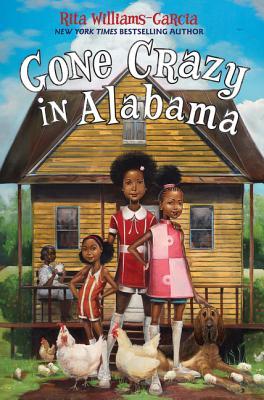
2016 Contenders: Gone Crazy in Alabama, by Rita Williams-Garcia
This was one of my most anticipated books of the year, partly because I was lucky enough to talk with the author about it a whole year before it came out. I was looking forward to the conclusion of the Gaither sisters' story arc, as well as the southern setting and family history.When we rejoin Delphine, Vonetta, and Fern, they are on their way to the Greyhound terminal to begin their journey to visit Big Ma and her mother, Ma Charle,s in rural Alabama. There are several potential sources of conflict, both overt and less obvious. Pa's new wife ("Mrs.") is pregnant. The friction between Delphine and Vonetta is still present, as is Vonetta's resentment towards Uncle Darnell, who's out of rehab and living with Big Ma. (It's a difficult time all around for Vonetta). And then there's the bad blood - buckets of it - between Ma Charles and her half-sister, Miss Trotter. The two sisters live on opposite sides of the same creek, but haven't spoken in decades. Oh, and the family ties to the Klan.
If you think that all makes Gone Crazy in Alabama sound like an awfully ambitious novel, then you are correct. Williams-Garcia has a lot of plot threads to weave together, a new setting and several new characters to introduce, and a trilogy to bring to a satisfying close. For the most part, she accomplishes all of it with finesse. The relationship among the three sisters, especially Delphine and Vonetta, is going through some growing pains, and the resolution of that arc is poignant, as is Vonetta's reconciliation with Uncle Darnell. The Alabama setting - lazy and idyllic on the surface, complicated underneath - is well-realized. There are several intriguing new characters, especially Ma Charles and Miss Trotter, whose mutual sniping provides much of the book's humor.
On the whole though, this is not nearly as funny a book as either of the previous two. There is a brush with tragedy that takes up several chapters, but even before that, most of the characters are going through difficult times for various reasons. That's all handled deftly enough that it doesn't weigh down the narrative, but some of the family history does slow the pace. Telling it through Ma Charles and Miss Trotter's dueling narratives is clever, but it's still a lot of history to get through, and as a reader I often felt lost. Your mileage may vary.
Taken as a whole, Gone Crazy showcases the lovely prose, sharp dialogue, and larger-than-life situations that Rita Williams-Garcia writes so well. The many fans of the Gaither sisters will find it a satisfying conclusion to the series.
Published in April by Amistad/HarperCollins
Tuesday, July 28, 2015
2016 Contenders: Stonewall: Breaking Out in the Fight for Gay Rights, by Ann Bausum
It is impossible to review Ann Bausum's new chronicle of the gay rights movement without thinking about where I was one month ago today: standing on Market Street in San Francisco, watching the biggest, most joyous Pride parade I have ever witnessed. It was two days after we all woke up to learn that the Supreme Court had granted same-sex couples the right to marry in all 50 states, and the mood in the city was total jubilation. The parade itself felt incredibly uncontroversial, with every corporation you can think of trying to get in on the act and soak up some of that LGBT goodwill. The Apple employees alone took up several city blocks.
Contrast that with the way things stood on the eve of the Stonewall Riots. Marriage equality was such a distant dream that Richard Enman, representing the Mattachine Society, said, regarding the legalization of same-sex marriage, "Homosexuals don't want that." "Cross-dressing" was a criminal offense, homosexuality was listed as a mental illness in the DSM, and men trying to pick up a date might be told to "keep moving, faggot, keep moving."
Bausum does an excellent job of evoking that time and place with a chatty prologue that addresses the reader directly and invites us to walk the streets of Greenwich Village with her. She maintains that sense of immediacy through the next several chapters, quickly establishing the historical backdrop and then plunging us into a play by play of the events at the Stonewall on June 27, 1969. She combines eyewitness accounts with historical context and broader social analyses to form a full picture of the significance of the riots. And she doesn't shy away from plainspoken descriptions of the gay experience in 1969, from sex in unlocked semi-trucks previously used to haul animal carcasses, to the raunchy chants that gay teenagers shouted at the police.
While the entire first half of the book is concerned with the lead-up to and immediate aftermath of the riots, the second half touches, in less detail, on the ensuing gay rights movement, including the AIDS crisis and the fight for marriage equality. Of course, despite the fact that the publication date is May 5, 2015, the book is already out of date, because it doesn't include the recent Supreme Court decision. Sam and I were speculating about whether Viking will release an updated edition, but things are moving so quickly that it might be impossible to keep up. Just last week, several legislators introduced the Equality Act, a comprehensive federal non-discrimination bill.
As the LGBT community continues to rack up victories, it will become ever more difficult to remember this history of brutal oppression. Bausum's book serves as an essential reminder of that history, honoring those who risked their lives to pave the way, and, I hope, providing inspiration to the next generation to continue the fight.
I think it's unlikely that Stonewall will receive Newbery recognition. Despite the immediacy of Bausum's prose, I wouldn't call it narrative nonfiction on the level of something like Bomb, and it feels like a strong year for fiction. I won't be at all surprised if it the Sibert Committee honors it, though, and it seems like a shoo-in for the Stonewall Book Award. (There's a question: has a book ever won its namesake award before?)
Published in May by Viking Books for Young Readers
Contrast that with the way things stood on the eve of the Stonewall Riots. Marriage equality was such a distant dream that Richard Enman, representing the Mattachine Society, said, regarding the legalization of same-sex marriage, "Homosexuals don't want that." "Cross-dressing" was a criminal offense, homosexuality was listed as a mental illness in the DSM, and men trying to pick up a date might be told to "keep moving, faggot, keep moving."
Bausum does an excellent job of evoking that time and place with a chatty prologue that addresses the reader directly and invites us to walk the streets of Greenwich Village with her. She maintains that sense of immediacy through the next several chapters, quickly establishing the historical backdrop and then plunging us into a play by play of the events at the Stonewall on June 27, 1969. She combines eyewitness accounts with historical context and broader social analyses to form a full picture of the significance of the riots. And she doesn't shy away from plainspoken descriptions of the gay experience in 1969, from sex in unlocked semi-trucks previously used to haul animal carcasses, to the raunchy chants that gay teenagers shouted at the police.
While the entire first half of the book is concerned with the lead-up to and immediate aftermath of the riots, the second half touches, in less detail, on the ensuing gay rights movement, including the AIDS crisis and the fight for marriage equality. Of course, despite the fact that the publication date is May 5, 2015, the book is already out of date, because it doesn't include the recent Supreme Court decision. Sam and I were speculating about whether Viking will release an updated edition, but things are moving so quickly that it might be impossible to keep up. Just last week, several legislators introduced the Equality Act, a comprehensive federal non-discrimination bill.
As the LGBT community continues to rack up victories, it will become ever more difficult to remember this history of brutal oppression. Bausum's book serves as an essential reminder of that history, honoring those who risked their lives to pave the way, and, I hope, providing inspiration to the next generation to continue the fight.
I think it's unlikely that Stonewall will receive Newbery recognition. Despite the immediacy of Bausum's prose, I wouldn't call it narrative nonfiction on the level of something like Bomb, and it feels like a strong year for fiction. I won't be at all surprised if it the Sibert Committee honors it, though, and it seems like a shoo-in for the Stonewall Book Award. (There's a question: has a book ever won its namesake award before?)
Published in May by Viking Books for Young Readers
Wednesday, July 22, 2015
2016 Contenders: The Story of Diva and Flea, by Mo Willems
Everyone with even a passing interest in children's literature knows Mo Willems. He's created some of the most iconic characters of the past twenty years: Elephant & Piggie, the Pigeon, Trixie and Knuffle Bunny, Cat the Cat.
What he hasn't done, at least up until now, is write a novel. Each of his books to this point has been either a picture book or an easy reader. The Story of Diva and Flea, then, is his first foray into a longer form.
That's not to say that it's a form that's particularly long in the grand scheme of things. My ARC of Diva and Flea runs a mere 67 (heavily-illustrated*) pages, and it's pitched at the same emerging readers who enjoy Kate DiCamillo's Mercy Watson books and similar fare. Perhaps it's better to refer to it as a "chapter book," as I imagine much of its readership will do.
The plot involves Diva, a tiny dog who resides in posh comfort at 11 avenue Le Play in Paris, and Flea, a large cat who considers himself a flâneur, which Willems repeatedly defines as one "who wanders the streets and bridges and alleys of the city just to see what there is to see." When they meet by chance and become friends, will Diva learn to be more adventurous? Will Flea see the benefits of domesticity?
I described the book to Rachael as "a more G-rated Lady and the Tramp," and even though she questioned whether such a thing was actually possible, I'll stand by that description. There's no romance, no baby, and no actual danger; what remains is a mismatched pair where each learns to appreciate the other's point of view and to be willing to take (minor) risks in order to do so. Even that "conflict" is subdued -- once the protagonists meet properly, there's really no clash of wills or second-act argument.
Perhaps more noticeably, the signature Willems humor is decidedly muted. There are the odd moments that brought a smile to my face, such as when Flea asks if "Breck-Fest" is a friend of Diva's, but there's nothing here that comes close being as funny as the Pigeon's tantrum in Don't Let the Pigeon Drive the Bus! or the slow-burning exasperation of There is a Bird on Your Head!
That doesn't mean Diva and Flea is anything less than pleasant, because it's perfectly serviceable. But for someone with Willems' pedigree, the expectations are sky-high, and I feel like Diva and Flea doesn't live up to them.
*(As an aside, I thought it was odd that Willems, he of the three Caldecott Honors, two Geisel Awards, and five Geisel Honors, didn't illustrate the book himself, but Tony DiTerlizzi's beautiful drawings are a perfect match for the text.)
Publication in October through Disney / Hyperion
What he hasn't done, at least up until now, is write a novel. Each of his books to this point has been either a picture book or an easy reader. The Story of Diva and Flea, then, is his first foray into a longer form.
That's not to say that it's a form that's particularly long in the grand scheme of things. My ARC of Diva and Flea runs a mere 67 (heavily-illustrated*) pages, and it's pitched at the same emerging readers who enjoy Kate DiCamillo's Mercy Watson books and similar fare. Perhaps it's better to refer to it as a "chapter book," as I imagine much of its readership will do.
The plot involves Diva, a tiny dog who resides in posh comfort at 11 avenue Le Play in Paris, and Flea, a large cat who considers himself a flâneur, which Willems repeatedly defines as one "who wanders the streets and bridges and alleys of the city just to see what there is to see." When they meet by chance and become friends, will Diva learn to be more adventurous? Will Flea see the benefits of domesticity?
I described the book to Rachael as "a more G-rated Lady and the Tramp," and even though she questioned whether such a thing was actually possible, I'll stand by that description. There's no romance, no baby, and no actual danger; what remains is a mismatched pair where each learns to appreciate the other's point of view and to be willing to take (minor) risks in order to do so. Even that "conflict" is subdued -- once the protagonists meet properly, there's really no clash of wills or second-act argument.
Perhaps more noticeably, the signature Willems humor is decidedly muted. There are the odd moments that brought a smile to my face, such as when Flea asks if "Breck-Fest" is a friend of Diva's, but there's nothing here that comes close being as funny as the Pigeon's tantrum in Don't Let the Pigeon Drive the Bus! or the slow-burning exasperation of There is a Bird on Your Head!
That doesn't mean Diva and Flea is anything less than pleasant, because it's perfectly serviceable. But for someone with Willems' pedigree, the expectations are sky-high, and I feel like Diva and Flea doesn't live up to them.
*(As an aside, I thought it was odd that Willems, he of the three Caldecott Honors, two Geisel Awards, and five Geisel Honors, didn't illustrate the book himself, but Tony DiTerlizzi's beautiful drawings are a perfect match for the text.)
Publication in October through Disney / Hyperion
Monday, July 20, 2015
2016 Contenders: Poet, by Don Tate
George Moses Horton was the first African-American poet to have a book published in the South (The Hope of Liberty, 1829). Amazingly, this occurred while he was still a slave. Though Horton's hope was that the money from the book would enable the purchase of his freedom, his master refused to sell him, and Horton's slavery continued until the end of the Civil War, some three and a half decades later. Through it all, Horton continued to write, producing another volume of poetry, many uncollected poems, and a brief autobiography.
Although Horton is still in print, and he retains a strong following in his home state of North Carolina, he remains much less known than other early African-American authors such as Phillis Wheatley and Jupiter Hammon. I completed an English degree at a southern university, and still never came across any of his work. I'm glad to say that Poet does an excellent job of discussing the man, his unusual life, and his writing, which may well make him a more familiar name to a younger generation.
The writing is spare, but clear. Tate made his name as an illustrator, but in his previous foray into writing (It Jes' Happened: When Bill Traylor Started to Draw, 2012), he certainly displayed a facility with words, and he continues to exhibit that talent in Poet. I really felt Horton's determination, his crushing defeat, and his indomitable will while turning the pages.
As good as the text is, it's not going to win the Newbery -- no picture book is going to break through and take the prize, not in a year with Circus Mirandus and Echo and Moonpenny Island and The Jumbies. Some of the other committees may appreciate it, however, and I do hope there's room for it on the Notables list.
Publication in September by Peachtree.
Although Horton is still in print, and he retains a strong following in his home state of North Carolina, he remains much less known than other early African-American authors such as Phillis Wheatley and Jupiter Hammon. I completed an English degree at a southern university, and still never came across any of his work. I'm glad to say that Poet does an excellent job of discussing the man, his unusual life, and his writing, which may well make him a more familiar name to a younger generation.
The writing is spare, but clear. Tate made his name as an illustrator, but in his previous foray into writing (It Jes' Happened: When Bill Traylor Started to Draw, 2012), he certainly displayed a facility with words, and he continues to exhibit that talent in Poet. I really felt Horton's determination, his crushing defeat, and his indomitable will while turning the pages.
As good as the text is, it's not going to win the Newbery -- no picture book is going to break through and take the prize, not in a year with Circus Mirandus and Echo and Moonpenny Island and The Jumbies. Some of the other committees may appreciate it, however, and I do hope there's room for it on the Notables list.
Publication in September by Peachtree.
Wednesday, July 15, 2015
2016 Contenders: Nanny X Returns, by Madelyn Rosenberg
Ali, Jake, Eliza, and the rest of the gang from last year's Nanny X are back for another adventure. This time, a criminal known only as The Angler has insisted that a large sculpture of a fish be placed on the White House lawn. If this isn't done, "the nation's greatest treasures" could be in danger. The Nanny Action Patrol (N.A.P.) has been assigned to the case, and Nanny X (and her diaper bag full of secret devices) must stop The Angler, with the help of her young charges and their other friends.
Much like its predecessor, Nanny X Returns is fast-paced and very funny. One of my favorite things about it is its grasp of the Washington D.C. area; Madelyn Rosenberg lives in Arlington, Virginia, and it's clear that she knows the region inside and out. Through touches as small as what exhibits are on specific floors of the D.C. museums, the setting truly comes alive on each page.
I'm not entirely sure that some of the thematic elements are as neatly wrapped up as I'd like. Some of them, such as the incipient romantic feelings between Ali and her friend Stinky, may well be points Rosenberg is holding in reserve for another book. Others, I wished had been returned to in the last few pages -- Ali's worries about whether the N.A.P. has its doubts about Nanny X, as well as her desire to solve the mystery first, come into play repeatedly during the book, but sort of fizzle out at the end.
These questions, however, didn't much affect my enjoyment of the book. I was delighted to return to the world of Nanny X and her crew, and I do hope this isn't the last visit I'll get to pay there. I also hope this particular series finds its way into the hands of the many children that I firmly believe will enjoy it.
As for the Newbery, I highly doubt Nanny X Returns will appear there -- it's popular, not literary, and it's just not the kind of book to which the committees are sympathetic. I'm optimistic, however, that it will land on the shelves of many libraries, where the children who love quick-reading humor will be able to find it.
Publication in October through Holiday House
Much like its predecessor, Nanny X Returns is fast-paced and very funny. One of my favorite things about it is its grasp of the Washington D.C. area; Madelyn Rosenberg lives in Arlington, Virginia, and it's clear that she knows the region inside and out. Through touches as small as what exhibits are on specific floors of the D.C. museums, the setting truly comes alive on each page.
I'm not entirely sure that some of the thematic elements are as neatly wrapped up as I'd like. Some of them, such as the incipient romantic feelings between Ali and her friend Stinky, may well be points Rosenberg is holding in reserve for another book. Others, I wished had been returned to in the last few pages -- Ali's worries about whether the N.A.P. has its doubts about Nanny X, as well as her desire to solve the mystery first, come into play repeatedly during the book, but sort of fizzle out at the end.
These questions, however, didn't much affect my enjoyment of the book. I was delighted to return to the world of Nanny X and her crew, and I do hope this isn't the last visit I'll get to pay there. I also hope this particular series finds its way into the hands of the many children that I firmly believe will enjoy it.
As for the Newbery, I highly doubt Nanny X Returns will appear there -- it's popular, not literary, and it's just not the kind of book to which the committees are sympathetic. I'm optimistic, however, that it will land on the shelves of many libraries, where the children who love quick-reading humor will be able to find it.
Publication in October through Holiday House
Tuesday, July 14, 2015
2016 Contenders: Circus Mirandus, by Cassie Beasley
The Phantom Tollbooth. The Little Prince. Breadcrumbs. The House with a Clock in its Walls. Circus Mirandus.
That's a list of books that exist in an uneasy space between pure fantasy and true realism. It's a list of books that, regardless of their varied endings, don't shy away from the world's darkness. It's a list of books that demonstrate what I'm starting to think of as Rachael's Maxim: "Story and imagination celebrate themselves when deployed effectively."
It's a list of classics.
Yes, that's a bold claim to make about Circus Mirandus, a debut novel that's hardly been out for a month, but I believe that, if we come back to this discussion in twenty years, it's a claim that will have been vindicated. There aren't many recent children's books that have made this kind of first impression on me, and I actually sat in the car after work, just so that I could finish the last five pages without having to wait another day.
Circus Mirandus is the story of Micah Tuttle, a ten-year-old boy who lives with his Grandpa Ephraim. Grandpa Ephraim, a benevolent figure whose closest point of comparison might be Grandpa Joe from Charlie and the Chocolate Factory, has cared for Micah ever since he was small. He's shared with Micah the Tuttle secrets of knot-tying, and he's regaled Micah with tales of the Circus Mirandus, a magical circus that Grandpa Ephraim visited as a child during the dark days of World War II. But now Grandpa Ephraim is desperately ill, his detestable sister, Great-Aunt Gertrudis, is making Micah's life miserable, and darkness seems to be settling into this formerly happy home. The only possible lifeline is that, when Grandpa Ephraim was a boy, the Circus Mirandus' greatest magician, the Lightbender, promised him a miracle -- a miracle that Grandpa Ephraim hasn't yet requested.
So begins the adventure. It would be criminal to reveal much more of the plot, but it's a grand one that takes Micah to the heights of ecstasy and the depths of despair. Along the way, he meets a host of memorable characters -- his newfound best friend, Jenny Mendoza; Chintzy the parrot; the mysterious proprietor of the circus, Mirandus Head; and many, many more. All of them felt real and solid to me, and even the worst of them turn out to have motivations for their unpleasantness.
The prose is captivating, and the book is willing to look into some very bleak places. The scene that includes the final performance of the Amazing Amazonian Bird Woman, in particular, is one of the most devastating passages I've read in a children's novel. And yet, if all of the characters don't achieve redemption, the book still manages to end on a defiantly upbeat note.
Circus Mirandus has received a tremendous amount of hype -- Dial/Penguin must have spent the GDP of a small country on the book's promotion, and the movie rights have already been sold. But for once, the hype is entirely deserved. This one's a winner, folks.
Published in June by Dial/Penguin
That's a list of books that exist in an uneasy space between pure fantasy and true realism. It's a list of books that, regardless of their varied endings, don't shy away from the world's darkness. It's a list of books that demonstrate what I'm starting to think of as Rachael's Maxim: "Story and imagination celebrate themselves when deployed effectively."
It's a list of classics.
Yes, that's a bold claim to make about Circus Mirandus, a debut novel that's hardly been out for a month, but I believe that, if we come back to this discussion in twenty years, it's a claim that will have been vindicated. There aren't many recent children's books that have made this kind of first impression on me, and I actually sat in the car after work, just so that I could finish the last five pages without having to wait another day.
Circus Mirandus is the story of Micah Tuttle, a ten-year-old boy who lives with his Grandpa Ephraim. Grandpa Ephraim, a benevolent figure whose closest point of comparison might be Grandpa Joe from Charlie and the Chocolate Factory, has cared for Micah ever since he was small. He's shared with Micah the Tuttle secrets of knot-tying, and he's regaled Micah with tales of the Circus Mirandus, a magical circus that Grandpa Ephraim visited as a child during the dark days of World War II. But now Grandpa Ephraim is desperately ill, his detestable sister, Great-Aunt Gertrudis, is making Micah's life miserable, and darkness seems to be settling into this formerly happy home. The only possible lifeline is that, when Grandpa Ephraim was a boy, the Circus Mirandus' greatest magician, the Lightbender, promised him a miracle -- a miracle that Grandpa Ephraim hasn't yet requested.
So begins the adventure. It would be criminal to reveal much more of the plot, but it's a grand one that takes Micah to the heights of ecstasy and the depths of despair. Along the way, he meets a host of memorable characters -- his newfound best friend, Jenny Mendoza; Chintzy the parrot; the mysterious proprietor of the circus, Mirandus Head; and many, many more. All of them felt real and solid to me, and even the worst of them turn out to have motivations for their unpleasantness.
The prose is captivating, and the book is willing to look into some very bleak places. The scene that includes the final performance of the Amazing Amazonian Bird Woman, in particular, is one of the most devastating passages I've read in a children's novel. And yet, if all of the characters don't achieve redemption, the book still manages to end on a defiantly upbeat note.
Circus Mirandus has received a tremendous amount of hype -- Dial/Penguin must have spent the GDP of a small country on the book's promotion, and the movie rights have already been sold. But for once, the hype is entirely deserved. This one's a winner, folks.
Published in June by Dial/Penguin
Subscribe to:
Posts (Atom)