Showing posts with label Verse Novel. Show all posts

Monday, March 18, 2019

2020 Contenders: Birdie, by Eileen Spinelli

Amateur ornithologist Birdie Briggs is twelve years old, and her life is in flux. She's experiencing her first crush, which has consequences for the rest of her social life; her mother may have a new love interest for the first time since the death of Birdie's father, and even her grandmother, Maymee, has a new man in her life. It's a lot for Birdie to manage, and she's trying to learn how to adapt.

I felt like the best thing about Birdie, Eileen Spinelli's new verse novel, is the way it captures the shifting emotions of a not-quite-teenager. Sometimes she's elated, sometimes she's depressed, sometimes she's throbbing with inchoate anger, but Birdie's feelings all rang true to me. Being twelve is a difficult time in one's life, and Spinelli records Birdie's internal experiences with grace and sympathy.

Indeed, Birdie is a gentle novel all the way around, one where the action and conflicts are largely interior. Bad things happen in the book's world, to be sure, but they're overcome with tenderness and love. It's a story and a setting filled with warmth.

Longtime readers of this blog will know that I'm not much of a verse novel fan. Trying to set that personal preference aside, I can tell you that the pacing of the book seemed effective to me. I don't think that Birdie possesses the same level of technical mastery of The Moon Within or Caminar, but it's certainly competent. I don't know if I would have made the same choice that Spinelli did in giving each of the poems a title, but that's probably just my own predilection as a reader.

You should never take your Newbery odds from me -- I'm the guy who said "no picture book will ever win the Newbery" the year that Last Stop on Market Street won, after all. That said, I'm not sure that Birdie is going to rise to the top of what's already shaping up to be a hypercompetitive field for the 2020 medal. I do think that fans of Spinelli's writing, and readers who enjoy carefully-crafted interior worlds, will enjoy Birdie very much.


Publication in April by Eerdmans

Monday, February 25, 2019

2020 Contenders: The Moon Within, by Aida Salazar

Sometimes, it's hard to realize how far children's literature has come until we stop and take a look back. This is not to say that there aren't still VERY real problems in the children's lit world, or that fighting for progress isn't still necessary, because neither of those things are true. But I think it's also important to note that the efforts of many authors, publishers, teachers, and librarians to advocate for diversity, inclusion, and a general expansion of "acceptable" content haven't gone for naught.

When I first started working in public libraries, in 2007, the kerfuffle du jour involved whether or not it had been appropriate to award the Newbery to a book that used the word "scrotum" (that'd be The Higher Power of Lucky, for anyone who doesn't remember that moment in time). And as recently as 2014 or so, my requests at major library conferences for information about LGBTQ+ books for middle grade readers was met with the sum total of "Tim Federle and Jennifer Gennari."

Now, less than a decade and a half since I started my library journey, I find myself writing a review of Aida Salazar's The Moon Within, a book being put out by a major publisher (Scholastic, on its Arthur A. Levine imprint). If you had asked me even three or four years ago if I'd thought a middle grade book of this type was publishable, I would have responded with a sad shake of my head. This is a verse novel starring a main character of Mexican/Puerto Rican ancestry, and her genderfluid best friend, in which the plot not only centers on a recreated indigenous Mexica ritual celebrating a young woman's menarche, but also includes a poetic but frank discussion of women's genitals, including the purpose of the clitoris. If you thought Are You There God? It's Me, Margaret didn't pull any punches, The Moon Within has never even heard of the concept of pulling punches.

But that's not to say that The Moon Within is confrontational for the sake of being confrontational. On the contrary, it's a novel filled with sensitivity and compassion for its characters -- especially its narrator, Celi Rivera. She comes across as a living, breathing person, one who sometimes makes good decisions and sometimes makes bad ones, but who's 100% worth cheering for. I wanted positive things to happen for her, and the book's climax filled my heart with warmth. You could, I suppose, refer to this as a "problem novel," but it's better described as an authentic-feeling, character-driven book that doesn't shy away from the kinds of issues that real people in real communities run up against.

If it's not clear, I genuinely enjoyed The Moon Within, and I'm more than a little glad to see this book published. I have no clear sense of the Newbery race yet, but the mere fact that the publisher is promoting this novel heavily warms my heart. I think Aida Salazar is a fascinating talent, and this is one heckuva debut.


Published Feburary 26th by Arthur A. Levine/Scholastic

Thursday, May 29, 2014

2015 Contenders: The Crossover, by Kwame Alexander

After I read the first three pages of The Crossover, I was excited. Here, perhaps, was another verse novel I could get behind. The vibrant, rhythmic poetry bounced like a basketball, and the voice of Josh Bell, the narrator, was clear and confident. I was curious to see where his story would go.

The problem is, those first three pages are the high point of the book. Maybe it wasn't possible to tell the whole story in that cadence, but I felt that -- with a few notable exceptions, most of which described on-court action -- the novel got prosier and prosier as it went along. The argument could be made that this mirrors the way Josh's swagger and confidence are shaken as the narrative moves along, but I'm not sure I would go that far. I just felt like Kwame Alexander had led with his best material.

I also had one of the problems that I almost always experience with verse novels, which is that the characters felt flat. Josh is a three-dimensional person, but even the secondary characters -- Josh's twin brother Jordan, Jordan's girlfriend Alexis, the boys' parents -- felt very one-note, and the tertiary characters barely registered for me at all.

The book already has a significant number of defenders, however (five starred reviews, plenty of positive blog notices, and cover blurbs from a laundry list of first-tier authors). To be fair, there are things it does very well. Alexander certainly knows his basketball, and anyone who's a hoops fan will be able to pick up on that right away. It's a quick read, and if the plot doesn't offer much in the way of surprises, neither did any of Matt Christopher's, and that never interfered with my enjoyment of his books. And it's nice to see characters who are so often caricatured as cruel and self-absorbed -- exceptionally skilled middle-school athletes -- treated with dignity and respect.

It's interesting to compare The Crossover with my pick for the best verse novel (and possibly the best book of any kind) of the year so far, Caminar. In purely literary terms, I think Caminar is by far the superior book, a technical tour de force with more assured verse, a much stronger protagonist, and more polished use of metaphor. I would champion it for Newbery consideration, and I would not do the same for The Crossover. And yet, I think for most readers, The Crossover will be much easier to love. It's a more accessible story, set in a more familiar environment, and I think it will be an easier book to find a reader for.

As I said, that doesn't mean I believe The Crossover should appear on the Newbery list. I do think, however, that it deserves to be noticed, and to be put into the hands of children who will find much to love about it.


Published in March by Houghton Mifflin Harcourt

Monday, February 24, 2014

2015 Contenders: Caminar, by Skila Brown

Now that's how it's done.

Caminar is a verse novel about a boy named Carlos, who lives in Guatemala during that country's interminable civil war. When his sleepy village suddenly flashes into violence, Carlos is cut off from everyone he has known and loved, and struggling, not just with survival, but with what it means to truly be an adult.

It's not a secret around this blog that I don't like verse novels. However, Skila Brown demonstrates a clear, effective understanding of the poetic aspects of the form -- her line breaks are purposeful, her typographical choices are effective, and her metaphors are inventive. The verse novel form allows Brown to explore a larger conflict through a series of perfectly-delineated moments. This is the verse novel as it was meant to be written and experienced.

Frankly, Caminar is so polished and assured that it's hard for me to believe that it's actually Brown's first book. I try to shy away from making these kinds of pronouncements, but Caminar sure looks to me like the arrival of an important new voice in children's literature. It never talks down to its audience, even when the subject matter is nuanced and difficult. Carlos is a believable, conflicted hero, and the other characters are also well-described and three-dimensional -- a place where many verse novels run into trouble.The themes are also expertly woven into the narrative, especially the bits about the nahuales, the animal spirit guides that bring protection and insight.

One could complain that the epilogue isn't really necessary, though I think it helps to bring the narrative full circle. But otherwise, I can't find much to complain about in Caminar. It's smart, precise, and vivid, and I expect to be talking about it a lot more during the rest of the year.


Publication in March through Candlewick

Thursday, February 13, 2014

2015 Contenders: Miss Emily, by Burleigh Mutén

The title character of Miss Emily is arguably the most famous bearer of that name, Emily Dickinson herself. The circus is coming to her hometown of Amherst, Massachusetts, and she has a plan to lead a few local children (including her niece and nephew) to watch the circus's midnight train pull in.

This is the setup for a gentle adventure, the kind that was more common in children's literature a half-century ago than it is now. The cast of characters is small, and the focus is on family and neighborhood relationships. Even the event that's the catalyst for the plot -- the arrival of the circus! -- is something of a throwback.

I'm not a scholar of Dickinson's life, but author Burleigh Mutén volunteers at the Dickinson Homestead, and the blurb on the back from Polly Longsworth (who wrote The World of Emily Dickinson) praises Miss Emily's "true-to-life plot and characterizations, and, above all, accuracy." I'm willing to accept the opinion of the experts here, and instead, focus on the questions I had about the book's format and structure.

Miss Emily is a verse novel, and as a book about a poet, that makes perfect sense. However, I don't understand the kind of verse novel it is. Dickinson was one of the most idiosyncratic poets in the history of American Literature; it's impossible to mistake one of her poems for anyone else's. The vast majority of her poems are in iambic heptameter (which simultaneously recalls many hymn texts and, as generations of snarky English majors have learned, enables nearly any Dickinson poem to be sung to the tune of "The Yellow Rose of Texas"); she makes heavy use of slant rhymes; and her highly individual punctuation uses dashes almost as weaponry. However, Miss Emily is essentially in unrhymed free verse, and dashes are used only fitfully. Even though the book isn't narrated by Dickinson, but by Mac, the child who lives across the street, this seemed like a really strange choice to me. Why write about a poet without making any use of her instantly recognizable style?

Additionally, the children aren't very sharply differentiated, which is what would be necessary for the thin plot to work. I didn't find myself either concerned with or interested in any of them -- or with Dickinson either, as the insights offered into her character are general and superficial. Longtime readers of this blog will know that the plots of many of my favorite books can be charitably described as "understated," but Miss Emily doesn't provide the other elements necessary to make this kind of book work.

My favorite thing about the book, as it happens, isn't relevant to the Newbery discussion at all. The more I see of his work, the more Matt Phelan becomes one of my favorite illustrators working today, and his drawings here strike just the right notes of whimsy and subtlety. Bluffton was one of my favorite books of last year, and Phelan's work here shows that he continues to do very well when given an interesting historical context.

It wouldn't surprise me if Miss Emily were to attract plenty of discussion, and perhaps other reviewers will like it more than I did. For me, however, it's not really a Newbery-caliber book.


Publication in March by Candlewick

Wednesday, December 11, 2013

2014 Contenders: Salt, by Helen Frost

Whenever I pick up a verse novel, the first thing that goes through my head is the question, "why this story in this format?" That is, what is it about this story or these characters that makes the author feel like verse would work better than prose to communicate the narrative?

Sometimes, there's a good answer. In The Wild Book, the narrator has tried writing in poetry as a way to help her dyslexia. In The One and Only Ivan (which, while not a full-on verse novel, has certain verse novel elements), the clipped, understated narration is meant to help show what it's like inside a gorilla's head.

More often, however, I can't find an answer that satisfies me. And that was probably my biggest complaint about Salt -- that I was never able to answer that question to my satisfaction. True, it allows for the book to switch quickly between its protagonists, but that's something that can be done in pure prose form too, and I think it might have benefited from that approach.

I also felt like the brief nature of all the scenes meant that the characterization wasn't particularly deep. We get a fairly good feel for James and Anikwa, the narrators, but the secondary characters end up painted in very broad strokes. Even with James and Anikwa, I felt like the characterization didn't have enough nuance for their conflict halfway through the book to really feel natural.

A lot of the language is beautiful -- anyone who loved Step Gently Out last year knows that Helen Frost is highly skilled with imagery. I'm not sure I felt like all the line breaks were purposeful enough, however, and I don't think that giving all of Anikwa's poems a specific shape on the page (one that's sort of like three stacked balls) helped with that challenge.

I did enjoy the setting -- the war of 1812 isn't a popular choice for children's books, and the portion of the conflict that didn't take place around the Chesapeake Bay even less so. I did feel like I'd spent some time in an interesting place after I'd finished the book.

The setting, however, was the only facet of the book that I felt was truly distinguished. That might be enough to get Salt on the notables list, but I'd be very surprised if it showed up in the Newbery announcement.


Published in July by Farrar Straus Giroux

Wednesday, July 10, 2013

2014 Contenders: Words with Wings, by Nikki Grimes


Gabby's parents have recently divorced, and she's about to start at a new school as Words with Wings opens. She's unhappy about both of those things, but finds solace in her daydreams, which generally take single words as their jumping-off place. But how can Gabby succeed at her new school when she always has her head in the clouds?

It's not a bad premise necessarily, but I have to confess that it's one that feels uncomfortably familiar. From Anne of Green Gables (1908), to Captain David, by Miriam Klugman (1991), to last year's What Came from the Stars, children's literature is littered with books featuring characters whose daydreaming and inattentiveness get them into trouble. Words with Wings slots a bit too neatly into this list, without bringing a particularly fresh perspective to a timeworn topic. Yes, the eventual response of Gabby's teacher, Mr. Spicer, is useful -- even inspiring -- but it's not necessarily enough to support an entire book.

Part of the difficulty, I think, is the format of the book. Words with Wings clocks in under 100 pages, and the fact that it's a verse novel means that a huge portion of that page count is white space. Gabby comes across reasonably clearly, but her parents, her new friend David, and even Mr. Spicer are all essentially ciphers. A book that treads such familiar territory lives and dies by the degree to which the story can present itself as individual, and I don't think Words with Wings really manages to escape the archetypal.

Now, Nikki Grimes is a skilled author (she won the 2003 Coretta Scott King for Bronx Masquerade, and has a mind-boggling four CSK Honors to her name), and so it's not as if Words with Wings is a difficult or tedious read. Some of the lines, indeed, are genuinely beautiful. I don't think it would be a particularly hard sell to a child reader who enjoys contemporary fiction and/or poetry. But I don't think Words with Wings rises to the level of "distinguished," and I don't expect to see it featured in the Newbery list.


Publication in September through WordSong / Highlights

Friday, April 19, 2013

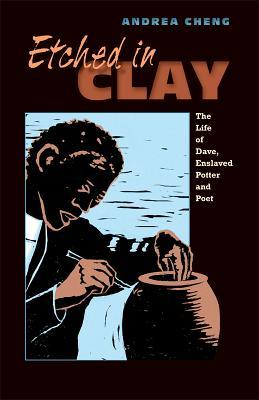
2014 Contenders: Etched in Clay: The Life of Dave, Enslaved Potter and Poet, by Andrea Cheng

Etched in Clay: The Life of Dave, Enslaved Potter and PoetWe know comparatively little about the life of Dave, the enslaved potter. We know roughly when he was born (around 1801), when he died (around 1870), and where he lived (South Carolina). We know that he lost a leg when he was about 35 years old, and that he was a skilled potter whose works were (and are still) prized by collectors. Most notably, we know that he could read and write, because he carved his name and some short poems into the clay of his own pots. 

In a series of dramatic monologues, Andrea Cheng fleshes out these sparse details and shapes them into a poignant glimpse into the world of this remarkable artisan and poet. Writing from multiple perspectives, she gives the reader a panoramic view of the social and political realities that circumscribed the life of an enslaved man in 19th century South Carolina. In understated verse, she recreates the key moments of Dave's life, including enough sensory imagery to anchor the story without bogging it down in detail. Woodcut illustrations, also by Cheng, mesh well with the plainspoken text.

Overall, Etched in Clay is an effective and engaging verse biography. It is worth noting that Cheng takes a completely different approach than Laban Carrick Hill and Bryan Collier did in their 2011 Coretta Scott King Honor Book, Dave the Potter. Where Hill and Collier focused narrowly on Dave's work as a potter, Cheng attempts to paint a much broader portrait of the man and his times. It's an ambitious tactic, and one that leads to some pitfalls.

My biggest issue with multiple-perspective verse novels is how damnably hard it can be to distinguish among the speakers, and Etched in Clay is no exception. Without contextual clues, I think I would be hard-pressed to tell the difference between Dave and any of the other characters. Part of the problem is Cheng's decision to standardize the language for modern readers. It works well in practical terms, but since everyone is speaking modern American English, they all end up sounding the same. That creates a jarring contrast with the snippets she includes of Dave's own rough, lyrical poetry.

My other issue is with the inclusion of historical background. It's very difficult to throw in details about law and social norms within the confines of a dramatic monologue, without turning it into an instance of As You Know, Bob. That leads to clunkers like the following: "Just be forewarned / while allowing our slaves / to read is our duty / teaching them to write / is punishable / by South Carolina law."

These are relatively minor quibbles, but they will probably keep Etched in Clay from attaining the status of "most distinguished" for me. I will surprised, however, if we don't see this one on the Notables list at the very least.

Published in January be Lee and Low Books


Tuesday, May 1, 2012

2013 Contenders: May B and Kindred Souls

Sometimes I meet a book that's just not right for me. This month, I met two. Oddly enough, they're both about sod houses. I'm sure that's a wacky psychological profile waiting to happen. Or maybe sod houses are this year's magical boarding schools.


May B, by Caroline Starr Rose

May, whose family shares a cozy sod house on the Kansas prairie, is sent to help out on a neighbor's homestead several miles away. When the neighbor and his wife disappear, May is left to face a harsh prairie winter on her own. And she's dyslexic. But she has plenty of time to work on her reading, being snowed in on the verge of starvation and all.

Verse novels are a pretty tough sell for me. I admit that I don't really "get" them as an art form. When I read one, I feel like I should at least understand why the author chose that particular medium over another one. In the case of May B, it makes some sense - spare, unforgiving landscape begets spare, unforgiving text - but I'm still not sure it works. I prefer powerful prose to less powerful poetry.

The book does have a lot going for it, including sharp imagery and clear descriptions of May's ordeal. May herself is a strong, believable character, though I think her dyslexia is an unnecessary addition. It distracts from the main conflict and dilutes the force of the story.

Anyhow, May B received at least two starred reviews, so your mileage may vary.

Kindred Souls, by Patricia MacLachlan

The author of Sarah, Plain and Tall turns her hand to a short, plainspoken story of the love between a grandfather and a grandson on a peaceful prairie farm. Jake and his 88-year-old grandfather, Billy, are unusually close - kindred souls, in fact. When Billy falls ill, Jake knows that the one thing that will help his grandfather heal is a sod house - a replica of the one he grew up in. The whole family pitches in to build him one.

And there we have my problem with this book, in a nutshell. I keep fiddling with that summary, trying to make this book sound less ridiculous, but in the end... yeah. It's about a family who drops everything to build a sod house for a beloved elderly relative. I know it's really about the difficulty of saying goodbye to those we love, and the meaning of home, and etc., but... a whole sod house? I'm not sure my relatives would go too far beyond fluffing my pillows.

It's not that I can't appreciate a quiet, homespun story of loss. Missing May is one of my favorite Newbery winners. In that one, though, Rylant's prose is both raw and transcendent. Though MacLachlan's writing is perfectly good here, the characters feel underdeveloped, the setting is too idyllic, and the addition of an "angel dog" lends the whole enterprise an aura of Hallmark Movie-ishness.

Ah well. Maybe the sod houses caught me on a bad day.  


Wednesday, February 1, 2012

2013 Contenders: The Wild Book, by Margarita Engle

One of the best things about Margarita Engle in general, and The Wild Book in particular, is her keen eye for detail. The slim verse novel is loosely based on the life of Fefa, Engle's grandmother, and it's clear that Engle paid close attention to the stories that her grandmother told.

The Wild Book details the life of a girl with dyslexia in the uncertain world of 1912 Cuba, and the descriptions of the everyday details of that time and place are startlingly observant. When she speaks, for instance, of encountering during a family camping trip "the coiled tunnels / hidden in trumpet-shaped / seashells," the vividness of the imagery is undeniable. Additionally, the book creates a sympathetic and realistic portrait of a child struggling to come to terms with and overcome her learning disability when such things were poorly understood.

I did wish I had a better view of the other characters in the book. Fefa is clearly drawn, but aside from Mamá, and to some extent Fefa's brother José, the other characters seem one-dimensional or vague. Some of that is understandable, given how much of the action takes place in Fefa's head, but I did find myself wishing at times that the other people in her environment were captured with as much detail as the daily events and surroundings of Fefa's life, which were truly beautiful.

I think this is a long shot for the Newbery, though it wouldn't surprise me if it shows up on the Notables list. I do think it's a very real candidate for both the Schneider and the Belpré, and I'd keep my eye on it, especially after its official publication in March.