Showing posts with label Animal Stories. Show all posts

Wednesday, January 13, 2021

Newbery Wayback Machine: Gay-Neck, The Story of a Pigeon, by Dhan Gopal Mukerji (1928)


Gay-Neck, The Story of a Pigeon begins, at least in my copy, with a brief dedicatory letter from the author to one Suresh Chandra Banerji, Esq. A portion of this letter reads:

"For a pigeon, life is a repetition of two incidents: namely, quest of food and avoidance of attacks by its enemies. If the hero of the present book repeats his escapes from attacks by hawks, it is because that is the sort of mishap that becomes chronic in the case of pigeons."

This is what I believe is called "giving away the game." The plot, such as it is, is mostly Gay-Neck (so named for the patch of iridescent feathers on his throat) flying, being attacked by something, and then escaping. To be fair, Mukerji does switch it up more than his note lets on -- for variety, Gay-Neck not only escapes from hawks, but also owls, a buzzard-hawk called a Baz, and WWI airplanes trying to shoot him down.

There is a sort of larger story, in which Mukerji, who tells this story as if it's autobiographical, hatches Gay-Neck from an egg, trains him in homing, rehabilitates him from injury, and finally sends him off from India to the European front in WWI to work as a carrier pigeon. This last part traumatizes Gay-Neck so that, after a particularly harrowing mission, he refuses to fly anymore, and is invalided back home, until he's cured of his fear at a Buddhist(?) monastery. 

The most interesting parts, though, have to do with Mukerji himself. His parents live in Calcutta, but spend part of the year in the Himalayan village of Dentam. Mukerji goes up there with them, but spends all of his time out in the jungle with a hunter named Ghond -- whose connection to Mukerji is never explained -- who teaches him to do things like hunt enraged water buffalo, hide from crazed elephants, and climb up to eagles' nests. Why is he learning to do this? Who knows! What do his parents think? They don't seem to think anything, until the very end when Gay-Neck comes back ahead of Mukjeri, and his parents worry that their son might be dead. I read the entire book, and I still have no idea why this city kid and pigeon fancier is spending all of his free time reenacting Kipling with this guy. 

Gay-Neck wasn't Mukerji's first book, and since one of the earlier titles is called Ghond, the Hunter, it's possible that this gets explained there. But in the form that Gay-Neck was published in...let's just say that I've read The Grey King, The High King, and Dicey's Song, and this might still be the Newbery that "stands alone" the least. 

Be that as it may, Gay-Neck was also a milestone in this history of the Newbery Medal. Dhan Gopal Mukerji, who had emigrated the US as a young man, would become the first person of color to win the award. (He would, alas, also be the only one to win the award until Virginia Hamilton in 1975(!); it's an unfortunate truth that sometimes progress happens slowly.) The one classic from the year, A.A. Milne's Now We Are Six, wasn't eligible, so Gay-Neck was probably a fair choice, as odd a book as it is.

Also, this is just a guess, but I think it's safe money that Gay-Neck is Bert's favorite Newbery winner.

"If you tell me more about this Ghond fellow, I'll show you my paper clip collection."


Wednesday, October 7, 2020

Newbery Wayback Machine: Ginger Pye, by Eleanor Estes (1952)

The title character of Ginger Pye is a fox terrier mix who belongs to ten-year-old Jerry Pye. The story covers the way they come together, and several of their ensuing adventures, until Ginger is abruptly dognapped halfway through the book. The remainder of the novel largely consists of the attempts of Jerry and his sister Rachel to locate Ginger, until the dénouement when they are reunited. 

The world of Ginger Pye is a relatively small one; the scene never leaves the environs of the Pyes' hometown of Cranbury (a thinly fictionalized version of West Haven, Connecticut). That world, however, is outlined with a keen eye. I could clearly visualize the places, events, and, especially, the characters. The supporting cast, in particular, is described in ways that feel true to the ideas children have of other people. From Sam Doody, the captain of the high school basketball team, whom the Pye children look up to with barely-disguised hero worship; to the children's Uncle Bennie, who is only three years old, but worthy of profound respect, simply because he's an uncle; to Mr. Tuttle, who is one of the tallest men in town when seated, but only of average height when standing, because his height is concentrated in his torso -- they all seemed, not only like recognizable people, but those people as they might be described by elementary school-aged children. 

This isn't a plot-driven novel, and the plot as it stands is probably the weakest element of Ginger Pye -- the confrontation between the Pye children and the dognapper seems like it's going to provide the climax of the book, but it never really happens. On the other hand, the plot isn't really the point; as in so many of these mid-century "family novels," the individual episodes are what the reader remembers after finishing the book.

As is often the case in books from the 1950s, there are some questionable racial attitudes in Ginger Pye. They're always mentioned more or less in passing -- I don't remember there being a single character of color on the book -- but they're there nonetheless, as when Rachel worries that that a whistle will bring a congregation of "Gypsies" around, or when she frets that a bee sting on her lip makes her "look like a Ubangi." It's the sort of thing one might want to discuss with a child reader before handing them the book.

Five Honor books were named in 1952: Americans Before Columbus, by Elizabeth Baity; Minn of the Mississippi, by Holling C. Holling; The Defender, by Nicholas Kalashnikoff; The Light at Tern Rock, by Julia Sauer; and The Apple and the Arrow, by Mary & Conrad Buff. I've never read any of them, so don't feel particularly able to talk about how they stack up to Ginger Pye, but I also note that none of them have become lasting classics. The best-known book that wasn't recognized by the Newbery committee is likely Ellen Tebbits, the second novel by Beverly Cleary. That one is well-regarded, but as far as I'm aware, isn't considered one of Cleary's top-tier titles. If parts of Ginger Pye perhaps haven't aged all that well, it was still one of the finest achievements in American children's literature for its year, and was a fine choice for the Newbery.

Thursday, September 24, 2020

Newbery Wayback Machine: The Tale of Despereaux, by Kate DiCamillo (2004)

The Tale of Despereaux likely needs little introduction from me. It exists in the rarified air of A Wrinkle in TimeMrs. Frisby and the Rats of NIMHThe Giver, and Holes -- Newbery winners that are eventually encountered by just about everyone who spends time with children's books. The last time that School Library Journal and Fuse #8 ran their Top 100 Children's Novels poll, Despereaux ranked #51, a placing that, if anything, undersells the book's popularity.

Kate DiCamillo is one of the most important American children's writers of the 21st century. She had already vaulted to prominence with her debut book, Because of Winn-Dixie, which had netted her a 2001 Newbery Honor, but Despereaux, her third novel, truly cemented her place in the firmament. Despereaux features all of her trademarks: an unlikely hero; a sweet relationship between a human and an animal; and moments of gentle humor mixed in with moments of deep tenderness. 

The novel's structure builds as several plot threads are introduced -- one in which the titular hero, a tiny, misfit mouse, meets and falls in love with a princess, and then is thrown into a dungeon; one in which a rat named Chiaroscuro, torn between his love of the light and the dark nature of ratly culture, accidentally causes a national catastrophe; and one in which a small girl named Miggery Sow is sold by her father into a life of hardship and abuse. All of these stories converge in the second half of the novel, culminating in an ending both thrilling and compassionate. 

Despereaux isn't a novel without flaws -- I may be in the minority, but I remain unenthused by the persistently intrusive narrator, and some of the descriptions of Miggery Sow start to shade uncomfortably into the physiognomic. However, they're minor flaws, and the book on the whole is a triumph. 

The 2003 publishing year featured an embarrassment of riches in American children's literature. In addition to Despereaux, the year included two highly-regarded books that would end up as Honor titles (Kevin Henkes' Olive's Ocean, and Jim Murphy's An American Plague), two classic picture books (Mo Willems' Don't Let the Pigeon Drive the Bus!, and Mordecai Gerstein's The Man Who Walked Between the Towers), and Gregor the Overlander, the book that introduced a pre-Hunger Games Suzanne Collins to a wide audience. Even with that competition, however, Despereaux was and remains an uncontroversial choice for the gold medal. 

Monday, March 16, 2020

2021 Contenders: Lily to the Rescue, by W. Bruce Cameron

When my stepdaughter was younger, her favorite genre was something that I referred to as "animals in mild peril." These are books where the protagonist usually has a parent or other relative who works as a vet, or a wildlife rescuer, or something similar, and where the plot will revolve around one specific animal's journey. The literary apotheosis of this type is probably something like Elana K. Arnold's A Boy Called Bat, and there are dozens of series with names like Animal Ark and Vet Volunteers that cover this ground at length.

W. Bruce Cameron is best known for his adult work (A Dog's Purpose; 8 Simple Rules for Dating My Teenage Daughter), but he's no stranger to the Animals in Mild Peril realm; in fact, Lily to the Rescue is a spin-off from Cameron's earlier Puppy Tales series. It's narrated by the title character, a rescue dog who works at a shelter, helping to comfort and socialize the other animals. Her special human is Maggie Rose, whose mom also works at the shelter. Lily reports what she sees and hears accurately, but her interpretations of events are often wrong, which is the source of much of the novel's gentle humor.

The plot involves Lily and Maggie Rose's rescue of an injured crow named Casey. There aren't any surprises here to anyone familiar with the genre, but the characters are warmly written, and the book's brisk pace means that it doesn't overstay its welcome. Lily to the Rescue isn't complex or powerful enough to be a real Newbery contender, but it's got more depth than most of its competition; given that it's going to be the starting point for its own series, readers who eagerly devour this sort of thing should plan on spending some time with Lily.


Publication in March by Starscape / Tom Doherty Associates / Macmillan

Wednesday, October 10, 2018

Newbery Wayback Machine: Mrs. Frisby and the Rats of NIMH, by Robert C. O'Brien (1972)

Mrs. Frisby is a mouse, raising her four children alone after the death of her husband. When her youngest, Timothy, takes ill, Mrs. Frisby tries to find a way to help him -- a task that will take her into places she didn't know existed, and eventually lead her to a group of superintelligent rats, who have mysterious ties to her husband's life.

This brief summary hardly does justice to one of the genuine classics of American children's literature. It's a treasure of a book, one that, its high concept aside, works because of the real, lived-in relationships between its characters. This holds true not only for the novel's central relationships (such as those between Mrs. Frisby and Nicodemus; Mrs. Frisby and her children; and Nicodemus and Jenner in the flashback section), but for those that are more subsidiary (Brutus and Justin; Mr. Ages and Nicodemus), and even for those that exist at the very periphery of the story (Jeremy and the Owl; Mr. Fitzgibbon and Paul).

To move one step further back, the relationships work because the characters are so carefully defined. Each figure in the story has real hopes, dreams, sorrows, and fears. The mice and rats who occupy most of the novel's space are as emotionally rich as any human character would be. It helps that they occupy a world that's open-ended -- though the plot comes to a satisfying end, many threads aren't fully tied off, and many mysteries remain.

Mrs. Frisby and the Rats of NIMH also reads as a surprisingly, even defiantly feminist novel. Rachael has often referred to Mrs. Frisby herself as the greatest single mother in children's literature, and I think that's a more than fair opinion. Mrs. Frisby doesn't have the genetically engineered smarts of the rats and Mr. Ages, the ancient wisdom and intimidating presence of the Owl, or the overwhelming physical superiority of Mr. Fitzgibbon and the other humans. Yet, whether comforting her children, rescuing Jeremy the crow, or risking her life in putting sleeping powder in Dragon the cat's food (the same task that killed her husband!), Mrs. Frisby shows herself repeatedly to be the bravest, fiercest, most big-hearted character in the book. The rats may have the kind of patriarchal society in which "the females sometimes went to meetings and sometimes not," but without Mrs. Frisby, they'd all be dead by the end of the story. (Mrs. Frisby has only a handful of other female characters, but I'd also point to the shrew, who is willing to stand in the doorway of Mrs. Frisby's house to protect it from an entire group of much, much larger rats, although she's mistaken in their motivations, and the rats pose no danger.)

The literary career of Robert O'Brien (whose real name was Robert Conly) was an unfortunately curtailed one. Though a journalist by profession, working for such prestigious publications as Newsweek, the Washington Times-Herald, and National Geographic, he didn't begin writing novels until his mid-forties, when he developed glaucoma, and had to move closer to his office, freeing up for writing the time he had formerly used in commuting. He published three books during his lifetime, of which Mrs. Frisby and the Rats of NIMH was the second; a fourth, Z for Zachariah, was completed from his notes by his wife and daughter following his tragic death from a heart attack at 55. However, even though we have only a few pieces of fiction from O'Brien's pen, Mrs. Frisby alone would have been enough to secure his legacy.


Monday, March 6, 2017

2018 Contenders: A Boy Called Bat, by Elana K. Arnold

A Boy Called Bat is the latest title from Walden Pond Press, who are longtime friends of For Those About to Mock. They asked me if I'd be interested in participating in the blog tour for this book, and of course, I said yes.

As I was reading A Boy Called Bat, I asked Rachael about children's books with well-written and well-developed autistic characters. I mentioned The Real Boy, and Rachael volunteered Rain Reign. To this list, I think we can definitely add A Boy Called Bat, whose titular protagonist rings more than a little true.

Bixby Alexander Tam, whom everyone calls Bat, is an autistic boy who loves animals. His mother is a veterinarian, and when she comes home with an orphaned baby skunk, Bat immediately forms a bond with the animal. The plan is to turn the skunk over to a wild-animal shelter in a month, but Bat wants to find a way to convince his mom to let the skunk stay.

My favorite thing about A Boy Called Bat was the interaction between the members of Bat's family. Bat's love/frustration relationship with his sister, Janie, the fierce love his mother has for him, and the way his divorced father fits into the picture are all deep and real. This is a book about a skunk, but it's really a book about a family learning to love and understand each other better.

I also appreciated the fact that the book is willing to end before all of the loose ends are wrapped up. The back cover says that sequels are planned, but A Boy Called Bat works fine as a stand-alone. I didn't feel like I was being left with unanswered questions; I more felt that an emotional conclusion had been reached, and the remaining plot threads were simply indicative of the fact that life doesn't usually wrap things up with a neat little bow.

It's still too early in the year for me to feel like I have a handle on the Newbery race, so I don't know how A Boy Called Bat will fare in it. I do think that there's a lot for the Schneider committee to like here, and I'm curious to see if they will choose to recognize this novel.


Publication on March 14, 2017, by Walden Pond Press

Friday, June 24, 2016

Newbery Wayback Machine: Rabbit Hill, by Robert Lawson (1945)

About half way through my reading of Rabbit Hill I had the following conversation with my fellow blogger Sam:
Me: Soooooooooo does anything ever actually happen in this book?
Him: It's been a few years since I read it but at one point I think someone gives the rabbits some lettuce. Which in this book is the equivalent of a Fast & Furious style drift race with machine guns. Rabbit Hill is basically a cross between The Tale of Peter Rabbit and Waiting for Godot.
Me: *died laughing*
Luckily Sam hired a necromancer to bring me back so I could finish the book and write this review!

Rabbit Hill is a novel written and illustrated by Robert Lawson. It's about an area in Connecticut called "Rabbit Hill" and the assortment of woodland creatures who reside there. Times have been hard for the animals of Rabbit Hill. "Folks" haven't lived in the "Big House" for years, and without humans, and the food they grow (and throw away), things have been meager. The centerpiece of the community is without a doubt little Georgie, the most precious of the rabbit children (which, if I were any of the many other rabbit children, I would take umbrage with, but I digress) and Georgie's got big news. All signs point to new folks moving into the house soon! Will they be nice folks who will plant a big garden? Or will they be mean folks with guns and traps and poison?

The day to day goings on in the life of Georgie, his family, and their friends, are pleasant, and generally unexciting. Here are the top 3 most dramatic things that happen in the book:
  • An animal gets chased by a hunting dog, but escapes by jumping about 18 ft across a creek, which is a record, but he's mostly just ashamed he got surprised by a dog in the first place.
  • An animal falls in a drainage basin, but is nursed back to health by humans.
  • An animal is hit by a vehicle, but is nursed back to health by humans. Despite the fact something like that ALREADY HAPPENED, all of the animals are still momentarily worried and mistrusting.
Honestly I think I've been ruined of all books about rabbits since I read Watership Down by Richard Adams, without a doubt the most epic book written about rabbits (and heroism, and religion, and gender roles) of all time. The woodland creatures in Watership Down face life-or-death, intense, emotional moments on nearly every page, so subconsciously I was bracing myself for little Georgie to undergo some serious trials and tribulations.

Like, ya know, this.

The good news is: here's a book for children where (spoiler alert) nothing bad happens to a single animal. The bad news is: here's a book for children where nothing much of anything happens. But that's not such a bad thing! It's refreshing to read a story about the importance of being kind to animals, and nothing else. And as a librarian it's nice to have a sweet and innocent story to suggest to young animal lovers.

I do feel the need to disclaim one thing: the folks, that is the family that moves into the house, around which most of the "action" of the book revolves, have a live-in maid/cook/servant, a "colored" woman named Sulphronia. Apparently in the original text, written before racial integration, the character is portrayed in African American stereotypes. But in every edition of the book published since the 1970's, like the copy I read, anything offensive has been edited out.

My favorite part of the book is the pictures. Lawson illustrated many well known books for children, including The Story of Ferdinand by Munro Leaf, and Mr. Popper's Penguins by Richard and Florence Atwater. He won a Caldecott medal for his own book They Were Good and Strong (1941) making him the only person so far to win a Caldecott and a Newbery medal! I felt the gentle drawings in Rabbit Hill indicated affection of the part of Lawson for his characters. Of course illustrations are not (supposed to be) taken into consideration during a Newbery deliberation, unless they make the book "less effective," which these do not, in fact they arguably make the book that much more effective, because they support the text.


Onto the next decade!


(And Rachael, if Arnie lets you borrow his laptop and you're seeing this, hi!)

Tuesday, February 23, 2016

Newbery Wayback Machine: The Voyages of Doctor Dolittle, by Hugh Lofting (1922)

Here I am! The slacker of For Those About to Mock with my 1920's review for the Newbery Wayback Machine. I have excuses, none of them great, as to why it took me so long to read this book, but look I made this cool gif, so hopefully you'll forgive me!

The Voyages of Doctor Dolittle is actually the second of Hugh Lofting's Doctor Dolittle books (there are 12 of them total!) and it was the winner of our illustrious Newbery medal in 1923. Lofting got the idea for Doctor Dolittle during World War I. He didn't want to write home about the brutalities of war, so he filled letters to his family with fantastic stories instead.

Voyages is told from the perspective of Tommy Stubbins, who is about 9 when the book begins and about 11 when the book ends. He lives in a quaint English town, Puddleby-on-the-Marsh, where his father is a cobbler. Stubbins is an interesting kid. His family doesn't make enough money for him to go to school, so he spends his days hanging out with his three best friends, "Joe, the mussel man," "Matthew Mugg, the cat's meat man," and "Luke the Hermit." Okay...

Stubbins has a fondness for animals which leads him to saving a wounded squirrel and eventually bringing that squirrel to renowned naturalist, John Dolittle. Dolittle is an animal doctor, and he's sort of the greatest animal doctor of all time because he can talk to animals, and by that I mean he has learned the languages of hundreds of animals and can actually converse with them. 

(Real talk: I chose this book as my 1920's selection because as a girl I was entranced by the Academy Award winning musical Doctor Dolittle starring Rex Harrison. Also whenever asked "If you could have a super power what would it be?" I always choose "The power to understand animals" because I've always wanted to talk with my dog. Although she'd probably just say "Are you gonna eat that?!?!" over and over and over again. Really I ought to rethink it... But getting back on track!)

But seriously... Are you gonna eat that?!?!

Stubbins asks his parents if he can live with Doctor Dolittle so he can apprentice with him and learn to become a naturalist and speak the languages of animals too. And they let him. Okay...

But the Doctor never stays in Puddleby too long, despite his many patients, and glorious garden, to occupy him. He prefers to be traveling, exploring new lands, meeting exciting animals. When he learns that his fellow naturalist, Long Arrow, son of Golden Arrow, has gone missing, and was last seen on the mysterious Spider Monkey Island, he and Stubbins, along with Bumpo, an African Prince and acquaintance of the Doctor, and a few of their animal friends, set sail to see what they can discover.

Here's all you really need to know about John Dolittle: He always sorts out whatever problem comes his way. He doesn't go about it in the most traditional way, but he always saves the day. For instance, he's never been classically trained in nautical arts, but he can get you anywhere you need to go on a boat. You never have to worry when Doctor Dolittle is around. If you have something that needs fixing, he'll do it, usually in the most unexpected way. 

The Voyages of Doctor Dolittle is delightful book for children. As an adult I personally found it repetitive. The Doctor gets a man off the hook for a murder charge by questioning his dog on the witness stand! The Doctor ends bull fighting on a particular Spanish island by wagering he can win a bull fight by simply communicating with the bulls! The Doctor saves an entire primitive native village from war, famine, and disease! I get it, the Doctor is incredible! Perhaps a little too incredible! As a child I probably wouldn't have been able to get enough of the Doctor's prolific adventures. As an adult I felt like they were overkill. In fact the adventure that is most foreshadowed in the book, that I looked most forward to, the Doctor finally coming face-to-face with the illusive great glass sea snail, felt so anti-climatic after all the other many adventures, that I just wanted to go back to quiet Puddleby and take a nap.

Also I really disliked the character of Polynesia, a hundreds-year-old parrot who travels with the Doctor and helps to educate Stubbins. Again, as a child I probably would have been besotted with this intelligent bird. As a cynical codger I found her to be a know-it-all, and a bit of an asshole (I asked Sam and Rachael if there was a nice way to say I thought the parrot was an asshole and they told me to just say it! So I have! Come at me Polynesia!)

I think the magic of Voyages lies with at what age you read it, and also what edition you get a hold of. It's pretty much impossible to read an original version of this book now. In fact this beloved Newbery winner went out of print in the good old U S of A for over a decade! When it was reissued, publishers chose to edit and omit parts of the book that were... well... racist. Some people may want to hold that against the book and the author. My 2 cents: Lofting was a guy in the 1920's, writing about a guy in the 1820's, and I honestly don't think he was a raging hate monger. He was a man of the times, and the times have changed, but so has the book now.

Was this the most distinguished contribution to American literature for children in 1923? Do you know the Newbery committee named ZERO honor books that year? So for all we know it was the only distinguished contribution to American literature for children in 1923! It is undeniably charming, and culturally significant, inspiring many adaptations for screen and stage. And really, if we could talk to the animals, what a lovely place the world would be.

Friday, October 23, 2015

2016 Contenders: Crenshaw, by Katherine Applegate

This past weekend, I was having brunch with two of my favorite people, Sam and Rachael, and the inevitable topic of conversation among a gathering of book lovers came up: “Whatcha reading?” I told them I was reading Crenshaw by Katherine Applegate. They asked if I was liking it. I sighed. I said I didn’t know how I felt about it. I told them the basic plot, and Sam said “Oh, it’s like Harvey for kids.” And I realized he was exactly correct, and that indeed I didn’t know how I felt about a Harvey for kids.

Harvey, for those who aren’t familiar, is a play by Mary Chase, which was famously adapted to a 1950 film starring Jimmy Stewart. It’s the story of a man named Elwood P. Dowd, who has a friend named Harvey, who he says is a six foot tall walking rabbit. Elwood’s family wonders if they should have him committed. There are clues that lead you to question whether Harvey is imaginary or just invisible to everyone but Elwood, but the general consensus is that he’s suffering from a delusion, but it’s a delusion that isn’t hurting anyone, least of all kind and caring Elwood, so he is spared the sanitarium.

Crenshaw is very much a nod to Harvey. Applegate even opens the book with a quote from the play. It’s the story of a boy named Jackson. Jackson is a fifth grader who loves facts. He’s very logical, values honesty, and wants to be scientist. When he was in first grade he had an imaginary friend, a very large talking cat named Crenshaw, but that’s baby stuff, and he’s outgrown Crenshaw. Or so he thinks. Much to his chagrin, Crenshaw has shown up in his life again.

Come to find out, Jackson met Crenshaw when his family was homeless. Both his parents lost their jobs. In addition to struggling financially, Jackson’s dad was also diagnosed with multiple sclerosis. When they could no longer afford to live in their house, the entire family - Jackson, his parents, his sister Robin who was just a baby then, and their dog Aretha - moved into their minivan. Times were very hard, and having a friend helped, so Crenshaw became a part of Jackson’s life. Eventually Jackson’s parents saved enough money for an apartment and re-establish some stability.

That was years ago, but lately Jackson’s noticed some serious signs of insecurity - a distinct lack of variety of food in the pantry, frequent yard sales, his parents arguing about applying for assistance - and he’s frankly scared to be homeless again. He’s also frustrated by his parents who insist on changing the subject when it arises or feigning that things are better than they are. It’s about this time Crenshaw reappears.

There were things about Crenshaw that were problematic for me.

For one, the character of Crenshaw is kind of pompous. I mean, he’s a cat, so I suppose that’s to be expected. But there are moments I felt he was impatient with Jackson, who is befuddled by his return. He alludes to being smarter than Jackson, which I guess could be true, but isn’t very friendly, and what is an imaginary friend supposed to be if not friendly?

There are a few Harvey-esque moments where you may question whether Crenshaw is truly an invention of Jackson’s stressed imagination, or if he’s… well… something else? So I guess you could categorize the book as magical realism, and if you go into it prepared for that kind of story you may enjoy it more than I did.

Another, totally valid in my opinion, way to read Crenshaw is as a horror story.

I recently had an in-depth online conversation with several friends about whether or not Halloween, and “scary” things in general, have been too toned down, to make things “kid-friendly.” What prompted the conversation was during a twilight walk through my neighborhood I realized that Halloween here had basically turned into “orange Christmas,” with twinkling lights replacing any more menacing decorations. Even the jack-o-lanterns looked cute. Traumatizing children is a real concern, of course, and caregivers should know and respect their children enough to not expose them to things they can’t handle yet. Trick-or-treating is supposed to fun. But it’s also supposed to be scary! Is it right to throw away traditions so we won’t upset anyone? Is it wrong to spook our kids every now and then, especially when we know danger isn’t actually present? I cited Grimm fairy tales, and an Austrian Krampuslauf, as examples of safe but scary things for children. Maybe I was a weird kid, but I liked creepy stuff, like Tim Burton movies, and Alvin Schwartz books, when I was young. And I tend to believe experiencing fear through media can help children be resilient when forced to face fear in real life. Are there monsters in my closet? Definitely not. The conversation unexpectedly meandered into a discussion about what is actually scary in the world - things like war, hunger, and social injustice - and how long we ought to protect children from these things, to maintain their innocence. I had not considered a correlation between the horror of ghosts and witches and things that are realistically scary. Like becoming homeless. And I think this idea very much colored my reading of Crenshaw.

Jackson is scared of his family being homeless again. He’s scared there won’t be enough to eat. He’s also scared when his dad has to use a cane, and I think it’s safe to say he’s a bit scared of the enormous talking cat he didn’t invite back into his life, showing up all over the place, making him question his own sanity. I could see this book truly distressing a sensitive reader. I work in a public library where homelessness and hunger are not far-fetched concerns for many in our service area, and I know kids who are housing insecure and food insecure. By the way, I want to give big ups to the librarian in this book, who is helpful and non-judgmental. Way to be, fictional librarian. You are a hero.

I found the ending of Crenshaw to be a bit ambiguous. Throughout the book the reader is lead to believe Crenshaw is only present when Jackson is in need (even if he doesn’t think he is in need). When Jackson’s family’s financial troubles appear to be resolved, at least for the time being, we presume Crenshaw will go away again, but he doesn’t. I was unsatisfied by this, because I wanted Jackson to be “okay” and I’m not sure him continuing to see and hear things others cannot constitutes being okay. But if Harvey is the precedent, I suppose it’s fine to just leave the story there?

I think Crenshaw is probably under consideration for the Newbery, however I don’t know how strong a contender it is. I don’t think it's as finely crafted as Applegate’s 2013 winner The One and Only Ivan. But it is a thought-provoking, opinion-inspiring novel, so the committee will at least have a possibly rollicking, possibly raucous, discussion about it ahead of them. Let the literary throw-down commence! Oh, and...

Friday, October 2, 2015

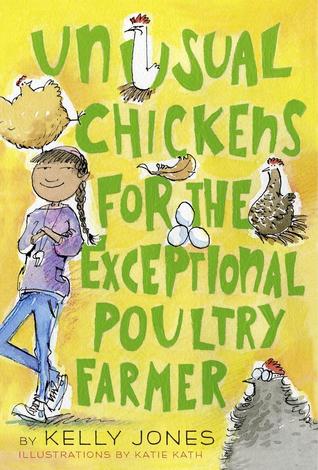
2016 Contenders: Unusual Chickens for the Exceptional Poultry Farmer, by Kelly Jones

I can't remember the last time I saw Daniel Pinkwater blurb a book. Of course, this one is not only about chickens (a special interest for Pinkwater) - it even name checks Pinkwater and his 1977 classic, The Hoboken Chicken Emergency. That has to be flattering. Still, Pinkwater is such a grouchy old coot that I have to believe he wouldn't praise a book unless he meant it. Of Unusual Chickens, he wrote, "Someone has finally written a real honest-to-goodness novel with chickens!  This news will excite people who like novels, people who like chickens...and chickens.  It is an unusual book!"

That it is. Sort of. On one level, the plot is a familiar one: a city girl moves to the country and struggles to fit in and make friends. In this case, the city girl, Sophie, and her mother are two of the only "brown people" in town (they are Latina), which only increases her feelings of alienation. They've left the city because Sophie's newly unemployed father has inherited a farm from his uncle, and along with it, several "unusual" chickens. 

That's where the other side of the story comes in. The chickens are not unusual in the "Martha Stewart, tiny-pastel-egg-laying" sense, but more in the "turn raccoons into stone and levitate the chicken coop" sense. Clearly, their care calls for an exceptional poultry farmer. Sophie's quest to become that farmer parallels her inner journey as she adjusts to her new surroundings. Of course, since we are dealing with supernatural chickens, there are many absurd and comedic stops along the way. 

First-time novelist Kelly Jones tells Sophie's story mostly through letters to her deceased grandmother, her great-uncle, and Agnes, the farmer who originally sold the unusual chickens. This farmer occasionally writes back, in letters whose erratic spelling and punctuation she blames on a malfunctioning typewriter (this may be a ruse - the unraveling of Agnes's mystery provides one of the more entertaining threads of this tale). The candid first-person narration allows Sophie's practical, wry, tween voice to shine through, and it is an appealing and authentic voice. There's a nice balance between supernatural comedy and real world concerns, and Katie Kath's line drawings play up the humor. 

Unusual Chickens is a small gem of a book, written with a light touch and a sensitive heart. I'll be surprised if it doesn't show up on the Notable Books list, though it's probably a long shot for the Newbery. 

Published in May 2015 by Knopf Books for Young Readers

Wednesday, July 22, 2015

2016 Contenders: The Story of Diva and Flea, by Mo Willems

Everyone with even a passing interest in children's literature knows Mo Willems. He's created some of the most iconic characters of the past twenty years: Elephant & Piggie, the Pigeon, Trixie and Knuffle Bunny, Cat the Cat.

What he hasn't done, at least up until now, is write a novel. Each of his books to this point has been either a picture book or an easy reader. The Story of Diva and Flea, then, is his first foray into a longer form.

That's not to say that it's a form that's particularly long in the grand scheme of things. My ARC of Diva and Flea runs a mere 67 (heavily-illustrated*) pages, and it's pitched at the same emerging readers who enjoy Kate DiCamillo's Mercy Watson books and similar fare. Perhaps it's better to refer to it as a "chapter book," as I imagine much of its readership will do.

The plot involves Diva, a tiny dog who resides in posh comfort at 11 avenue Le Play in Paris, and Flea, a large cat who considers himself a flâneur, which Willems repeatedly defines as one "who wanders the streets and bridges and alleys of the city just to see what there is to see." When they meet by chance and become friends, will Diva learn to be more adventurous? Will Flea see the benefits of domesticity?

I described the book to Rachael as "a more G-rated Lady and the Tramp," and even though she questioned whether such a thing was actually possible, I'll stand by that description. There's no romance, no baby, and no actual danger; what remains is a mismatched pair where each learns to appreciate the other's point of view and to be willing to take (minor) risks in order to do so. Even that "conflict" is subdued -- once the protagonists meet properly, there's really no clash of wills or second-act argument.

Perhaps more noticeably, the signature Willems humor is decidedly muted. There are the odd moments that brought a smile to my face, such as when Flea asks if "Breck-Fest" is a friend of Diva's, but there's nothing here that comes close being as funny as the Pigeon's tantrum in Don't Let the Pigeon Drive the Bus! or the slow-burning exasperation of There is a Bird on Your Head!

That doesn't mean Diva and Flea is anything less than pleasant, because it's perfectly serviceable. But for someone with Willems' pedigree, the expectations are sky-high, and I feel like Diva and Flea doesn't live up to them.


*(As an aside, I thought it was odd that Willems, he of the three Caldecott Honors, two Geisel Awards, and five Geisel Honors, didn't illustrate the book himself, but Tony DiTerlizzi's beautiful drawings are a perfect match for the text.)


Publication in October through Disney / Hyperion

Wednesday, April 1, 2015

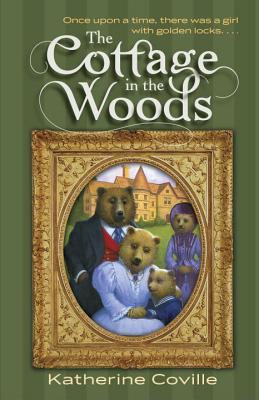
2016 Contenders: The Cottage in the Woods, by Katherine Coville

Fellow fans of The Wind in the Willows: have you ever tried to pin down exactly how big Toad is? Most of the time he seems to be the same size as Ratty, Mole, and Badger - that is, the size of a real toad. But he's always stealing motorcars from people, and presumably they are people-sized motorcars. And then there's the scene where he borrows the clothes of a human washerwoman and escapes from prison... oy.

I think Grahame gets away with this kind of logistical nonsense due to the slippery, dream-like tone of the novel. I mean, one moment everyone's being sensible and Edwardian, and the next moment Rat and Mole run into the god Pan. Clearly, the laws of physics are not operating in a consistent manner (so if Toad wants to part his hair in the middle, I'm going to roll with it, even if Beatrix Potter disagrees).

What works for Grahame does not serve Katherine Coville as well in her new gothic-fairy-tale-parable-mashup novel. The Cottage in the Woods retells the story of Goldilocks and the Three Bears from the point of view of Baby Bear's governess Ursula, recasting Papa Bear as a wealthy gentleman bear and Goldilocks as a traumatized enfant sauvage. The whole thing takes place in the Enchanted Forest, where enchanted animals coexist uneasily with their human counterparts.

Coville has done an effective job of spoofing the traditional gothic governess narrative - too effective, I would say. Ursula's habits, mindset, and manners are so recognizably and consistently those of an early nineteenth-century English lady that it's jarring when we are reminded of her bearish attributes. I kept being thrown out of the story as I wondered how a bear would play a pianoforte with its claws, or why exactly a bear would need the tight corsets that Ursula is constantly complaining about.

(It's telling that when I just did a Google image search for "bear corset," I got lots of pictures of corsets with bears on them, but no pictures of bears in corsets. And this is the INTERNET we're talking about.)

And then there's the romance. In keeping with the conventions of the genre, Ursula falls in love with a dashing young bear above her station, and then spends several chapters pining after him. This really made me question the intended audience. I just don't think that Ursula's hand-wringing internal monologues about filial duty would hold the interest of many middle grade readers.

Oh, and I haven't even mentioned the weird political plot: the sinister Anthropological Society is busy campaigning for human rights which, in this case, means curfews and other apartheid-like limitations placed on the rights of enchanted animals. That's an awfully heavy topic, and its resolution is disconcertingly blithe (though in keeping with the sentimental tone of the novel as a whole).

The Cottage in the Woods is a valiant effort, with more than competent writing and several well-developed characters (and some truly bad baddies), but ultimately it falls short of the mark. 

Published February 10th 2015 by Knopf Books for Young Readers

Wednesday, April 16, 2014

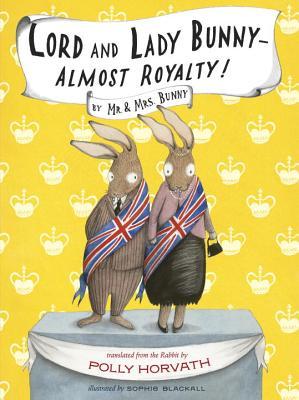
2015 Contenders, Point/Counterpoint Edition: Lord and Lady Bunny - Almost Royalty! by Mr. and Mrs. Bunny (Polly Horvath, translator)


Point: Tess Goldwasser, Rabbit Enthusiast and Children's Librarian, St. Mary's County Libary

In the thrilling sequel to Mr. and Mrs. Bunny Detectives Extraordinaire, Mrs. Bunny longs for a new hat, which, of course, means a new occupation (you’ll remember the Bunnies became detectives mainly for the fedoras). What does Mrs. Bunny want to be? Queen. Of course. So begins the laugh-after-laugh shenanigans of Lord and Lady Bunny: Almost Royalty.

In order to achieve Mrs. Bunny’s dream, our heroes must travel to England. They board a cruise ship, only to run into their dear friend Madeline! Madeline (we’ll remember) is the clever daughter of neo-hippies Flo and Mildred, who happen to also be traveling to England, as they’ve inherited a Sweet Shoppe, and Flo believes the universe wants him to spread a love of sugar as far and well as he can, after ingesting a fortuitous box of pop tarts.

And that’s not all! Along Mr. and Mrs. Bunny’s journey to almost royalty, there are appearances from most beloved characters from the first installment, like Mrs. Treaclebunny, and a certain expert in animal communication (and rare coins apparently), as well as JK Rowling, Polly Horvath herself, everybody’s favorite floss-appreciating Prince of Wales, and some extremely stuck up hedgehogs.

It all sounds ridiculous, but would we want anything less from a book about bunnies by Polly Horvath? Bottom line: the book is smart and sweet. It’s genuinely funny, and while some of it may go over kids’ heads, the Newbery basically defines “child appeal” as appealing to any child, not all, or even most, children, and I personally know a lot of savvy children who will love this book (probably many of the same who enjoyed Flora and Ulysses).

Now, I turn it over to Rachael, who will discuss the experience of listening to Bunnies on audio, (and cover any points I missed)

Counterpoint: Rachael Stein, Blog Slacker and Audiobook Listener


Devoted About to Mock readers may remember that I loved Mr. and Mrs. Bunny - Detectives Extraordinaire!  They may also remember, however, that I called it an "Only Skink," by which I meant that it was... difficult to categorize. Difficult to evaluate. Difficult to shoehorn into any given set of awards criteria. I can muster up some sympathy for the casual reader who picks up Mr. and Mrs. Bunny, not knowing what she is in for. In for what she is. For what she is in? 

If you've returned for a second helping of Horvath's lunatic lapine world, however, you deserve exactly what you get. And what do you get, exactly? More! More bunnies, more hippies, and more royalty - plus vegetable candy, uppity hedgehogs, and a trip to jolly olde England. As Mrs. Bunny notes, travel is terribly educational: “And Mrs. Treaclebunny has promised to speak English from now on as well. In fact, she said when she goes to England, that's all she speaks anyway because the animals speak English there. She says anyone who has read children's books with animals in them set in England would know that. Is The Wind in the Willows written in Mole with a little Ratty thrown in? Is Winnie-the-Pooh written in Bear? No, it's English, because that's what the animals there speak. I didn't know that before. Travel is so broadening.”

Polly Horvath narrates the Lord and Lady Bunny audiobook herself, and I'm afraid she's a bit of an Only Skink in this area as well. As a new member of the ALSC Notable Children's Recordings committee, I'm learning to evaluate audiobooks according to performance and production, rather than plot and character. With my committee member hat on, I'm forced to concede that Horvath's narration is a little breathy and her character voices are inconsistent. Compared to someone like Katherine Kellgren, she's kind of amateurish. When I put on my avid listener hat, though, I must make the argument that none of those things matter in this case! No one but Horvath could adequately narrate these books, and in its own Skinkish way, her narration is pitch-perfect. As the people who heard me laughing out loud in the grocery store can attest - not to mention Sam, who had to put up with me walking around the house saying, "I'm, like, the Dalai Lama of sugar!"

So there. 

You're not going to see this one on the Newbery list, nor, most likely, on the Notable Recordings. Oh well. As Polly Horvath's fictional counterpart says, "Life is cruel. Carry chocolate bars." 

Published in February by Schwartz and Wade and Listening Library.  

Friday, September 13, 2013

2014 Contenders: Flora and Ulysses: The Illuminated Adventures, by Kate DiCamillo


16052012Last spring, Jack Gantos and I were hangin’ out, shootin’ the breeze*, and talking about which new kids’ books we liked. He said that he really liked Mr. and Mrs. Bunny –Detectives Extraordinaire, partly because Horvath’s animals are smart. He remarked that just because your characters are animals doesn’t mean that they have to be dull-witted. I think he actually used a funnier word than that, but it’s been too long and I don’t remember what it was. If you see him around, ask him about stupid animal stories. 

Anyway, I think that’s what turns a lot of people off about talking animal stories – they associate the genre with cutesiness, preciousness, and simpleminded characters. That stereotype has a basis in reality, of course, especially in picture books. There are some authors who seem to think that if your story stinks, moving it to the animal kingdom will disguise the smell. 
 
Needless to say, Polly Horvath doesn’t fall into that trap, and neither does Kate DiCamillo. I thought of Horvath’s bunnies when I was reading DiCamillo’s newest, Flora and Ulysses, because the two books share a certain sensibility. As the Horn Book review of Mr. and Mrs. Bunny advised, “Look not for logic; this is a romp.” That advice holds true for Flora and Ulysses, whose plot is set into motion when a giant, multi-terrain vacuum cleaner sucks up an ordinary squirrel. Ulysses the squirrel, when resuscitated by Flora, retains extraordinary non-squirrellish powers (mainly flying, understanding human speech, and typing).

It is in the content of Ulysses’s typed compositions, however, that the novel diverges from the “madcap romp” genre. This wouldn’t be a Kate DiCamillo novel if it didn’t whack you in the head with pure beauty when you’re least expecting it. So what does a squirrel write, in DiCamillo’s world, when awakened from his dumb animal nature and presented with a typewriter? Why, he looks around at the trees and sky he loves, and at his new friend, and he writes poetry : “I love your round head / the brilliant green / the watching blue, / these letters, / this world, you.”

And then, because this is still a comic novel, he adds a postscript: “I am very, very hungry.” 

Until that poem appeared, I thought this novel was just okay, but that’s just so exactly the kind of poem a newly reverent squirrel would write that, once again, I found that Kate DiCamillo had totally pwned my heart.

I think this one may have a hard time at the Newbery table. It has those gorgeous DiCamillo moments – Ulysses’ poems, Flora’s struggles with her feelings, her father’s loneliness and awkwardness… But it’s also a comedy, and it doesn’t have the kind of character development you see in, say, The Year of Billy Miller. In Flora and Ulysses, the characters are cartoonish, and I think that’s an appropriate stylistic choice here, but it may count against them when it’s time to vote. Then, too, I’m not sure the sentence-level writing is all that special, for the most part, when compared to Billy Miller or Hokey Pokey. Neither are the settings. Thematically, it shines, but that may not be enough. 

And I should mention the illustrations. These are the “illuminated” adventures of Flora and Ulysses, meaning that some of the plot is advanced by comic strips drawn by K.G. Campbell. They tie in thematically with Flora’s interest in comics and superheroes, but they mean that the book could fall into the same liminal space occupied by Brian Selznick, though not to the same extent.

In any case, I like it a whole lot, and I think Jack Gantos would too.


*Okay, fine. He was here for an author visit and we were waiting for a class to arrive. 

Publication in September by Candlewick Press