Hello! As observant readers may have noticed, I have been silent in this space for several months. Perhaps I fell through a dimensional portal behind a Burger King, or perhaps a lot of sad things happened in my personal life, but either way, here I am. And I'm skipping ahead to the eighties, because... well, because A Visit to William Blake's Inn looked like a manageable read. Walk before I run, etc.
It also happens to be an excellent time to look back at the 1982 Newbery winner because for over thirty years it was the only book to have won both a Newbery Medal and a Caldecott Honor. This year, of course, Last Stop on Market Street duplicated that feat. Both books were total left-field choices for the Newbery, and both of them beat out some strong contenders for the gold medal (Ramona Quimby, Age 8, in the case of A Visit to William Blake's Inn).
I initially chose Visit as my 1980s selection because it's one of the few Newbery winners from the eighties that I hadn't read. Frankly, if it hadn't won the award, I wonder if it would have vanished into obscurity by now like so many other poetry books. In that sense, it's a winner very much in line with the original intent of the award: to encourage and reward excellence in American children's literature. It could be argued that it's the quirky books like this one that most need the signal boost that an award like this provides (though of course that's not a factor the committee would have taken into account).
And A Visit to William Blake's Inn is a strange little book, to be sure. It is a series of loosely connected poems about a child who goes to stay at an inn whose proprietor is the eighteenth-century poet (and painter and printmaker), William Blake. The inn is populated by the fantastical beings that Blake portrayed in his visionary creations. The verse is formal and metered, the imagery is vivid, and the tone swings back and forth between whimsy and melancholy.
Two things strike me as odd and gutsy about the idea of writing a book of children's poems inspired by William Blake. First: those are some big shoes you're trying to fill. Adult readers are necessarily going to be comparing your verse to Blake's, and that's daunting, to put it mildly. Second: it's going to be filled with allusions that your child readers will miss entirely. There is some chance the target audience (9-12-year-olds?) may have read "The Tyger," but it's unlikely they will have the familiarity with Songs of Innocence and Experience that would be required to fully appreciate this book.
And yet, it works. The poetry is not true Blake, but it's apparently good enough to have fooled a whole generation of teachers. As for the allusions? As we say so often in this field, the poems stand alone. You don't need to know the source material to appreciate these dragons, angels, tigers, and rats.
And so, though I am a huge fan of Beverly Cleary in general and Ramona in particular, I can't argue with the 1982 committee's choice. A Visit to William Blake's Inn is a rare jewel of a book, and it deserves its medal.
Showing posts with label Poetry. Show all posts
Monday, July 25, 2016
Tuesday, May 5, 2015
2016 Contenders: Historical Animals, by Julia Moberg
Books that pair poetry with nonfiction facts seem to be in vogue as of late. It's a structure that I associate most with Joyce Sidman, but Historical Animals is the second non-Sidman book we've reviewed this year (Random Body Parts is the other) that also utilizes this format.
However, if Random Body Parts was no Winter Bees or Dark Emperor, Historical Animals is no Random Body Parts. The brief poems, each of which describes a famous animal from history, possess some of the most awkward meter I've read in a long time, and are filled with rhymes that are forced, or that are noticeably approximate. I can't immediately think of another volume of modern children's poetry I've read that is as technically inexpert.
The nonfiction sections are, if anything else, even more difficult to deal with. The facts are often presented with little context, to the point of being shorn of meaning. We're told, for instance, that the poet Virgil spent 800,000 sesterces on a funeral for his housefly, but not what a sesterce was, or how much one was worth. This problem is compounded by the fact that the book contains no source list, no suggestions for further reading, and no glossary.
The book also suffers from sloppy editing. Errors include writing BCE for CE (pg. 22); spelling the name of the country as "Chili" (pg. 26); and stating that Florence Nightingale wrote a book in 1959 on the same page that lists her date of death as 1910 (pg. 40). Historical Animals also features awkward constructions ("Tortoises have the same life span as humans. Some can live from ninety to one hundred and fifty years old."), disconcerting word choices ("Dolly was named after the performance artist Dolly Parton."), and questionable taste (claiming that South American penguins like "life as Latinos").
Even the layout and illustrations seem subpar. I couldn't understand the logic by which some of the headings carried the names of the animals themselves, while others listed the name of the person who owned them. The cartoonish pictures, credited to Jeff Albrecht Studios, may attract the eyes of younger readers, but also make errors such as giving the famed rescue dog Barry der Menschenretter the incorrect colors.
Obviously, I don't think Historical Animals should or will win anything. Charlesbridge usually puts out much better titles, and I do expect that other books that they produce will be of higher quality than this one.
Published in February by Charlesbridge / Imagine!
However, if Random Body Parts was no Winter Bees or Dark Emperor, Historical Animals is no Random Body Parts. The brief poems, each of which describes a famous animal from history, possess some of the most awkward meter I've read in a long time, and are filled with rhymes that are forced, or that are noticeably approximate. I can't immediately think of another volume of modern children's poetry I've read that is as technically inexpert.
The nonfiction sections are, if anything else, even more difficult to deal with. The facts are often presented with little context, to the point of being shorn of meaning. We're told, for instance, that the poet Virgil spent 800,000 sesterces on a funeral for his housefly, but not what a sesterce was, or how much one was worth. This problem is compounded by the fact that the book contains no source list, no suggestions for further reading, and no glossary.
The book also suffers from sloppy editing. Errors include writing BCE for CE (pg. 22); spelling the name of the country as "Chili" (pg. 26); and stating that Florence Nightingale wrote a book in 1959 on the same page that lists her date of death as 1910 (pg. 40). Historical Animals also features awkward constructions ("Tortoises have the same life span as humans. Some can live from ninety to one hundred and fifty years old."), disconcerting word choices ("Dolly was named after the performance artist Dolly Parton."), and questionable taste (claiming that South American penguins like "life as Latinos").
Even the layout and illustrations seem subpar. I couldn't understand the logic by which some of the headings carried the names of the animals themselves, while others listed the name of the person who owned them. The cartoonish pictures, credited to Jeff Albrecht Studios, may attract the eyes of younger readers, but also make errors such as giving the famed rescue dog Barry der Menschenretter the incorrect colors.
Obviously, I don't think Historical Animals should or will win anything. Charlesbridge usually puts out much better titles, and I do expect that other books that they produce will be of higher quality than this one.
Published in February by Charlesbridge / Imagine!
Friday, March 6, 2015
2016 Contenders: Random Body Parts, by Leslie Bulion
What an odd book Random Body Parts is! It's a series of poems that are also riddles, the answer to which is always a part or parts of the body. Each riddle is followed by a fact box about the poem's subject, in a manner reminiscent of some of Joyce Sidman's books. And then, at the end of the book, there's a brief note about each poem, which includes the poetic structure used, and how each one incorporates a tribute or reference to Shakespeare.
The immediate reaction may be to look at this disparate set of elements and wonder if this isn't a cynical ploy to try and hit as much of the Common Core book market as possible. However, despite the diversity of its elements, Random Body Parts actually works fairly well. In general, the poems work as poetry, and the side and end notes provide interesting information in an easy-to-understand way.
I'd definitely recommend purchasing Random Body Parts for just about any library collection, and I think it may have broader child appeal than many other poetry books. I don't, however, see it generating much awards discussion. Leslie Bulion is a solid poet, especially considering the restrictions placed on her by this book's structure. When compared to works by the top tier of current children's poets, though, Random Body Parts doesn't have the otherworldly reverence of Joyce Sidman, the quiet pensiveness of Bob Raczka, the brain-twisting cleverness of Jack Prelutsky, or the formal inventiveness of Marilyn Singer. Given that those four poets have the grand sum total of one Newbery Honor between them (which belongs to Sidman, who Honored in 2011 for Dark Emperor & Other Poems of the Night), it's unlikely that Random Body Parts will break through and make the Newbery rolls.
Published in March by Peachtree
The immediate reaction may be to look at this disparate set of elements and wonder if this isn't a cynical ploy to try and hit as much of the Common Core book market as possible. However, despite the diversity of its elements, Random Body Parts actually works fairly well. In general, the poems work as poetry, and the side and end notes provide interesting information in an easy-to-understand way.
I'd definitely recommend purchasing Random Body Parts for just about any library collection, and I think it may have broader child appeal than many other poetry books. I don't, however, see it generating much awards discussion. Leslie Bulion is a solid poet, especially considering the restrictions placed on her by this book's structure. When compared to works by the top tier of current children's poets, though, Random Body Parts doesn't have the otherworldly reverence of Joyce Sidman, the quiet pensiveness of Bob Raczka, the brain-twisting cleverness of Jack Prelutsky, or the formal inventiveness of Marilyn Singer. Given that those four poets have the grand sum total of one Newbery Honor between them (which belongs to Sidman, who Honored in 2011 for Dark Emperor & Other Poems of the Night), it's unlikely that Random Body Parts will break through and make the Newbery rolls.
Published in March by Peachtree
Sunday, February 1, 2015
2015 Contenders: If it Rains Pancakes, by Brian P. Cleary
If it Rains Pancakes is an interesting hybrid volume: part book about poetry, part book of poetry. It begins with an introduction to what a haiku is, followed by several examples of the form. This process is then repeated for the lantern, another Japanese-derived poetic form.
If I were teaching a poetry class or unit, particularly for elementary school children, I think I'd love If it Rains Pancakes. The explanations of the forms are simple and clear, and Brian P. Cleary's poems that follow show how flexible each form is. In such a setting, this book would be perfect.
As a "contribution to literature," I'm not sure the book is quite as effective. Some of the poems are certainly gems -- "The Mind," with its clever take on memory, was my favorite, and one I think deserves to be anthologized. Others are perhaps less creative, if certainly serviceable. I did think that, taken as as a literary work, If it Rains Pancakes wasn't on the same level as Santa Clauses or Winter Bees, two other volumes of poetry that we've looked at recently.
I will also confess that I was a bit bothered by the fact that every poem in the haiku section is given a title -- not something as unobtrusive as the dates that accompany each poem in Santa Clauses, but a title that states the theme or setting of the piece. Very few published haiku have titles, and in fact, the prominent haiku-themed poetry journals look highly askance on the practice. (Modern Haiku strongly discourages titles, for instance, and Haiku Journal won't even accept submissions with titles.) It's a small issue, to be sure, but it felt like an important one to me.
There's a possibility that If it Rains Pancakes will make this year's Notables list; it's among their final nominations, and I'm curious to see if it makes that last cut. I doubt it will show up in the Newbery committee's selections though.
Published in May by Millbrook / Lerner
If I were teaching a poetry class or unit, particularly for elementary school children, I think I'd love If it Rains Pancakes. The explanations of the forms are simple and clear, and Brian P. Cleary's poems that follow show how flexible each form is. In such a setting, this book would be perfect.
As a "contribution to literature," I'm not sure the book is quite as effective. Some of the poems are certainly gems -- "The Mind," with its clever take on memory, was my favorite, and one I think deserves to be anthologized. Others are perhaps less creative, if certainly serviceable. I did think that, taken as as a literary work, If it Rains Pancakes wasn't on the same level as Santa Clauses or Winter Bees, two other volumes of poetry that we've looked at recently.
I will also confess that I was a bit bothered by the fact that every poem in the haiku section is given a title -- not something as unobtrusive as the dates that accompany each poem in Santa Clauses, but a title that states the theme or setting of the piece. Very few published haiku have titles, and in fact, the prominent haiku-themed poetry journals look highly askance on the practice. (Modern Haiku strongly discourages titles, for instance, and Haiku Journal won't even accept submissions with titles.) It's a small issue, to be sure, but it felt like an important one to me.
There's a possibility that If it Rains Pancakes will make this year's Notables list; it's among their final nominations, and I'm curious to see if it makes that last cut. I doubt it will show up in the Newbery committee's selections though.
Published in May by Millbrook / Lerner
Friday, January 30, 2015
2015 Contenders: Winter Bees, by Joyce Sidman
After last year's unorthodox but effective What the Heart Knows, Joyce Sidman returns to familiar territory with Winter Bees & Other Poems of the Cold. As in her 2011 Newbery Honor book, Dark Emperor & Other Poems of the Night, Sidman produces a series of nature poems around a common theme, and pairs each one with a prose nonfiction note that elaborates on the poem in question's subject.
The book starts with "Dream of the Tundra Swan," a stunning tour de force of alliteration, assonance, and startling imagery. It's probably one of the fifteen or twenty best poems I've ever read for children; it's that good. I'm not familiar with very many books for children that come out of the gate as strongly, and the piece raises the expectations for the book sky-high.
Perhaps it's inevitable then that the remainder of the volume doesn't quite live up to that initial salvo. The book jacket indicates that "Dream of the Tundra Swan" was the first poem Sidman wrote for the collection, and that initial burst of inspiration turned out not to be entirely sustainable. Interestingly, the second-best poem in the book might well be the very next one, "Snake's Lullaby," which, if it isn't at that level, at least comes close in its incisive description of hibernating garter snakes.
That's not to say that the rest of the book is a failure by any means. Sidman is a highly-skilled poet, and her work never dips below the level of solid craftsmanship. But Winter Bees is so obviously front-loaded that the concluding impression doesn't match the initial hopes that it raises -- especially since it doesn't have a final piece that ties everything together, like Dark Emperor did.
It might have been better to finish the book with the best poem, but the schema that Sidman has chosen doesn't allow her to do that. The sequencing at least loosely follows the rhythm of the season, with the first few poems being about the onset of winter, while the last few concern its end. That's certainly a legitimate choice -- and one that's similar to the one Sidman used in Dark Emperor -- but it does place some serious constraints on her ability to move individual pieces around for maximum impact.
This maybe makes it sound like I enjoyed Winter Bees less than I did. It's an excellent book, and one that solidifies Sidman's place in the uppermost echelon of American children's poets. "Dream of the Tundra Swan" ought to be showing up in anthologies for generations to come. I'm not sure the book as a whole is as consistent as Dark Emperor, however, and given that that one was kind of a left-field honor book, I don't know that Winter Bees will duplicate its awards success.
Published in November by HMH.
The book starts with "Dream of the Tundra Swan," a stunning tour de force of alliteration, assonance, and startling imagery. It's probably one of the fifteen or twenty best poems I've ever read for children; it's that good. I'm not familiar with very many books for children that come out of the gate as strongly, and the piece raises the expectations for the book sky-high.
Perhaps it's inevitable then that the remainder of the volume doesn't quite live up to that initial salvo. The book jacket indicates that "Dream of the Tundra Swan" was the first poem Sidman wrote for the collection, and that initial burst of inspiration turned out not to be entirely sustainable. Interestingly, the second-best poem in the book might well be the very next one, "Snake's Lullaby," which, if it isn't at that level, at least comes close in its incisive description of hibernating garter snakes.
That's not to say that the rest of the book is a failure by any means. Sidman is a highly-skilled poet, and her work never dips below the level of solid craftsmanship. But Winter Bees is so obviously front-loaded that the concluding impression doesn't match the initial hopes that it raises -- especially since it doesn't have a final piece that ties everything together, like Dark Emperor did.
It might have been better to finish the book with the best poem, but the schema that Sidman has chosen doesn't allow her to do that. The sequencing at least loosely follows the rhythm of the season, with the first few poems being about the onset of winter, while the last few concern its end. That's certainly a legitimate choice -- and one that's similar to the one Sidman used in Dark Emperor -- but it does place some serious constraints on her ability to move individual pieces around for maximum impact.
This maybe makes it sound like I enjoyed Winter Bees less than I did. It's an excellent book, and one that solidifies Sidman's place in the uppermost echelon of American children's poets. "Dream of the Tundra Swan" ought to be showing up in anthologies for generations to come. I'm not sure the book as a whole is as consistent as Dark Emperor, however, and given that that one was kind of a left-field honor book, I don't know that Winter Bees will duplicate its awards success.
Published in November by HMH.
Wednesday, January 28, 2015
2015 Contenders: Santa Clauses, by Bob Raczka
Santa Clauses is a slim volume of 25 haiku -- one for each of the days in December leading up to Christmas. The entire book is written in character, with Santa himself as the speaker of each poem. Some of the pieces deal with preparations for the big Christmas Eve trek, while others focus on the Clauses' domestic life.
This could be the description of either a great book or a terrible one, depending on the execution. To Bob Raczka's credit, Santa Clauses ends up as the former. It's a cozy, sparkling book, one that exudes the warmth and good cheer one hopes for during the holiday season.
There's almost no poetic form easier to write in English than haiku -- and very few where writing a great one is as difficult. It's an unforgiving form, in which every word is critically important, and there's essentially no margin for error. And yet I don't think there's a bad poem in Santa Clauses, while there are several excellent ones. Raczka's eye for small but beautiful images is a keen one, and his choice not to make the entire book about Santa's "public" life pays great dividends. Poems such as "December 8th," about seeing one's shadow in the moonlight, or "December 16th," where the images of hardening icicles and baking cookies come together, transcend the framework of the book to become universal.
I'll be honest and say that I didn't expect much from Santa Clauses before reading it; the concept sounded overly cutesy, and haiku so often fail. But after finishing it, I almost couldn't wait for next December, when I can pull the book out and read it to my daughter. Additionally, Chuck Groenink's detailed illustrations have a wonderful interplay with the text; it has the feel of something I'll think of in twenty years as a holiday classic.
That doesn't mean it has a shot at the Newbery, however. We've talked at length before about how hard it is for poetry to win the medal, and there's no precedent for Christmas poetry being recognized. Indeed, although many books in the Newbery canon contain a Christmas scene, I think the only "pure" Christmas book of any kind ever to be recognized is Nicholas: A Manhattan Christmas Story, which honored way back in 1925, and is now remembered largely as a footnote in the career of its author, legendary children's librarian Anne Carroll Moore. As good as Santa Clauses is, I doubt it will break through to the Newbery rolls.
Published in December by Carolrhoda Books / Lerner
This could be the description of either a great book or a terrible one, depending on the execution. To Bob Raczka's credit, Santa Clauses ends up as the former. It's a cozy, sparkling book, one that exudes the warmth and good cheer one hopes for during the holiday season.
There's almost no poetic form easier to write in English than haiku -- and very few where writing a great one is as difficult. It's an unforgiving form, in which every word is critically important, and there's essentially no margin for error. And yet I don't think there's a bad poem in Santa Clauses, while there are several excellent ones. Raczka's eye for small but beautiful images is a keen one, and his choice not to make the entire book about Santa's "public" life pays great dividends. Poems such as "December 8th," about seeing one's shadow in the moonlight, or "December 16th," where the images of hardening icicles and baking cookies come together, transcend the framework of the book to become universal.
I'll be honest and say that I didn't expect much from Santa Clauses before reading it; the concept sounded overly cutesy, and haiku so often fail. But after finishing it, I almost couldn't wait for next December, when I can pull the book out and read it to my daughter. Additionally, Chuck Groenink's detailed illustrations have a wonderful interplay with the text; it has the feel of something I'll think of in twenty years as a holiday classic.
That doesn't mean it has a shot at the Newbery, however. We've talked at length before about how hard it is for poetry to win the medal, and there's no precedent for Christmas poetry being recognized. Indeed, although many books in the Newbery canon contain a Christmas scene, I think the only "pure" Christmas book of any kind ever to be recognized is Nicholas: A Manhattan Christmas Story, which honored way back in 1925, and is now remembered largely as a footnote in the career of its author, legendary children's librarian Anne Carroll Moore. As good as Santa Clauses is, I doubt it will break through to the Newbery rolls.
Published in December by Carolrhoda Books / Lerner
Thursday, October 9, 2014
2015 Contenders: Brown Girl Dreaming, by Jacqueline Woodson
Brown Girl Dreaming is a memoir of Jacqueline Woodson's childhood, told in a sequence of poems. It begins at her birth in Ohio, covers her move to South Carolina, and another, later move to Brooklyn. The time period coincides with the heart of the Civil Rights Movement, and the tensions between Black and White, North and South, Secular and Sacred, and Old and New are notes that repeat in different combinations as the book moves forward. What Brown Girl Dreaming does well, it does very well. Woodson's eye for arresting detail is on full display here -- the color of the dirt, the sound of playground rhymes, the taste of lemon chiffon ice cream. Her personal voice too is very strong; throughout the book, I had a firm sense of just who Woodson was as a child. The other characters are also well-drawn and described. Everyone in the book felt real, something that not even all memoirs accomplish.
I was less sold on the technical aspects of the book. Many of the more personal moments were in beautiful poetry, but the political aspects -- and, oddly enough, the parts about Woodson discovering her desire to become a writer -- felt prosy and a bit shopworn, hitting themes that have come up over and over again in children's literature of the past decade without seeming to add a particularly fresh perspective. Similarly, sometimes the line breaks worked marvelously, but sometimes I felt like they were inserted simply because the line was getting too long. And I'd echo the complaint that came up in discussions over at Heavy Medal, that the titles on the individual poems interrupt the flow of the book without adding much thematically or tonally.
Each individual poem is a sort of a vignette, and I'm unconvinced that this kaleidoscope approach works --- too many of them don't work to advance the narrative, which led me to question the editing. However, this was also a complaint that I had about No Crystal Stair, and most readers didn't agree with me then, so my opinion should perhaps be taken with a grain of salt.
Actually, No Crystal Stair isn't a bad point of comparison in general for Brown Girl Dreaming. BGD is being touted in many circles as the Newbery front-runner, and No Crystal Stair was also a highly-reviewed book (and one that ended up winning the Boston Globe-Horn Book award). I didn't like either of them nearly as much as the general consensus, and in both cases, my main criticisms were structural. It may simply be the case that, as with that previous title, I'm not necessarily the right reader for the book, and so my review shouldn't be given all that much weight.
Because the critical consensus for Brown Girl Dreaming has been so overwhelmingly positive, it's likely this will be one of the titles we choose for our Maryland Mock Newbery. I'm excited to hear the discussions about it, and I hope that listening to and participating in those discussions will help me further refine my opinions of this title.
Published in September by Nancy Paulsen Books / Penguin
Friday, November 22, 2013
2014 Contenders: If You Want to See a Whale, by Julie Fogliano
Every year, a picture book or two gets bandied about in the (online, publicly visible) Newbery discussions. Last year gave us Each Kindness and Step Gently Out. This year, we've had Africa Is My Home (assuming you take it as a picture book, rather than a heavily-illustrated work of short fiction); the other title that I've seen crop up in the most discussions is probably If You Want to See a Whale.
In a way, it's academic exercise, discussing these picture books. No "traditional" picture book has ever won the Newbery (though that's an assertion that assumes you agree with me on how to categorize A Visit to William Blake's Inn [1982 winner], which I think of as an illustrated collection of poetry rather than a picture book, and which is filed in the 811s in our local library system, but which did win a Caldecott Honor). The Honors list isn't much better -- aside from another poetry book, Dark Emperor (2011 Honor), the only picture books I can find are Wanda Gág's Millions of Cats (1929 Honor) and The ABC Bunny (1934 Honor), from the pre-Caldecott days. (If you can think of one I missed, leave a comment!)
And yet I feel like it's an important discussion to continue having. Even without the iconic illustrations, the texts of Goodnight Moon and Where the Wild Things Are and Horton Hears a Who are, I would argue, key parts of American children's literature. It's very hard to talk about picture books without considering the illustrations -- it feels kind of like trying to evaluate a symphony without ever mentioning the string section -- but the ones that fall within the Newbery range (which is the overwhelming majority of them) deserve our attention nonetheless.
With all that said, it seems to me that the text of If You Want to See a Whale does several things extremely well, and a few things maybe not as well. The sound of the book when read aloud is fantastic -- Julie Fogliano has a keen ear for alliteration and assonance, and lines such as the ones in which she describes clouds "in the sky that's spread out, side to side" are a joy just to say. The ending of the book in the text is also beautifully ambiguous, fading out on the lines "and wait... / and wait... / and wait..." The last of illustrator Erin E. Stead's pictures shows the whale quest coming to a successful end, but it does so wordlessly -- although she's given us a tidy ending, Fogliano as author has declined to do so.
The main thing that bothered me -- and maybe it's just from sitting through too many Creative Writing workshops back in college -- was the book's unwillingness to fully commit to its central conceit. I know that the book isn't really about whale-watching at all, but a metaphor is best when it works on both the literal and figurative levels. A window isn't helpful for watching for whales (or at least, nowhere near as helpful as being outside), and if you're on a beach or in a boat, roses and bugs aren't likely distractions.
This doesn't mean that If You Want to See a Whale isn't a delight, but I do think it means that it's not Newbery material. When Rachael reviewed Each Kindness last year, she talked about the intense difficulty of writing a short text. One flawed line in a 300-page novel might pass by unnoticed; the same isn't true of a poem of 52 lines, several of which are only two or three words long. Surviving the scrutiny that such a short text invites is an incredibly high bar, and I'm unconvinced that Whale clears it.
Published in May by Roaring Book Press
In a way, it's academic exercise, discussing these picture books. No "traditional" picture book has ever won the Newbery (though that's an assertion that assumes you agree with me on how to categorize A Visit to William Blake's Inn [1982 winner], which I think of as an illustrated collection of poetry rather than a picture book, and which is filed in the 811s in our local library system, but which did win a Caldecott Honor). The Honors list isn't much better -- aside from another poetry book, Dark Emperor (2011 Honor), the only picture books I can find are Wanda Gág's Millions of Cats (1929 Honor) and The ABC Bunny (1934 Honor), from the pre-Caldecott days. (If you can think of one I missed, leave a comment!)
And yet I feel like it's an important discussion to continue having. Even without the iconic illustrations, the texts of Goodnight Moon and Where the Wild Things Are and Horton Hears a Who are, I would argue, key parts of American children's literature. It's very hard to talk about picture books without considering the illustrations -- it feels kind of like trying to evaluate a symphony without ever mentioning the string section -- but the ones that fall within the Newbery range (which is the overwhelming majority of them) deserve our attention nonetheless.
With all that said, it seems to me that the text of If You Want to See a Whale does several things extremely well, and a few things maybe not as well. The sound of the book when read aloud is fantastic -- Julie Fogliano has a keen ear for alliteration and assonance, and lines such as the ones in which she describes clouds "in the sky that's spread out, side to side" are a joy just to say. The ending of the book in the text is also beautifully ambiguous, fading out on the lines "and wait... / and wait... / and wait..." The last of illustrator Erin E. Stead's pictures shows the whale quest coming to a successful end, but it does so wordlessly -- although she's given us a tidy ending, Fogliano as author has declined to do so.
The main thing that bothered me -- and maybe it's just from sitting through too many Creative Writing workshops back in college -- was the book's unwillingness to fully commit to its central conceit. I know that the book isn't really about whale-watching at all, but a metaphor is best when it works on both the literal and figurative levels. A window isn't helpful for watching for whales (or at least, nowhere near as helpful as being outside), and if you're on a beach or in a boat, roses and bugs aren't likely distractions.
This doesn't mean that If You Want to See a Whale isn't a delight, but I do think it means that it's not Newbery material. When Rachael reviewed Each Kindness last year, she talked about the intense difficulty of writing a short text. One flawed line in a 300-page novel might pass by unnoticed; the same isn't true of a poem of 52 lines, several of which are only two or three words long. Surviving the scrutiny that such a short text invites is an incredibly high bar, and I'm unconvinced that Whale clears it.
Published in May by Roaring Book Press
Thursday, November 21, 2013
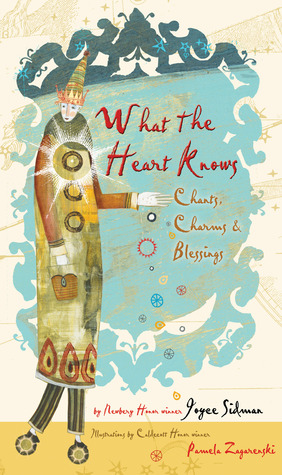
2014 Contenders: What the Heart Knows, by Joyce Sidman
Joyce Sidman's newest book of poetry is a strange beast indeed. The subtitle is "Chants, Charms & Blessings," and in her note to readers, Sidman talks about how humans have always "used language to try to influence the world," and encourages readers to make poems of their own and "chant them, in your own voice." She divides her book into four parts: Chants & Charms, Spells & Invocations, Laments & Remembrances, and Praise Songs & Blessings. The result is something like a poetic Book of Common Prayer (or Book of Shadows), with all of the elevated diction and heightened emotion such a mode requires. Both the subject matter and tone are widely varied among the individual poems, soaring from lost socks to the slippery nature of time, and then swooping back down to ugly sweaters, all the in the space of three pages.I don't believe I've ever had cause to mention my religious background on this blog, or in any of my writing about children's books. In the interest of making clear the kind of reader I am, though, I think it's only fair to say that I have been a solitary Pagan, a high church Episcopalian, an enthusiastic half-Jew, a Unitarian-Universalist, and a quasi-Buddhist in my life. Like the titular character in Life of Pi, I'm spiritually profligate - I just love a good prayer. And even outside of overt spirituality, I've built my entire life around the idea that words can shape reality. This book basically speaks directly to my heart.
Even as a biased reader, though, I think it's fair to say that this is a magnificent collection of poetry. Sidman is the Kevin Henkes of children's poets: I don't know any serious children's poet who speaks so respectfully to their readers. The best poetry is always about more than what it's about, and Sidman achieves that more often than not in this collection, turning ordinary objects into metaphors for loss, transience, and comfort. She does not restrict herself to the tangible, though - occasionally the poems enter the realm of pure surrealism, as in "Song in a Strange Land," which plays out like a fever dream.
What the Heart Knows is not only distinguished thematically, though. The poems are also characterized by razor-sharp imagery, as in "Blessing on the Smell of Dog": "May his scent seep through / perfumed shampoos / like the rich tang of mud in spring." The sound of the words themselves is deeply satisfying as well, filled with the repetition, alliteration, and insistent rhythms that characterize the tradition of sacred poetry. The fact that these are secular prayers only adds to their power, solemnizing the topics we usually dismiss.
Other reviewers have pointed out that the poems are not perfectly equal in quality, and that's fair, but there's very little filler, in my opinion. Nina also questioned whether the illustrations distract from the poetry, and I think that is actually a good question - I was so focused on the text that I barely noticed the illustrations at all. It's possible that the book would be even more effective with a simpler design. There is the age question as well - this is really aimed higher than Sidman's usual middle-grade age range, but surely not too high for the Newbery.
Overall, it's a gorgeous piece of work - definitely in my top five books of the year - and I do hope it gets some love on Newbery day.
Published in October by HMH Books for Young Readers
Wednesday, June 19, 2013
2014 Contenders: Stardines Swim High Across the Sky and Other Poems, by Jack Prelutsky
Jack Prelutsky has long had an interest in imaginary creatures with portmanteau names. Behold the Bold Umbrellaphant and Other Poems (2006) was a collection of nothing but poems about such creatures, and several pieces from Prelutsky's last poetry volume, I've Lost My Hippopotamus, also used this trope. Picking up right up where Prelutsky left off, Stardines is a collection of sixteen such poems, each one describing a creature that is a "blending of the animate and inanimate," as the jacket blurb says.
This highly specific focus works very much in the book's favor. Where Hippopotamus was sometimes inconsistent, Stardines doesn't include any pieces that are obviously second-tier. Similarly, the fact that there are only sixteen poems -- none of which is more than three stanzas -- means that the concept doesn't have time to overstay its welcome.
As we talked about in last year's discussion of Hippopotamus, one of the unwritten, yet never-broken rules of the Newbery is that Humorous Poetry Doesn't Win. As good as Stardines is, I don't foresee it being the book to break through that barrier. Even in what's shaping up to be a fairly weak year, I don't think Stardines is the leading poetry candidate (that would be Follow, Follow), and the committee is notoriously loath to honor more than one volume of poetry in any given year.
However, we still might see Stardines on awards day. In her mid-year awards post, Elizabeth Bird over at Fuse #8 argues that Carin Berger's gorgeous 3-D diorama photography makes Stardines a worthy Caldecott contender. I'm not by any means a Caldecott expert, but the illustrations are jaw-dropping, and perfectly matched to the text. I'll be very curious to see if the Caldecott committee has a positive response to the artwork.
Published in February by Greenwillow / HarperCollins
Friday, April 19, 2013
2014 Contenders: Follow Follow, by Marilyn Singer
Good poetry is hard to write, and good formal poetry can be even harder. Follow Follow, Marilyn Singer's newest book, consists of poems in a fiendishly tricky form: the reverso, in which the poem tells a story one way, and then, when the lines are read in the reverse order, tells a different one. The only allowable changes are in punctuation and capitalization.
That this book works, and works marvelously, is a testament to Singer's skill with words. Each poem (except the first and last, which deal with the poet's craft) takes a classic fairytale or fable and looks at it from two angles. It's really stunning how different the same words can be when reversed.
My favorite example of this is "The Little Mermaid's Choice." The opening lines of the first part encourage the traditional plot of the tale: "For love, / give up your voice. / Don't / think twice." However, the same words form the cautionary closing of the second part: "Think twice! / Don't / give up your voice / for love." It's a perfect inversion, and a good sample of the craft evident in the rest of the book.
Although it's something that can't be taken into Newbery consideration, the formatting of the book is lovely. Each two-page spread features the poem, printed in two columns (one for each version), as well as a lavish full-page illustration by Josée Masse. It's beautifully done, and so much more child-friendly than many of the other poetry books for kids that I often see.
Follow Follow comes billed as a "companion to" Mirror Mirror, Singer's first book of reversos, which was a 2011 Notable. However, there's no reason that they need to be read together; it's definitely a stand-alone. Anyone who enjoyed Mirror Mirror, however, will find plenty to love here.
It's hard to judge exactly how good Follow Follow's Newbery chances are. Poetry rarely wins -- the last time it did was with Joyful Noise in 1989 -- but there have been recent honors for The Surrender Tree (2009) and Dark Emperor (2011), and at any rate, the committee is different every year. Regardless, however, I'm putting this book firmly on my "keep this one in mind to return to later in the year" list.
Published in February by Dial / Penguin Young Readers
That this book works, and works marvelously, is a testament to Singer's skill with words. Each poem (except the first and last, which deal with the poet's craft) takes a classic fairytale or fable and looks at it from two angles. It's really stunning how different the same words can be when reversed.
My favorite example of this is "The Little Mermaid's Choice." The opening lines of the first part encourage the traditional plot of the tale: "For love, / give up your voice. / Don't / think twice." However, the same words form the cautionary closing of the second part: "Think twice! / Don't / give up your voice / for love." It's a perfect inversion, and a good sample of the craft evident in the rest of the book.
Although it's something that can't be taken into Newbery consideration, the formatting of the book is lovely. Each two-page spread features the poem, printed in two columns (one for each version), as well as a lavish full-page illustration by Josée Masse. It's beautifully done, and so much more child-friendly than many of the other poetry books for kids that I often see.
Follow Follow comes billed as a "companion to" Mirror Mirror, Singer's first book of reversos, which was a 2011 Notable. However, there's no reason that they need to be read together; it's definitely a stand-alone. Anyone who enjoyed Mirror Mirror, however, will find plenty to love here.
It's hard to judge exactly how good Follow Follow's Newbery chances are. Poetry rarely wins -- the last time it did was with Joyful Noise in 1989 -- but there have been recent honors for The Surrender Tree (2009) and Dark Emperor (2011), and at any rate, the committee is different every year. Regardless, however, I'm putting this book firmly on my "keep this one in mind to return to later in the year" list.
Published in February by Dial / Penguin Young Readers
Friday, January 11, 2013
2013 Contenders: Water Sings Blue, by Kate Coombs
"I must go down to the seas again, to the lonely sea and the sky,And all I ask is a tall ship and a star to steer her by."
"For whatever we lose (like a you or a me)
it's always ourselves we find in the sea."
Admission: I have a great weakness for sea poetry. Like Melville's Ishmael, "when my hypos get such an upper hand of me, that it requires a strong moral principle to prevent me from deliberately stepping into the street, and methodically knocking people's hats off--then, I account it high time to get to sea as soon as I can." Or at least to seek out some nautical literature.
And sea poets, in turn, seem to have a weakness for formal meter and rhyme. Maybe it's something about the rhythm of the sea itself, but look at those two excerpts above, from poems by John Masefield and e. e. cummings. Don't they just capture the great, surging rhythm of the world's oceans? I think so.
So it was with great pleasure that I opened Water Sings Blue to find that Kate Coombs has chosen to write about the sea in rhyming, metered verse. It feels like there's not a lot of "serious" modern children's poetry that rhymes. Plenty of light verse and nonsense verse rhymes, of course. But when children's poets get all SRS BSNS, they seem to feel the need to do so in free verse.
Not that Water Sings Blue is uniformly serious. To paraphrase one of the reviews, it has as many moods as the sea. While the individual poems vary in tone, though, they are united by the poet's arresting use of imagery and metaphor. "Please, O Lord," entreats a fish in "Prayer of the Little Fish. "Protect me from / the high, dry, breathless air." Breathless air, y'all. That knocks me out.
At its best, the musicality of Coombs' language adds another layer of meaning to the poems. In "Sand's Story" she writes, "Now we grind and we grumble / humbled and grave, / at the touch of our breaker / and maker, the wave." All that alliteration and internal rhyme just reinforces the relentlessness of a force that slowly crumbles mountains.
And yet... and yet. Despite the gorgeousness of the language, despite the stunning imagery... not all of this verse scans properly. In fact, quite often, it doesn't. "I'm going shopping at the tide pool. / They carry everything there - " My, that feels awkward. Incongruously awkward, given the talent of the poet and her attention to detail otherwise.
Ultimately, though, the weird scansion is not nearly enough to sink this pretty little book. No pun intended. Content trumps form for me, so it's definitely among my top ten of the year. As for Newbery... well, it's a strong year and poetry rarely medals, but I'd be happy to see a silver Honor sticker on the cover of this one.
(Thanks to reader Brandy for the recommendation!)
Friday, March 9, 2012
2013 Contenders: I've Lost My Hippopotamus, by Jack Prelutsky
I'm always interested in the way that awards committees of any kind come to interpret their own rules. There are the rules as they are written, yes, but there are also the conventions and tendencies that aren't written down, though they're followed so closely that they might as well be.The Newbery terms plainly state "There are no limitations as to the character of the book considered except that it be original work." Definition 1 adds, "the committee shall consider all forms of writing—fiction, non-fiction, and poetry."
However, in practice, poetry has gotten something of a short shrift. In the Newbery's 91-year history, poetry has won exactly twice: A Visit to William Blake's Inn, by Nancy Willard, in 1982, and Joyful Noise: Poems for Two Voices, by Sid Fleischman, in 1989**. It hasn't done much better in the Honors; aside from the recent Dark Emperor and Other Poems of the Night, by Joyce Sidman (2011), it's hard to find an Honored volume of poetry that isn't something else too, such as a biography (Carver: A Life in Poems, by Marilyn Nelson, 2002), novel/narrative (Inside Out & Back Again, by Thanhha Lai, 2012; The Surrender Tree: Poems of Cuba's Struggle for Freedom, by Margarita Engle, 2009), or...um...alphabet book (The ABC Bunny, Wanda Gág, 1934).
But the situation becomes even more stark when one considers humorous poetry. American children's literature has produced some truly classic volumes of humorous poetry -- think Where the Sidewalk Ends, or The New Kid on the Block, or Sad Underwear and Other Complications. However, none of these books has ever so much as Honored. None. Never. No matter how "distinguished" a volume of humorous poetry may be, according to the tradition of the Newbery committees, it Just Doesn't Count.
I thought about this a lot while reading I've Lost My Hippopotamus. I loved Jack Prelutsky's work when I was a child, and so I was excited to check this new book of his out. It doesn't really break any new ground for him, but that doesn't mean it isn't entertaining and inventive. As a lover of portmanteaus (portmanteaux?), I enjoyed Prelutsky's heavy use of them in this volume -- some of my favorites were in the poems "A Dozen Buffalocusts," "Flamingoats," and "The Halibutterflies." I also appreciate the fact that Prelutsky respects the intelligence of his readers. He uses the right word for the circumstance, regardless of whether it's a word a child is likely to know at first sight, trusting that the reader will be smart enough to either determine the meaning from context, or go to a dictionary and look it up. Peregrinate, ineluctable, jocosity, dulcet, kudu -- on and on like that, but always the right word at the right time, used to be appropriate and funny, rather than as some kind of vocabulary-building exercise. I think that's something many children will respect.
I'm not sold on Jackie Urbanovic's illustrations, which seem messy and cluttered to me, and which I think will have limited child appeal. And the book does include a few clunkers in and around the entertaining poems -- it's not a perfect collection. But the excellent pieces outnumber the bad ones, and given that none of the poems extend beyond a two-page illustrated spread, it's easy just to let the momentum of the book carry you on to the next poem. My overall impression was very much a positive one.
At any rate, this won't win anything, or even be seriously considered. But I think the fact that I can say this with perfect confidence is a shame. A lot of crimes against verse are committed in the name of humorous poetry, true, but the best of it isn't any less "distinguished" than the best of any other genre, and it's too bad that the Newbery hasn't ever recognized any of these works.
Publication in March through HarperCollins Children's.
**I'm not counting Out of the Dust (1998), Karen Hesse's winning verse novel. If you want to count it, you can raise the number to three.
Subscribe to:
Posts (Atom)