Thursday, February 16, 2012

The Winner's Circle: The View from Saturday, by E.L. Konigsburg (1997)

Fairly or unfairly, I think we often judge a book by a familiar author by different standards than we do one by someone unfamiliar. We may be surprised by greatness or incompetence once, but after that, we come to expect it.

I thought about this a lot as I struggled to figure out exactly how to evaluate The View from Saturday, the 1997 Newbery winner by E.L. Konigsberg. How much of my reaction, I wondered, was based on the knowledge that this was from the hand of the same person who produced From the Mixed-Up Files of Mrs. Basil E. Frankweiler?

That was a book that I read and loved for its inventive setting and clever puzzles. The View from Saturday, by comparison, I found a frustrating climb with very few handholds. Where Claudia Kincaid, the protagonist of the earlier novel, was a believable and resourceful heroine, the four children in The View from Saturday seemed like cardboard cutouts. Nadia, in particular, seemed more like a construct than a character, and as a reader, I never felt like the four sections narrated by the children were told in a child's voice, even allowing for the fact that child narrators in literature often need to display a bit more sophistication than is likely. The adults weren't a lot better -- the way that Mr. Singh shows up at the end to provide some deus ex machina insights seemed to me especially grating.

Similarly, the puzzle in From the Mixed-Up Files was fresh and interesting. In The View from Saturday, the novel's structure itself is a puzzle; it starts in media res, then intercuts the action at the Academic Bowl with stories told by the four children, before moving into flashback and then catching up to its beginning. There are reasons to play with narrative structure -- When You Reach Me is a fantastic example of a book that uses its structure to deepen the sense of mystery. But there was nothing in The View from Saturday that required a nonlinear structure, especially since the mystery at its heart -- why did Mrs. Olinski chose these four children for her team? -- never felt all that compelling to me.

Also, for a book set at an Academic Bowl, it has something of a loose grasp of trivia. The climax of the book hinges on the question, "In what work of fiction would we meet the original Humpty Dumpty, and who wrote it?" Mrs. Olinski's team, unlike their opponents, know that it is Lewis Carroll's Through the Looking-Glass, as opposed to Alice's Adventures in Wonderland. However, the first printed reference to Humpty Dumpty is in Gammer Gurton's Garland, an 1810 collection of songs and poems for children, and the character achieved great popularity through George L. Fox's performances in the Humpty Dumpty pantomimes in the 1860s. Carroll's book may possibly have been the first novel to feature H.D., but it seems unfair to give him credit for creating a character that has its own Roud Folk Song Index number. And if this seems like churlish nitpicking on my part, consider that Julian manages to successfully challenge the judges' ruling and assert that the word "tip" (as in gratuity) is an acronym that has entered the English language as a word (it originally standing for to insure promptness) -- despite the fact that no less an authority than the Oxford English Dictionary had concluded by 1989 that this was a completely false etymology. (It's actually a word that comes into the standard language via rogues' cant, which is at least as interesting.)

Would any of this have bothered me as much if I wasn't expecting greatness out of Konigsburg? It's hard to say. But I don't think it's a particularly good book, and I certainly wouldn't have given it the Newbery, even in a year that didn't produce many "classic" titles.

Monday, February 13, 2012

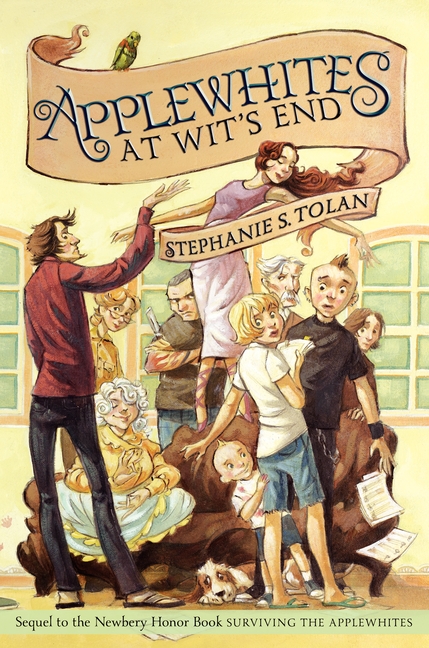
2013 Contenders: Applewhites at Wit's End, by Stephanie S. Tolan

You can think of it as the jumbo-sized version of "let's put on a play and save the old school" -- let's put on a summer camp and save our family homestead! As Applewhites at Wit's End opens, the Applewhite clan -- a three-generation collective of creative types, all but one of whom are family members -- have lost all of their money due to accounting fraud, and are in danger of losing Wit's End, their combination home/studio/playhouse, which they've built from an abandoned motor lodge. In order to raise the required money, they hit on the idea of running a summer camp for creative children, even though none of them have any experience at all in doing so.

It's all a setup for a warmhearted and terrifically funny excursion, seen alternately through the eyes of E.D., a 13-year-old girl who's the only one of the Applewhites without a creative talent, and Jake, a teen with a troubled past whose luck and outlook have changed since being taken in by the Applewhites. The book works as an ensemble comedy, a paean to creativity, and even as a bit of a mystery story. The setting and references are firmly present-day, but in its spirit and tone, it reminded me of a lost classic from the past, something that would sit comfortably on a shelf alongside Pippi Longstocking, Ginger Pye, and The Story Girl. It's the kind of book that I firmly believe I would have loved as a child -- and that, even as an adult, I genuinely enjoyed reading.

The novel is a sequel to Stephanie S. Tolan's 2003 Newbery Honor book Surviving the Applewhites. I haven't read that one, but I didn't find that it mattered. The tongue-in-cheek front matter, which includes a family tree and an introduction to the "cast of characters," served well enough to acquaint me with the Applewhites, and the few plot points from the earlier book that seemed to make a difference were quickly recapped in the text. At no point when reading it did I feel that it didn't stand alone.

As a side note, it occurred to me that, if Mary Higgins Clark or John Grisham take ten years to write a sequel, people are often willing to accept that -- but if a children's author takes ten years, the original audience has grown up, and so needs to some extent to be rebuilt. Perhaps this is one reason that Tolan was so careful to make the book easy to read for someone unfamiliar with the earlier work.

Official publication is in May through HarperCollins Children's Books. I'm putting this one on my Newbery short list. I don't know if the committee will be willing to give the award to a humorous book twice in a row, but I'd be intensely surprised if it didn't at the very least make the Notables list.

Friday, February 10, 2012

The Winner's Circle: Smoky, the Cowhorse, by Will James (1927)

There's a recency bias to superlatives. We all want to say that something we've just seen is "the best ever" or "the worst ever." However, in my humble opinion, if we want to talk about the worst ever winner of the Newbery medal -- or, indeed, the worst year for American children's publishing in the Newbery era, we have to go back to the year 1926, which was capped by the awarding of the 1927 Newbery Medal to Smoky, the Cowhorse, by Will James, AKA, the man keeping Jack Gantos company in the Newbery Winners Who've Served Time club.

Smoky narrates, in excruciating detail, the life of a horse. Not just an incident in the horse's life, or some condensed bit of action, but years and years of equine life. The horse is nonanthropomorphic, and lives much of his life out on the range, which means that for huge stretches of the book, there's a real limit on the number of human characters.

This can be done, and done well -- The Incredible Journey is a good example. But that book has a specific narrative arc, something that imposes structure on the silent life of animals. Smoky, a largely episodic novel with terrible pacing, has some kind of overall narrative involving Smoky and Clint, the human who eventually becomes his owner, but huge portions of the book have little or nothing to do with that.

It's also a highly problematic book in that the human villain is referred to as "a halfbreed of Mexican and other blood that's darker," or, for short, "the breed," and is given no redeeming characteristics of any kind. Overt racism is all too common in children's books from the 1920s -- there's a reason that you can't purchase an unexpurgated version of The Voyages of Doctor Doolittle, after all -- but it's extremely uncomfortable, especially since the book doesn't offer much in the way of compelling plot or characters that would give a reader reason to even try and overlook the negative racial aspects.

And yet. as truly dreadful as Smoky, the Cowhorse is, I'm hard-pressed to say what should have won the award instead. The one unquestioned classic children's book published in 1926, Winnie-the-Pooh, was written by A.A. Milne, an Englishman, and so was ineligible. Hugh Lofting churned out number eight in his series, Doctor Doolittle's Caravan, but even Lofting's fans don't remember that as one of the better titles. Margery Williams, in the stretch of her career between her 1922 breakthrough with The Velveteen Rabbit and her 1937 Newbery Honor for Winterbound, published The Apple Tree, but that's such a minor work in her career that it's all but forgotten. Most of the other major children's authors working at the time simply happened not to publish anything that year. Famously, 1927 was one of the three years in which no Honor books were named, and it appears that there may have been a good reason. (Rachael found a fascinating article that indicates that the Doctor Doolittle book and Smoky are the only two children's books published in '26 that a) were eligible for the Newbery, and b) were still in print in 2001. Given that one was still in print because it was in a famous series, and the other was in print because it won the Newbery, that's not much of an endorsement for the year.)

If I were forced to guess, I'd bet that The Apple Tree would have been a better choice for the award, simply on the theory that even a mediocre Williams title would be better than the dreck that is Smoky. But what I think requires no guessing is that there was a very real reason that the ALA thought an award to encourage publishers to print good children's books needed to be established, that reason being that American children's literature in the 1920s was Not Ready For Prime Time. The 1927 award is the one that best illustrates this point, but it's only the most obvious of several early examples. (I'm looking at you, The Cat Who Went To Heaven.)

Anyway, it's nice to be able to look back and see how far we've come, but that's about the only thing that can be said for Smoky, the Cowhorse. I can really only recommend it for people trying to read all the Newberys, and even then, I'd save it for the end.

Thursday, February 9, 2012

2013 Contenders: The Moon Over High Street, by Natalie Babbitt

Anton Boulderwall is an aging inventor and factory owner who lives in the best house on High Street, the fanciest thoroughfare in Midville, Ohio. Myra Casimir is a schoolteacher who also lives in Midville, but in a much more proletarian neighborhood. And Joe Casimir is a boy who comes to stay with Myra, his distant relative, while his grandmother is recovering from a broken hip, only to find himself the unlikely focal point of Midville's class tensions. Mr. Boulderwall wants to adopt Joe and leave him the factory -- but this would require Joe to move to High Street and turn his back on his dreams of becoming a scientist who studies the moon.

It's all fine as far as a setup goes, a sort of more fraught take on Charlie and the Chocolate Factory or something of that nature. However, the execution leaves a fair amount to be desired. The theme of rich vs. working class (no one in the book is really "poor") is hammered into the ground by the dialogue and narration, and especially by Mrs. Boulderwall, a humorless shrew who exists largely to make derogatory statements about Joe such as "He's just not our kind of people" and "He's nothing but hired help to me." Even the book's title is less an indication of the setting than an unsubtle hint as to the direction in which Joe finally chooses to go. And, though Joe is the one who makes the decision, he's not the one who tells Mr. Boulderwall -- that falls to Gran, in a scene in which she and Mr. Boulderwall spend six pages trading cliches while the nominal hero of the book is offstage.

Although Mr. Boulderwall appears displeased with the result of that conversation, it's hard to see why. Mr. Boulderwall seems to have little interest in Joe as a person -- he likes Joe because of their shared Polish ancestry, and he finds it convenient that Joe's parents aren't living, but that's about it. Frankly, I found the section in which he insists that Mrs. Boulderwall set up another meeting with Joe without giving her any reason other than "I just want to see that boy again" more than a little creepy. However, Myra isn't a whole lot better; she tells Joe flat out that she sees him as some sort of substitute for the fiancee she lost in the Korean war, a man also named Joe. Only Beatrice, the girl next door, seems to have an interest in Joe that's based on anything internal to him.

Natalie Babbitt is, of course, a well-known figure in the world of children's literature; Tuck Everlasting is a minor classic, and Knee-Knock Rise won a Newbery Honor in 1971. I think this book will get a long look because of its author's track record -- many people had high hopes for it -- but I don't anticipate it showing up on any end-of-year shortlists or placing for any of the major awards.

Official publication in March through Michael Di Capua Books/Scholastic

Wednesday, February 8, 2012

2013 Contenders: Jake and Lily, by Jerry Spinelli


I hope it's not bad form to review a book that doesn't come out until May, but I couldn't wait. 

Jake and Lily are twins – the spooky kind. They hear each other's thoughts, sense when the other twin is in danger, and, most magically, sleepwalk together every year on their birthday. Lily wants to believe that they are a matched pair – alike in every way – but Jake has his doubts. In the summer of their eleventh year, Jake finally moves into his own bedroom, and the twins begin the painful process of differentiation.

I was hooked from the first chapter, which is narrated in alternating lines by the twins. The immediacy, wit, and authenticity of the language quickly establishes both the closeness of the sibling relationship and the conflict just beneath the surface. The twins take turns narrating subsequent chapters – first as a collective memoir, and then, after Jake moves out, as entries in separate journals. This structure ingeniously mirrors the plot: as Jake and Lily grow apart, so do their stories. The theme of belonging vs. differentiation is echoed in the story of their ex-hippie grandfather, Poppy, and in a tense subplot about a local bully. Vivid imagery grounds the book firmly in a sort of suburban every-town, and also amplifies the sense of wonder during the interludes of magical realism. 

I have only a couple of quibbles. First, the book seems too long by about fifty pages. It bogs down in the last third, and the slow pace combined with the urgent tone reminded me (not in a good way) of Keeper, by Kathi Appelt. I would also like to have gotten to know the parents better. Mom and Dad are written nearly identically, which is ironic, given the context. 

Overall though, Spinelli has written another winner.


HarperCollins - May 2012

Monday, February 6, 2012

The Winner's Circle: Island of the Blue Dolphins, by Scott O'Dell (1961)

Sometimes, in literature as in life, it is after one has lost everything that one finds the greatest strength. And so it is in Scott O'Dell's Island of the Blue Dolphins, one of the loneliest children's books ever written -- and whose heroine, Karana, is one of the strongest protagonists in all of children's literature.

The list of obstacles Karana must overcome is stunning. Her mother is dead before the book opens, and her father and most of the men in her tribe are killed in a skirmish with the Aleuts on page 23. The rest of the tribe, including her sister, sail away for the mainland, but Karana realizes her younger brother has been left behind and swims back to shore to take care of him. However, he is killed by a pack of wild dogs seven pages later, and for almost the entire rest of the book, Karana is the only human character. Left with no companionship or assistance, needing to master skills that her culture had barred her from learning for gender reasons (such as weaponmaking), and having no timetable at all for rescue, Karana not only doesn't curl up and die, but overcomes every challenge that the world can throw at her.

And so, on the one hand, Island of the Blue Dolphins is the ultimate survival story, one more impressive than Robinson Crusoe, The Swiss Family Robinson, and Hatchet put together. On the other, it's a meditation on transience and loss, on appreciating beautiful moments while knowing that they can't be preserved. Karana's dog, Rontu, becomes her constant companion and partner in exploration -- but he grows old and dies well before the novel's end. One summer, when the Aleuts return to hunt otters, they bring with them a girl named Tutok, who becomes Karana's secret friend -- but she leaves with the others at the end of the summer and never returns. Throughout the book, Karana comes across places and items on the island that once had significance to her people, but she doesn't know the stories that go with them and has no way of obtaining them.

There's a sadness here that extends well beyond the margins of the pages. There is a real Island of the Blue Dolphins: San Nicolas, one of the Channel Islands off the coast of California. There was a real woman who lived there in isolation for eighteen years after being left behind when the rest of her tribe evacuated the island. "Now that the white men had come back," Karana says in the last chapter, after the ship finally arrives for her, "I could not think of what I would do when I went across the sea." And we know, though Karana does not, that there is almost no answer to that question; within two months of the real Lone Woman of San Nicolas Island's rescue, she was dead of dysentery. The missionaries called her Juana Maria, but what she called herself is lost -- by the time of her rescue, all of the other members of her tribe were dead or gone, and no one who could speak her language could be found. (O'Dell's sequel to Island, Zia, does present an alternate history in which at least a few of the tribe's members survive.)

And yet, however tragic Karana's story may be, she is undefeated by it. She describes the small joys that her lonely life provides with utter sincerity, and though the novel's tone is melancholy, it never becomes bitter or nihilistic. Even when the rest of the world has abandoned her, Karana finds value in her animals, her crafts, her hand-constructed home on the headland. Her life has intrinsic meaning, which remains even when all extrinsic meaning is gone.

As for the novel's Newbery award, I'd say it's richly deserved. The best-remembered of that year's other books is probably The Cricket in Times Square, which I read as a child and enjoyed, and which remains a much-loved classic, but doesn't have the same emotional heft as Island of the Blue Dolphins. This is a powerful book, and one that more than earned its Medal.

Wednesday, February 1, 2012

2013 Contenders: The Wild Book, by Margarita Engle

One of the best things about Margarita Engle in general, and The Wild Book in particular, is her keen eye for detail. The slim verse novel is loosely based on the life of Fefa, Engle's grandmother, and it's clear that Engle paid close attention to the stories that her grandmother told.

The Wild Book details the life of a girl with dyslexia in the uncertain world of 1912 Cuba, and the descriptions of the everyday details of that time and place are startlingly observant. When she speaks, for instance, of encountering during a family camping trip "the coiled tunnels / hidden in trumpet-shaped / seashells," the vividness of the imagery is undeniable. Additionally, the book creates a sympathetic and realistic portrait of a child struggling to come to terms with and overcome her learning disability when such things were poorly understood.

I did wish I had a better view of the other characters in the book. Fefa is clearly drawn, but aside from Mamá, and to some extent Fefa's brother José, the other characters seem one-dimensional or vague. Some of that is understandable, given how much of the action takes place in Fefa's head, but I did find myself wishing at times that the other people in her environment were captured with as much detail as the daily events and surroundings of Fefa's life, which were truly beautiful.

I think this is a long shot for the Newbery, though it wouldn't surprise me if it shows up on the Notables list. I do think it's a very real candidate for both the Schneider and the Belpré, and I'd keep my eye on it, especially after its official publication in March.