Showing posts sorted by date for query mr bunny. Sort by relevance Show all posts

Tuesday, December 4, 2018

Rachael's Departure and Greatest Hits

It's with a heavy heart -- but also with a lot of gratitude -- that I announce that Rachael Stein, who co-founded this blog with me back in January 2012, will no longer be contributing in this space. She's moved to the exciting (and important!) world of correctional libraries, and won't be involved in children's services in her new position, and so she felt it was time to step away from For Those About to Mock.

I could tell you about the professional debt I owe her, how I probably wouldn't have become involved in ALSC, or participated in the Morris Seminar, or known half of what I know about children's literature without her. But instead, I'd like to invite you to take a stroll back in time to revisit some of her greatest hits.

- Rachael was (and is) a huge fan of Jeanne Birdsall's Penderwicks books. In her review of The Penderwicks in Spring, which was Rachael's most-read post of all time, she provides a thoughtful, nuanced examination of the penultimate volume in that series. Also worth a second look is her final review for this site, a discussion of the series' conclusion, The Penderwicks At Last.

- I always appreciated Rachael's ability to defend her opinions about books, even if they were a bit out of the mainstream. To take two stellar examples, witness her argue for the Newbery eligibility of Tom McNeal's Far Far Away, and then thrill to her encomium of the "only skink" in her review of Polly Horvath's Mr. and Mrs. Bunny -- Detectives Extraordinaire! 

- Rachael's writing was often at its most entertaining when she encountered a book she really didn't care for. One of my favorite instances is her review of The Island of Dr. Libris, by Chris Grabenstein ("...if you hand it to to the literary-minded kids you know, I won't even judge you. Much."). And then there's her legendary look back at Eric P. Kelly's 1929 Newbery winner, The Trumpeter of Krakow, which she at one point refers to as "Project Runway: Medieval Krakow."

Farewell from this space, Rachael! The correctional library is lucky to have you!

Wednesday, April 16, 2014

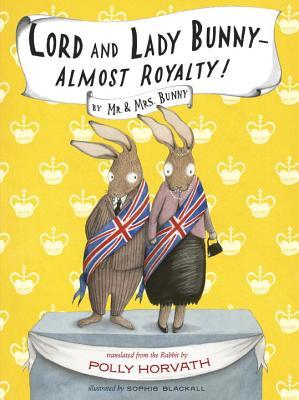
2015 Contenders, Point/Counterpoint Edition: Lord and Lady Bunny - Almost Royalty! by Mr. and Mrs. Bunny (Polly Horvath, translator)


Point: Tess Goldwasser, Rabbit Enthusiast and Children's Librarian, St. Mary's County Libary

In the thrilling sequel to Mr. and Mrs. Bunny Detectives Extraordinaire, Mrs. Bunny longs for a new hat, which, of course, means a new occupation (you’ll remember the Bunnies became detectives mainly for the fedoras). What does Mrs. Bunny want to be? Queen. Of course. So begins the laugh-after-laugh shenanigans of Lord and Lady Bunny: Almost Royalty.

In order to achieve Mrs. Bunny’s dream, our heroes must travel to England. They board a cruise ship, only to run into their dear friend Madeline! Madeline (we’ll remember) is the clever daughter of neo-hippies Flo and Mildred, who happen to also be traveling to England, as they’ve inherited a Sweet Shoppe, and Flo believes the universe wants him to spread a love of sugar as far and well as he can, after ingesting a fortuitous box of pop tarts.

And that’s not all! Along Mr. and Mrs. Bunny’s journey to almost royalty, there are appearances from most beloved characters from the first installment, like Mrs. Treaclebunny, and a certain expert in animal communication (and rare coins apparently), as well as JK Rowling, Polly Horvath herself, everybody’s favorite floss-appreciating Prince of Wales, and some extremely stuck up hedgehogs.

It all sounds ridiculous, but would we want anything less from a book about bunnies by Polly Horvath? Bottom line: the book is smart and sweet. It’s genuinely funny, and while some of it may go over kids’ heads, the Newbery basically defines “child appeal” as appealing to any child, not all, or even most, children, and I personally know a lot of savvy children who will love this book (probably many of the same who enjoyed Flora and Ulysses).

Now, I turn it over to Rachael, who will discuss the experience of listening to Bunnies on audio, (and cover any points I missed)

Counterpoint: Rachael Stein, Blog Slacker and Audiobook Listener


Devoted About to Mock readers may remember that I loved Mr. and Mrs. Bunny - Detectives Extraordinaire!  They may also remember, however, that I called it an "Only Skink," by which I meant that it was... difficult to categorize. Difficult to evaluate. Difficult to shoehorn into any given set of awards criteria. I can muster up some sympathy for the casual reader who picks up Mr. and Mrs. Bunny, not knowing what she is in for. In for what she is. For what she is in? 

If you've returned for a second helping of Horvath's lunatic lapine world, however, you deserve exactly what you get. And what do you get, exactly? More! More bunnies, more hippies, and more royalty - plus vegetable candy, uppity hedgehogs, and a trip to jolly olde England. As Mrs. Bunny notes, travel is terribly educational: “And Mrs. Treaclebunny has promised to speak English from now on as well. In fact, she said when she goes to England, that's all she speaks anyway because the animals speak English there. She says anyone who has read children's books with animals in them set in England would know that. Is The Wind in the Willows written in Mole with a little Ratty thrown in? Is Winnie-the-Pooh written in Bear? No, it's English, because that's what the animals there speak. I didn't know that before. Travel is so broadening.”

Polly Horvath narrates the Lord and Lady Bunny audiobook herself, and I'm afraid she's a bit of an Only Skink in this area as well. As a new member of the ALSC Notable Children's Recordings committee, I'm learning to evaluate audiobooks according to performance and production, rather than plot and character. With my committee member hat on, I'm forced to concede that Horvath's narration is a little breathy and her character voices are inconsistent. Compared to someone like Katherine Kellgren, she's kind of amateurish. When I put on my avid listener hat, though, I must make the argument that none of those things matter in this case! No one but Horvath could adequately narrate these books, and in its own Skinkish way, her narration is pitch-perfect. As the people who heard me laughing out loud in the grocery store can attest - not to mention Sam, who had to put up with me walking around the house saying, "I'm, like, the Dalai Lama of sugar!"

So there. 

You're not going to see this one on the Newbery list, nor, most likely, on the Notable Recordings. Oh well. As Polly Horvath's fictional counterpart says, "Life is cruel. Carry chocolate bars." 

Published in February by Schwartz and Wade and Listening Library.  

Wednesday, November 13, 2013

2014 Second Takes: Flora & Ulysses: The Illuminated Adventures, by Kate DiCamillo

If there's one thing that I find myself thinking about over and over in the course of writing about books, it's that comedy is terrifically hard to evaluate. And here, with Flora & Ulysses, that again comes into play. Is it funny? I thought it was hysterical, but if you're, say, the kind of person who found last year's Mr. & Mrs. Bunny - Detectives Extraordinaire! overly weird, you're unlikely to agree with me.

As Rachael mentioned in her review, the bits where Ulysses the squirrel writes his poetry are simply beautiful. There's a real emotional center to this book -- as ridiculous as a lot of it is, it isn't just a pile of jokes. That mixture of poignancy and silliness is pure DiCamillo, and though sometimes that feels manipulative to me, I think she pulls it off in Flora & Ulysses.

There was one thing that did bother me, though. I'm starting to grow weary of books that give their characters obsessions with Treasure Island, or Heloise's Hints, or that old standby, the dictionary. There are times where it's effective, but too often, it feels like a writing shortcut to give characters a memorable quirk. Flora is a huge, huge fan of a comic series starring The Amazing Incandesto (as well as its associated "bonus comics"), and I didn't feel like that was particularly effective. It would have been a better book, I think, if DiCamillo had fully trusted the humor and the poetry to carry the novel, rather than shoehorning all the comic book stuff in there too.

Anyway, I think Flora & Ulysses is still quite good, and I think it would be one of the easiest sells to a child reader of anything we've discussed on the blog this year. Even aside from the question of its illustrated nature, however, I don't think it's going to be in the running for the year's major awards.

Friday, September 13, 2013

2014 Contenders: Flora and Ulysses: The Illuminated Adventures, by Kate DiCamillo


16052012Last spring, Jack Gantos and I were hangin’ out, shootin’ the breeze*, and talking about which new kids’ books we liked. He said that he really liked Mr. and Mrs. Bunny –Detectives Extraordinaire, partly because Horvath’s animals are smart. He remarked that just because your characters are animals doesn’t mean that they have to be dull-witted. I think he actually used a funnier word than that, but it’s been too long and I don’t remember what it was. If you see him around, ask him about stupid animal stories. 

Anyway, I think that’s what turns a lot of people off about talking animal stories – they associate the genre with cutesiness, preciousness, and simpleminded characters. That stereotype has a basis in reality, of course, especially in picture books. There are some authors who seem to think that if your story stinks, moving it to the animal kingdom will disguise the smell. 
 
Needless to say, Polly Horvath doesn’t fall into that trap, and neither does Kate DiCamillo. I thought of Horvath’s bunnies when I was reading DiCamillo’s newest, Flora and Ulysses, because the two books share a certain sensibility. As the Horn Book review of Mr. and Mrs. Bunny advised, “Look not for logic; this is a romp.” That advice holds true for Flora and Ulysses, whose plot is set into motion when a giant, multi-terrain vacuum cleaner sucks up an ordinary squirrel. Ulysses the squirrel, when resuscitated by Flora, retains extraordinary non-squirrellish powers (mainly flying, understanding human speech, and typing).

It is in the content of Ulysses’s typed compositions, however, that the novel diverges from the “madcap romp” genre. This wouldn’t be a Kate DiCamillo novel if it didn’t whack you in the head with pure beauty when you’re least expecting it. So what does a squirrel write, in DiCamillo’s world, when awakened from his dumb animal nature and presented with a typewriter? Why, he looks around at the trees and sky he loves, and at his new friend, and he writes poetry : “I love your round head / the brilliant green / the watching blue, / these letters, / this world, you.”

And then, because this is still a comic novel, he adds a postscript: “I am very, very hungry.” 

Until that poem appeared, I thought this novel was just okay, but that’s just so exactly the kind of poem a newly reverent squirrel would write that, once again, I found that Kate DiCamillo had totally pwned my heart.

I think this one may have a hard time at the Newbery table. It has those gorgeous DiCamillo moments – Ulysses’ poems, Flora’s struggles with her feelings, her father’s loneliness and awkwardness… But it’s also a comedy, and it doesn’t have the kind of character development you see in, say, The Year of Billy Miller. In Flora and Ulysses, the characters are cartoonish, and I think that’s an appropriate stylistic choice here, but it may count against them when it’s time to vote. Then, too, I’m not sure the sentence-level writing is all that special, for the most part, when compared to Billy Miller or Hokey Pokey. Neither are the settings. Thematically, it shines, but that may not be enough. 

And I should mention the illustrations. These are the “illuminated” adventures of Flora and Ulysses, meaning that some of the plot is advanced by comic strips drawn by K.G. Campbell. They tie in thematically with Flora’s interest in comics and superheroes, but they mean that the book could fall into the same liminal space occupied by Brian Selznick, though not to the same extent.

In any case, I like it a whole lot, and I think Jack Gantos would too.


*Okay, fine. He was here for an author visit and we were waiting for a class to arrive. 

Publication in September by Candlewick Press

Tuesday, January 8, 2013

Digressions: Okay for Newbery

Meanwhile, on Google chat... 

Sam:  Man, I hope Wonder doesn't win.

Me:  I think it probably won't, but I would actually rather have Wonder win than something that's both flawed and unappealing. coughsummerofthegypsymothscough... 

Sam:  Gah. I'm trying to think how many of this year's books I'd actually be ok with winning.

Me:   Good question!

It is a good question, isn't it? At some point in the discussion and voting process, I guess that's what the committee members have to decide: not only which book they're pushing for, but which ones they would accept as winners. Which books would leave them at the "I'm not super excited, but I am at peace with this choice" level on the consensus meter.

For me (and these are, of course, my feelings prior to the Mock Newbery discussion next Monday, so everything is subject to change), the list looks something like this. 

Top Choices (totally behind any of these; smiley face on the consensus meter) 
  • Twelve Kinds of Ice (my actual first choice right now)
  • Splendors and Glooms
  • Liar and Spy
  • Starry River of the Sky
  • Mr. and Mrs. Bunny, Detectives Extraordinaire 

Second Tier (wouldn't go away from the table seething; "meh" face on the consensus meter) 
  • Wonder
  • The One and Only Ivan
  • No Crystal Stair
  • Crow
  • Moonbird

I won't go into my third tier. I've already mentioned my non-fandom re: Summer of the Gypsy Moths, but to delve further would be petty. 

How about you guys?

Monday, January 7, 2013

2013 Contenders: Penny and Her Song, by Kevin Henkes

Some of the best-known and best-loved American children's books are easy readers. However, if you added up all the Newbery mentions given to The Cat in the Hat, Are You My Mother?, Owl at Home, Bread and Jam for Frances, Sammy the Seal, and There Is a Bird on Your Head!, you wouldn't even have to use any fingers to tabulate the result. In fact, outside of the Honor taken by Frog and Toad Together in 1973, the list of easy readers on the Newbery rolls is essentially blank.

Sure, since 2006, we've had the Geisel award, which is devoted specifically to easy readers. And sure, it's hard to separate the text of many of the best easy readers from the illustrations. Still, given how insistent the Newbery criteria are about including books for the entire age range from birth to fourteen, it's interesting that almost every committee has elected not to give even the most distinguished easy readers a nod.

Back at the beginning of 2012, there were some rumblings that perhaps Penny and Her Song would be the book to break that streak. As the year went on, those noises got quieter, and at this point, almost nobody is predicting that the book will pick up any non-Geisel awards.

Maybe it has to do with the fact that it's so much harder to hit many of the Newbery criteria in the limited space available in an easy reader. Penny has great characters -- the excited but obedient title character, her kind parents, her baby siblings who serve as the book's source of understated humor. But are they as beautifully and incisively drawn as those in Liar & Spy, or Splendors and Glooms, or even Mr. and Mrs. Bunny? I don't think that's even a real question.

That this is a function of the format rather than the author is borne out by a look at Kevin Henkes' middle-grade novel from last year, Junonia. That one was one of our finalists at the Maryland Mock Newbery, and though it didn't end up winning anything (either there or in the Newberys proper), it did make the Notables list, and it certainly rated very highly in each of the Newbery criteria. Is that because it's an objectively better book than Penny and Her Song? I don't think it actually is -- it's just longer, and has more room to develop its characters, setting, and themes.

The more I think about it, the more I'm puzzled as to what an easy reader Newbery winner would even look like. Are You My Mother? and Green Eggs and Ham are classic books, ones read and beloved by generations of children, but to win the Newbery, either one would have had to beat The Island of the Blue Dolphins. The year that The Cat in the Hat was eligible, the winner was Rifles for Watie. That one was on my list of Newbery mistakes, but would I take The Cat in the Hat over Gone-Away Lake, another classic that was eligible in that year? That seems to me to be a tough position to take, especially since the Newbery criteria mean that one can't give any weight to Dr. Seuss's iconic illustrations. It might just be that, given the rules as they're currently constituted, there isn't an easy reader that could win.

So maybe it's a good thing we have the Geisel award now, a place to recognize the best easy readers and discuss their unique strengths. Though I don't imagine Penny and Her Song will make a Newbery appearance, I'll be looking for it (and possibly the sequel, Penny and Her Doll, which also came out this year), when the Geisel awards are announced.


Published in February 2012 by Greenwillow / HarperCollins

Wednesday, December 19, 2012

2013 Second Takes: Splendors and Glooms, by Laura Amy Schlitz

Splendors and Glooms requires my single least-favorite kind of review to write. It's fun to write about books that I love, or even about books that I hate. Even writing about books that are interesting but flawed can lead to discussions about what makes a book work or not work. But what of a book where the reaction is "it's perfectly fine, I'm just the wrong reader for it?"

I think of Laura Amy Schlitz as both the most British and the most 19th-century of our contemporary American authors. In Splendors and Glooms, she manages a pitch-perfect homage/update to the Victorian Gothic, with heavy doses of Charles Dickens mixed in. The characters are real and vivid, and the settings -- both the grime of London and the wild beauty of Windermere -- are detailed and well-described. It's distinguised writing, no question of that.

The book's flaws are the kind common to the source genre, and some readers will probably think of them as features. The pacing is phlegmatic, and the narrative takes a long time to get going, and even longer to wind down. Despite the fact that it's a book with an action-oriented plot structure, it's not the kind of thing you enjoy if you're in a hurry to get where you're going. The more you enjoy spending time in the world that Splendors and Glooms creates, the more you'll enjoy the winding road through it.

As for me, I'm not a big fan of Victoriana, and I prefer my fantastical adventure novels either more introspective or more unsettling. Rachael is much closer to the optimal reader for Splendors and Glooms, and her review of it was highly positive. Monica Edinger and Nina Lindsay were also lavish in their praise. Nina did observe, "This seems to be a “love it or hate it” title, and if you’re not loving it, it asks a lot of you." I'm not loving it, and I felt like in the end, it asked too much of me. However, that's a function of the intersection between book and reader, not of any overt problems with the book itself. It actually fits the Newbery criteria quite well, especially in "delineation of a setting" and "delineation of characters." I don't think it's as exceptional as Mr. & Mrs. Bunny, The One and Only Ivan, or Twelve Kinds of Ice, but that's not at all to label it as bad or unworthy. It's quite good -- it's just that it's quite good for Someone Else.

Friday, November 16, 2012

Housekeeping: The Ones We're About to Mock

We weren't going to publish this until Monday, so we're a bit ahead of the game, but Sam and I have settled on a final reading list for the Maryland Mock Newbery (to take place on January 14 at the Caroline County Public Library - register at the Maryland Library Association website, email any questions to Rachael, etc., etc.)!

For those who wish to mock with us, please run out and try to get your grubby hands on the following titles:

  1. Liar and Spy, by Rebecca Stead
  2. Mr. and Mrs. Bunny - Detectives Extraordinaire! by Polly Horvath
  3. Splendors and Glooms, by Laura Amy Schlitz
  4. The One and Only Ivan, by Katherine Applegate
  5. We’ve Got a Job: The 1963 Birmingham Children's March, by Cynthia Levinson 
Why these five? Well, we took a couple of factors into account.

1. None of these books were published later than August. We know it can be difficult to find copies of books published later in the year, so no Twelve Kinds of Ice for us.

2. We wanted an assortment of titles that will generate the liveliest, most thoughtful discussion possible, so we chose books that represent humor and seriousness, fiction and nonfiction, and both ends of the Newbery age range.

We had to leave a lot of great titles by the wayside for various reasons. We know Wonder is at the top of many people's lists. We like it too, but both of us feel that the five titles above are even better. Hey, it's a strong year.

Conversely, these five titles do not represent the definitive Top Five of the year for either Sam or me (maybe we'll post those lists in January). We had to compromise on a couple of things in order to provide for the best possible discussion. 

Wednesday, November 14, 2012

2013 Second Takes: Moonbird, by Phillip Hoose

Sam is very picky about his nonfiction - specifically about whether it has that ineffable spark that elevates it to literature. He thinks very highly of Moonbird - highly enough that he used the big L word (no, not that one). I'm not sure I agree.

I see where Sam is coming from in terms of Hoose bringing the personal into nonfiction. The best nature writing - some of the best literary nonfiction in general - employs that technique, but it doesn't often make its way into children's books. When's the last time you read a juvenile informational book that used the first person singular outside of the author's note? Hoose does set himself apart by weaving his own experiences into the story of B95 and the other red knots.

Does he do it in the most distinguished way, though? I don't think so. Stylistically, this book falls on the "good" side of the good/great divide. The settings are described vividly, the organization is effective, the profiles of people working in the field add texture... but none of it really thrilled me. I wasn't captivated by  B95's plot arc in the way I was while reading about the plight of the Titanic and the quiet triumphs of Temple Grandin.

And what about character? Hoose does an excellent job of turning an unassuming little shorebird, B95, into a literary hero, and thus giving the reader a point of interest to follow through the book. But how does B95 compare, as a character, with Mr. and Mrs. Bunny? With Parsefall and Lizzie? With Georges and Safer? Not very well, I would argue.

Sorry, Moonbird. If you're still alive, I hope you're not crying little Patagonian birdy tears of literary unworthiness all over the restinga. You're still the star of a very good book.  


Friday, October 26, 2012

Individually distinct.

"Any work of art which is not a beginning, an invention, a discovery is of little worth. The very name Troubadour means a 'finder,' one who discovers." -Ezra Pound

According to the Newbery Medal terms and criteria,

“Distinguished” is defined as:
• Marked by eminence and distinction; noted for significant achievement.
• Marked by excellence in quality.
• Marked by conspicuous excellence or eminence.
• Individually distinct.
 I started thinking about that last definition after writing my most recent post. Which are the individually distinct titles of the year - the ones that aren't Another Folksy Missing Mom Book or Another Victorian Thriller? The titles that are "making it new," as Pound exhorted?
  • Mr. and Mrs. Bunny. Yes, it falls firmly within a tradition of tongue-in-cheek nonsense, following in the slightly unstable footsteps of Norton Juster and Daniel Pinkwater. But it's not quite like anything else, is it? After all, it's translated from the Rabbit. 
  • Starry River of the Sky. As I noted, it's not really like anything else, except for its companion book, Where the Mountain Meets the Moon. Nothing else that I can think of is both folklore and meta-folklore in quite the same way. 
  • The One and Only Ivan. Children's lit is full of animal rescue stories, of course, but I can't think of one that resembles this one in tone and style - that odd, melancholy hybrid of poetry and prose that makes Ivan's voice so memorable. 
And then there are the ones that Sam has read, and I haven't yet:
  • No Crystal Stair. There are other "documentary novels," but not many, as several people have pointed out in their reviews. 
  • What Came from the Stars. It doesn't sound like it succeeds, but it was at least trying to do something new in its blend of science fiction and realism. 
Of course, being individually distinct is not, in itself, enough to win the Medal, but I always give extra points to authors who are clearly taking a risk. There's also an argument to be made that doing a really, really effective reinterpretation of an old genre/style/plot can be just as effective, but that's another post.

For now, what do you think? What titles are we missing here?   

Thursday, October 11, 2012

2013 Second Takes: Mr. and Mrs. Bunny - Detectives Extraordinaire!, by Polly Horvath

It's really, really hard to describe Mr. and Mrs. Bunny - Detectives Extraordinaire! It exists in a nebulous space between Watership Down and MAD Magazine, and if that doesn't sound like a place that's even possible, I probably would have agreed with you before reading it. This is true even though Rachael's initial review of the book gave me as much of a heads-up as it was possible to provide.

And you know what? It's amazing.

Certainly, in terms of the Newbery criteria, Mrs. and Mrs. Bunny truly excels in its characters. From its questionably competent title characters, to the insufferable Mrs. Treaclebunny, to the perennially exasperated Madeline, each personage who appears in the story is impossible to forget. It's similarly exceptional in setting and style.

If you wanted to criticize the book, the place to go might be to the development of plot critereon. Yes, the book has a plot, but it helps not to think too hard about the plausibility of any given event. However, plausibility isn't the point of the book, and it would require a superlative resistance to Horvath's manic charm in order to complain too loudly on that point.

Mrs. and Mrs. Bunny is a weird, weird book, and it might be one that's not all that easy to build consensus around, especially given how notoriously hard it is to generate agreement on humor. But at the same time, it has some of the same magic that's made novels such as The Phantom Tollbooth and Sideways Stories from Wayside School lasting classics. I need to go through the rest of our semifinal list to see exactly where Mr. and Mrs. Bunny places in my final list, but it's certainly a strong and worthy contender, and a book that I'll probably buy for my daughter for Christmas.


If you have any other thoughts, please feel free to share them in the comments!

Tuesday, October 2, 2012

Semi-Final Reading List: Sam Edition

It's hard for me to believe we're already at this point in the year -- and that we had almost 50 books to choose from for our shortlist. There's a couple more that we may look at when we have a chance (Bomb: The Race to Build—and Steal—the World's Most Dangerous Weapon, by Steve Sheinkin, and Twelve Kinds of Ice, by Ellen Obed come to mind), but for the most part, we're on to the Taking A Closer Look section.

Rachael has already explained the rules, so here's the list of four that she assigned me:

Mr. and Mrs. Bunny - Detectives Extraordinaire!, by Polly Horvath
The One and Only Ivan, by Katherine Applegate
Splendors and Glooms, by Laura Amy Schlitz
Wonder, by R.J. Palacio

To these, I added:

The Lions of Little Rock, by Kristin Levine
Titanic: Voices from the Disaster, by Deborah Hopkinson

All systems are go! Forward full speed!

Wednesday, September 12, 2012

The wisdom of hindsight.

One thing that's difficult for account for in a Mock Newbery - and that is also incredibly frustrating to me as a reviewer on deadline for SLJ - is the way time has a sneaky way of tempering one's critical stance. I'm always glad when I can read books early in the year and then revisit them later on, because my opinion has often changed in surprising ways. Cases in point:

1. Love-love-loved Wonder when I read it, but as the emotional high has faded, the book's flaws have emerged more insistently.

2. Liked Mr. and Mrs. Bunny - Detectives Extraordinaire! just fine on initial reading, but in the last few months it has really grown on me. I keep looking back and thinking, man, that Polly Horvath is really something. (A view shared, I might add, by Jack Gantos: when he came to visit our libraries, that was the only 2012 book he specifically mentioned liking.)

And there are others that have shifted in my esteem - some falling off my Newbery radar entirely, and some creeping steadily towards my personal shortlist.

Maybe this is more of a problem for me than most people. I'll be the first to admit that I am a passionate and capricious reader - tendencies that I try to temper with good, solid, critical skills, but that still get the better of me sometimes.

If I end up on the Real Live Newbery Committee, I'll be interested to see how this plays out. I've even remarked to Sam that I almost wish we gave the award out in June instead of January, so that the committee could have time to let the initial buzz and fervor around certain titles fade away. But maybe they're really good at sequestering themselves from all of that (Moon Over Manifest, anyone?), and I imagine that the discussion, in itself, works to temper overly feverish devotion. 

Here's hoping!

Tuesday, March 27, 2012

2013 Contenders: Mr. and Mrs. Bunny - Detectives Extraordinaire! by Polly Horvath

Ursula K. Le Guin recently wrote an excellent post about literary awards. The whole thing is thoughtful and thought-provoking, but this passage in particular caught my eye:

"I wish we gave literary prizes freely, the way they used to give prizes at the Pet Show at Codornices Park in Berkeley when I was a kid. Every kid in the neighborhood brought their pet, and every pet got a prize, an ad hoc, unique prize: for Soulfulness — for Loud Meowing — for Unusual Spot Placement — for Being the Only Skink…. There was no Best of Breed (in those days there were many mongrels and few breeds), and certainly no Best of Show."

I very much doubt that Mr. and Mrs. Bunny is going to win the Newbery Medal (though I could be wrong - I used to think there was an upper limit for Newbery weirdness, but then a little book about funeral homes, Hell's Angels, and geriatricidal octogenarians made the cut). If there were a literary equivalent of Being the Only Skink, though, Polly Horvath would have it in the bag.

And that gets at the heart of my ambivalence about literary awards. I disagree with Le Guin when she says that in "declaring a book as `the best,' a literary award serves that book. It does not serve literature." When Frederic Melcher and the Children's Librarians' Section created the Newbery award, their explicit intent was "to encourage original creative work in the field of books for children." To that end, I think it has met its goal. It has encouraged excellence in writing (and publishing) for children by rewarding excellence in writing for children (with prestige and increased sales).

In that sense, maybe literary awards are most effective within ghettoized genres. If no one believes there's such a thing as aesthetic greatness within children's literature (or science fiction, or romance), the establishment of an award can create a change in perception on the part of both publishers and readers. 

On the other hand, this is the age of shrinking shelf space and vanishing bookstores. Awards encourage publishers to give riskier titles a chance in the first place, but if they don't garner the Big One, how long do the books stay in print? There will always be a place on the library's shelves for Polly Horvath, but she'll be in and out of Barnes & Noble in the space of a month, if they ever stock her at all. I guess we'd better hold on to our libraries and our children's librarians: loyal defenders of Only Skinks and other oddities.

But I digress. A lot.

Mr. and Mrs. Bunny is really freaking weird, even for Polly Horvath. The fact that she is listed, on the cover, as having translated the book "from the Rabbit" should tip you off. The plot, such as it is, concerns a sensible little girl whose hippie parents have been kidnapped by some evil foxes (who also own Fox Entertainment, naturally). She enlists the help of Mr. and Mrs. Bunny, who have recently taken up detective work (mostly as an excuse to wear fedoras).

I described Polly Horvath to Sam as "Daniel Pinkwater meets Kate DiCamillo," but this one obviously has a pinch of Beatrix Potter, and possibly Kenneth Grahame, thrown in. It's hilarious, surreal, and good-natured (with a touch of bite). I will also note that it's so, so nice to see a woman writing unabashedly in the darkly humorous vein. We need more of that.

Sophie Blackall's illustrations complement the text perfectly. They make me want to buy an illustration from her etsy shop. I do worry, though, that the cute bunnies on the cover will put off the weird little boys who will otherwise love this book. Skink defenders, do your work! 

Published by Schwartz & Wade - on shelves now.