Friday, September 6, 2013

2014 Contenders: Beholding Bee, by Kimberly Newton Fusco

So there's a book out this year that's set during World War II. Its protagonist is a girl who lives with a caretaker; said caretaker is older than her, but not by that much. When circumstances conspire to take the caretaker figure away, our main character is led onward by a ghostly presence, which may just help her find her forever home. Which book am I describing?

All right, pencils down. Did you say Gingersnap? If so, then you're correct. But if you answered Beholding Bee, the most recent title from Kimberly Newton Fusco...then you're also correct.

It's not as if we haven't had two oddly similar books come out in the same year before -- just last year, this was part of our discussion around Glory Be and The Lions of Little Rock. However, the weirdly specific plot points that Gingersnap and Beholding Bee share genuinely took me aback. The books were published only a month apart, by different imprints (though of the same publisher), so it's not a case of plagiarism or anything -- just a bizarre, bizarre coincidence.

At any rate, in much the same way that the similarities between them threw into sharp relief how much better Lions was than Glory Be, the forced comparison makes it obvious how much superior Beholding Bee is to Gingersnap. Where the characters in Gingersnap were flat and ill-defined, those in Beholding Bee are presented in much sharper focus. And, perhaps most importantly, the fact that Beholding Bee is twice as long as Gingersnap means that the ideas get a much fuller treatment in the former, as opposed to the latter book's maddening lack of detail.

 
*SPOILERS*

This doesn't mean that all the plot threads are tied up by the end of the book. Although the supernatural elements come to a natural conclusion, and Bee has made great progress in coming to terms with the facial birthmark that has brought her so much social difficulty, several other strands are left hanging. We don't get to see Bobby's much-discussed return, we don't know what happens to Ruth Ellen's father (who seems to be missing in action somewhere in Europe), and we don't get to see the end of the standoff between Bee and the school bully, Francine. If I had to guess, I'd wager that Fusco is planning to return to this set of characters, and has thus left herself enough room for the sequel(s). I have no problem with that, but it's worth noting that a reader who expects a neat ending will be disappointed.

I quite liked Beholding Bee, and I'd love to see what happens next in the story. As I look at the Newbery criteria, however, I can think of other contenders that are a bit stronger in theme (Penny and Her Marble), presentation of information (Courage Has No Color), plot (The Water Castle), characters (The Hidden Summer), setting (Zebra Forest), and style (The Real Boy). As such, I wouldn't put Beholding Bee in my top tier of contenders, but not because it's a weak title -- just because others are especially strong.


Published in February by Alfred A. Knopf / Random House

Tuesday, September 3, 2013

2014 Contenders: Barbed Wire Baseball, by Marissa Moss

The mass internment of Japanese Americans (and others, including those of German, Italian, and Hungarian descent) during World War II is a low point in the history of the USA. One of the thousands sent to the internment camps was Kenichi Zenimura, a brilliant baseball player and manager whose career had included playing in and organizing barnstorming tours with the likes of Babe Ruth, Lou Gehrig, and Biz Mackey.

Barbed Wire Baseball spends a few pages on Zenimura's early life, but most of the book takes place during his internment. In the harsh desert landscape of the Gila River (Arizona) camp, Zenimura decided to help the other prisoners (who included his wife and two sons) in the way he knew best -- by building a baseball field. It wasn't just any field either, as the book goes to great lengths to show the care and love that Zenimura showered on the facility, which included a carefully manicured infield, grass landscaping, and bleachers for the spectators.

It's an inspiring story, no doubt about it, especially when you take into account some of the information in the appendix, which indicates that Zenimura was able to create a 32-team league within the camp, and also notes that both of Zenimura's sons went on to play professionally in Japan. (In a poetic touch, both played their careers for the team based in Hiroshima.)

The book's text makes some choices I'm not sure I agree with, however. Throughout, it only refers to Zenimura as "Zeni," to the point that it's only by reading the appendix that the reader can even find out the full name of the story's main character. I'm also not sure the decision to include so few details about Zenimura's pre-internment career -- and to confine all information about his life after the first game played on the field at Gila River to a couple pages in the appendix -- serves the subject particularly well. The man meant so much to his sport that he earned the nickname "The Father of Japanese American Baseball," and even if the picture book treatment necessitates brevity, the focus of Barbed Wire Baseball is so narrow that I'm not sure readers will come away understanding Zenimura's importance.

Barbed Wire Baseball is a joy to look at. I love Yuko Shimizu's illustrations, which, astoundingly, are the first she's ever done for a picture book -- I hope we see more from her in the coming years. The book fills a valuable niche, and, quibbles aside, will at least merit consideration from the Notables committee. I think it's clearly a lesser work than the similarly-structured You Never Heard of Willie Mays?!, however, and since I didn't posit any Newbery love for that one, I highly doubt we'll see any for Barbed Wire Baseball.


Published in April by Abrams.

Thursday, August 29, 2013

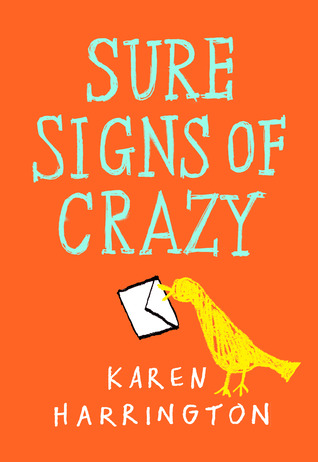
2014 Contenders: Sure Signs of Crazy, by Karen Harrington


Rachael Stein : what category am i describing:

1. talks to a plant, and says it's her best friend

2. loves the dictionary, and peppers her story with definitions

3. tragic past 


Sam Eddington: crappy characters in kids' books?

Rachael Stein: YOU ARE A WINNER 

I wanted to hate this book so much. I've read a lot of middle grade fiction these past few years, and if there's anything I hate more than folksiness that rings false, it's a Quirky Character. They always have tragic pasts, odd habits, and some kind of obsession that allows the author to frame the story in terms of word definitions, or household hints, or whatever. They always make me picture the author sitting in a writer's workshop, slaving away over a character sheet. 

Sarah, the twelve-year-old protagonista of Sure Signs of Crazy, is Quirky all right. Tragic past? Mother tried to drown her in the sink when she was two, and succeeded in drowning her twin brother. Also, her father drinks a lot of Jim Beam. Odd habits? Talking to a plant and writing letters to Atticus Finch. Obsession? The dictionary. She keeps a list of what she calls "trouble words" - words that "will change the face of the person you say it to." A few pages in, I couldn't see this story going anywhere good. 

I stuck with it though, and it didn't even take very long to win me over. I still think some of the Quirks should have stayed behind on the character sheet (though I was kind of attached to Plant by the end), but as artificial as she should seem, Sarah's voice is strong and genuine. Her words and her actions ring true, and she makes enough cringe-worthy mistakes to balance out her unusually perceptive letters to Atticus. Every one of the secondary characters is written gracefully as well. I hate when authors fail to respect their own characters, but Harrington writes with sympathy about even the least likeable members of her dramatis personae. That counts for a lot with me. 

The settings are well-realized too. Living in a rental home myself, though not one as bleak as Sarah's, I recognize her descriptions of their less charming aspects (especially the cabinets). When she stands on the stump in her front yard and watches over her small town Texas neighborhood, I can see it clearly too, and she almost makes me like it. 

Sure Signs of Crazy is getting a fair bit of attention, and it's certainly the type of book we think of as a "Newbery book" - missing mother, quirky girl (though not that many of the winners actually fit that profile). Depending on the committee's tastes, I can see it getting quite a few nominations for its distinguished characters and settings, and I wouldn't be surprised to see a silver Honor sticker on the cover next January.
 
Published in August by Little, Brown 

Wednesday, August 28, 2013

2014 Contenders: Becoming Ben Franklin, by Russell Freedman

What can one say about Russell Freedman, the unquestioned dean of American children's nonfiction writers? The man could fill a room with his awards, which include a Newbery (Lincoln: A Photobiography, 1988) and three Honors (The Wright Brothers, 1992; Eleanor Roosevelt, 1994; The Voice that Challenged a Nation, 2005); a Sibert (The Voice that Challenged a Nation, 2005) and an Honor (Lafayette and the American Revolution, 2011); a ridiculous five Golden Kites; the 1998 Laura Ingalls Wilder Medal; and a National Humanities Medal (2007). We're getting to the point where you could tell me that he has a Nobel Prize stashed underneath his couch cushions and I'd probably believe you.

Anyway, one of the side effects of being the illustration that the dictionary uses for "acclaimed" is that expectations for your work become high. Very high. Maybe unreachably high, which brings us to Freedman's latest effort, Becoming Ben Franklin.

BBF covers Franklin's entire life, from his birth in Boston to his death 84 years later. Freedman tries to give a balanced view of Franklin's dizzying array of accomplishments as a statesman, scientist, inventor, author, and printer -- and he largely succeeds. I've read a good deal of Franklin-related material, including his Autobiography, and Freedman does about as well in condensing his subject's incredible life into a children's book of less than 100 pages as I think it's possible to do.

However, I do have some quibbles with the book. The first chapter seemed weak to me, as it didn't leave me with the knowledge of why I should care about Franklin's life. That's not a huge issue for me as an adult reader, but for a child, who may not know a whole lot about who Franklin was, I really feel like more of a clearly stated thesis would be helpful up front.

Additionally, there is at least one instance where I'm not sure about the exactitude of the facts. On page 75, Freedman states, "Slavery in the United States would continue until America's Civil War and Abraham Lincoln's Emancipation Proclamation of 1863." However, that's not actually true -- famously, the Emancipation Proclamation only freed the slaves in the Confederate states, and the Thirteenth Amendment, which ended slavery in the rest of the union, wasn't passed until December of 1865, months after the Civil War had ended. It's a small issue, but it does affect the Presentation of Information item in the Newbery criteria -- and it's especially odd coming from a writer who won the Newbery for his book about Lincoln.

Small issues aside, Becoming Ben Franklin is a very good book, a worthy addition to any library, and a fantastic introduction to one of the most wide-ranging American minds. However, I think it's a minor entry in Freedman's bibliography, one that doesn't quite reach the level of his stellar best work.


Published in March by Holiday House.

Tuesday, August 27, 2013

2014 Contenders: Frog and Friends: Outdoor Surprises, by Eve Bunting

I picked this one up on a whim, since I haven't read very many of this year's easy readers that aren't a The Henk Production. Outdoor Surprises is an entry in a series that's been running since 2011, and contains three stories about Frog and the other animals who live near his pond. I liked the first one the best, in which Frog organizes a community concert, but must figure out what to do after a sore throat robs him of his singing voice on the eve of the concert.

The book is by Eve Bunting, who is now in the fifth decade of her writing career. Though she's never won any of the major ALA awards, she has picked up an Edgar (Coffin on a Case!, 1993 award) and a Golden Kite (One More Flight, 1977 award), and was the author of the text for Smoky Night, which won illustrator David Díaz the 1995 Caldecott. I have fond memories of reading The Mask and The Mirror Planet when I was a child. In other words, she's no slouch, and her books deserve to be taken seriously.

And yet, Outdoor Surprises is illustrative, because it serves to showcase that hard-to-define but real line between good and great. It's a fine book, one that I wouldn't mind reading to a child or recommending to a parent. But the characters in Outdoor Surprises seem flat, with many of the secondary characters becoming virtually indistinguishable. Easy readers rarely have a truly original plot, meaning that they often live and die by the characters and the small details associated with them. Indeed, some of the most iconic characters in children's literature come from easy readers: the Cat in the Hat, Frog and Toad, Elephant and Piggie, Little Bear. While we may someday think of Penny that way, I think it's highly unlikely that Frog and Friends will hit the mark.

This isn't to say that Outdoor Surprises is a disappointment -- it's winsome in its own way, and the illustrations (by Josée Masse, who also worked on this year's Follow Follow) are beautiful. But I doubt that this title, or the rest of the books in the series, will merit anything other than a minor mention in Eve Bunting's career summaries, and I wouldn't expect to see it in the Geisels, let alone on the Newbery list.


Published in April by Sleeping Bear Press.

2014 Contenders: The Nazi Hunters: How a Team of Spies and Survivors Captured the World's Most Notorious Nazi, by Neal Bascomb

There is a challenge inherent in writing about a decade-and-a-half long manhunt - a hunt that involved bending/breaking international agreements and endangering several lives in the course of a quest to kidnap, imprison, and ultimately put to death an old man who was living in poverty and basically minding his own business. It is the challenge of establishing, quickly and efficiently, that the man in question was a really, really big, um, jerk. (I'd use other words, but this is a family blog.) There was a time when the name "Eichmann" was synonymous with "really really big jerk" (thanks, in no small part, to the trial resulting from this man hunt), but for young readers today, that may not be the case.

So I was impressed, right at the outset, at how elegantly Neal Bascomb summarizes Eichmann's crimes. In less than twenty pages, he interweaves statistics and personal accounts (notably the story of survivor Zeev Sapir) to form a panoramic view of a truly evil man. By the time we move on to the spy operation itself, there is no doubt in the reader's mind that this is a man who deserves what's coming to him.

The same effectiveness  characterizes the rest of the book, along with an urgency that kept me turning pages through long waits and blind alleys that could easily have slowed the narrative momentum. Bascomb continues to drive home the stakes, both individual and global, of apprehending Eichmann at any cost. Most of the men on the Israeli intelligence team had seen family members sent to their deaths on Eichmann's watch. They were also aware at all times of the importance to posterity of putting such a high-ranking Nazi official on trial. Bascomb keeps this higher goal in sight even as he plunges the reader into the sensory details of grungy Argentine neighborhoods and nail-biting plane rides. The result: a ripping good read that drives home, both viscerally and intellectually, the risks and rewards of this mission.

Nazi Hunters is unlikely to be eligible for the Newbery, since Bascomb published an adult version of the book, Hunting Eichmann, in 2009. We'll see it on the Notables list, though, and it should be on your library's shelves as well.

Published in August by Arthur A. Levine Books (Scholastic)

Monday, August 26, 2013

2014 Contenders: You Never Heard of Willie Mays?!, by Jonah Winter

Aside from taking in a game on a beautiful afternoon, there's nothing that diehard baseball fans (a group of which I count myself a proud member) love more than making lists -- and there's no list more fun to make than that of the greatest players of all time. However, there's only a handful of names one can make a reasonable case for putting at the top of that list: Babe Ruth, Ty Cobb, Honus Wagner for sure, and maybe Ted Williams, Oscar Charleston, Mickey Mantle, and (depending on how you feel about steroid use and sports) Barry Bonds. Oh, and Willie Mays -- the Say Hey Kid, the pride of the Giants, one of the most spectacular hitters and fielders ever to roam the diamond, and maybe the greatest.

You Never Heard of Willie Mays?! is written in the second person, as a conversational introduction to the legendary center fielder. Jonah Winter emphasizes Mays' importance in his historical moment, when the major leagues were still in the process of integration (Mays actually played a few seasons in the Negro Leagues as a teenager). He skillfully portrays Mays not only as a preternaturally gifted athlete, but as a tireless worker and ambassador for the game.

Winter makes the interesting choice of ending his story after the 1954 World Series, in which the 23-year-old Mays' spectacular play led the Giants to victory.  This leaves out the remaining 18 years of Mays' career -- which included two more World Series appearances, a second MVP award, and four home run titles -- as well as his eventual induction into the Hall of Fame.  I recognize that the narrative Winter has chosen to tell comes to a natural conclusion there, but I'm not sure I agree with the decision to confine the rest of Mays' brilliant career to the appendix.

I doubt that this particular volume will graze the Newbery list -- the writing is very good, but that hasn't helped other relatively short, heavily illustrated books in recent years (see Each Kindness, Twelve Kinds of Ice, Balloons over Broadway). Winter's previous book in a similar vein, You Never Heard of Sandy Koufax?!, made the Notables list in 2010, however, and that seems like a more realistic projection for You Never Heard of Willie Mays?!


Published in January by Schwartz & Wade / Random House