Showing posts with label Science Fiction. Show all posts

Wednesday, August 30, 2017

2018 Contenders: Landscape with Invisible Hand, by M.T. Anderson

So, as it turns out, we were neither abducted by aliens, nor decided to decamp to some off-the-grid cabin far away from the blogosphere. Rather, a gigantic library software project has been the only thing we've had time to think about this summer, and we're just now managing to emerge, squinting, into the sunlight again. So to speak.

But enough about me. Much more interesting than my essay about How I Spent My Summer Non-Vacation is the latest M.T. Anderson book, Landscape with Invisible Hand. It's a story narrated by Adam Costello, a teenage artist living in a near-future Rhode Island. An alien race called the vuvv have made contact with Earth, bringing amazing technology, lifesaving medicine -- and completely destroying the human economy. The vast majority of jobs are now obsolete, and while a few rich people live in floating cities among the clouds, most humans live in misery, struggling to find anything to eat, drinking contaminated water, and threatening each other with physical violence over part-time food court jobs, for which there are dozens, even hundreds, of applicants.

Landscape with Invisible Hand, from its mocking, Adam Smith-referencing title to its final period, functions as a blistering satire of modern America. The vuvv are patronizing colonialists, self-congratulatory about their efforts on behalf of humanity, but either blind or indifferent to the immense suffering their arrival has inflicted. Despite the fact that there are nowhere near enough jobs remaining, humanity's leaders and rich elites blame the suffering of the majority on the majority's sloth and greed, refusing to do anything that might actually help the situation. Most art and music consists of shameless attempts to please the vuvv, whose concept of human culture is built out of  the detritus of the 1950s -- warmed-over doo-wop, uninspired still-life paintings, rockabilly clothes. Even the novel's ending casts some serious shade on the very concept of the "American Dream."

This being an M.T. Anderson book, Landscape does also have a bruised, but beating heart. Even the most odious of the core characters is recognizably human, and Adam's unbreakable desire for meaning and beauty manage to carry him through even the lowest points of the plot. I don't want to give it away here, but his monologue at the end of the chapter titled "A Small Town Under the Stars" is possibly the emotionally moving thing I've read this year.

Really, Landscape is a YA novel; I doubt it has any chance of showing up in the Newbery rolls, if only because its careful deployment of f-bombs would render all the pearl-clutching about the use of "scrotum" in The Higher Power of Lucky charmingly quaint. But the publisher's guidelines say the book is for ages 12 and up, and the Newbery is supposed to be for books for readers up to 14. I do think Landscape qualifies under the letter of the law, and it's a good enough book that, if I were on the committee, I'd urge everyone to give it a very close look.


Publication in September by Candlewick

Thursday, May 14, 2015

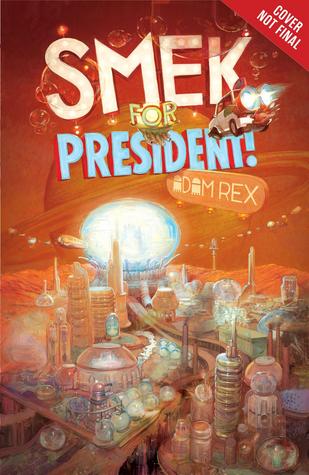
2016 Contenders: Smek for President, by Adam Rex

If I don't review this book RIGHT NOW, Sam is going to kill me. I actually read it in ARC form last year, but then the publication date was pushed back in order to coincide with the movie of the first book, and then I wanted to wait until I listened to the audiobook, and then I still didn't write my review because I'm lazy, etc., etc.... Suffice it to say that it would be prudent, as regards my marriage, to go ahead and write this thing.

So, Tip and J. Lo are back! It's been a year or so since they banished the Gorg, saved the planet, and gently encouraged the Boov (except J. Lo) to take up residence elsewhere. Things are quiet - too quiet for Tip, who's used to tooling around the country in her flying car with no parental supervision. In a spectacularly boneheaded move on both their parts, Tip and J. Lo take off in Slushious to pay an impromptu visit to New Boovworld. Their goal is to restore J. Lo's tarnished reputation, but when they arrive, of course, nothing goes according to plan.

Smek for President is a more thoughtful, introspective book than The True Meaning of Smekday, which feels like a strange thing to say about a novel that prominently features a form of transportation known as a "hoverbutt." In the hands of a skilled author, though, the ridiculous can exist comfortably alongside the sincere, and Rex does an excellent job of weaving genuine emotion into the fabric of his surreal humor.

Tip spends long stretches of the novel alone, working through her feelings in conversation with the (imaginary) ghost of Chief Shouting Bear. Her voice is slightly different than it was in the first book - the voice of a girl on the cusp of adolescence, seething with resentment, guilt, and confusion, and unsure of what kind of person she wants to be.

J. Lo's plot arc is somewhat grim as well - he spends a third of the book in prison - but still filled with his usual Boovish nonsense His unlikely friendship with Tip is as poignant and authentic as ever, though, even as they bicker and snipe at one another like true siblings. 

Of course, this all takes place in the context of the first-ever election for High Boov, and Rex's talent for wicked-smart political satire is on full display as he depicts the rituals of Boovish politics and the general goings-on of New Boovworld.

It's a delightful book, and if you enjoyed The True Meaning of Smekday, I doubt that I have to tell you to run out and get your copy ASAP. It's not going to win the Newbery, though. In addition to being a sequel, it's too funny and too weird. I do hope that the release of the movie, Home, will inspire more children to check it out.

I should also mention how absolutely glorious the audiobook is - Bahni Turpin's narration may be the best comedic audiobook performance I've ever heard. Among children's lit audiophiles, it's legendary. Go have a listen!

Published in February by Disney-Hyperion

Friday, February 27, 2015

The Winner's Circle: A Wrinkle in Time (1963)

 In a sense, there's no point in reviewing A Wrinkle in Time, Madeline L'Engle's first children's novel, and winner of the 1963 Newbery Award. It's securely ensconced in the upper echelon of the American children's literature canon, in the same realm as Charlotte's Web, The Giver, and Bridge to Terebithia. Indeed, the last time that Fuse #8 ran the Top 100 Children's Books poll, A Wrinkle in Time finished second, just below Charlotte's Web.

When I was a child, I loved A Wrinkle in Time, and read it through on several occasions. I hadn't picked it up in years though, and so I decided to read it again to refresh my memory of it.

Rereading my childhood favorites is always an interesting exercise for me. In some cases, I find that they're even better than I remembered -- that, now that I'm an adult, I find even more to appreciate in them. That's the case for Anne of Green Gables, The Phantom Tollbooth, The Hobbit, Higglety Pigglety Pop!, and many others.

On the other hand, sometimes I go back and fail to locate the magic that I once found in those titles. As a child, I adored The Chronicles of Narnia; as an adult, I find them almost unreadable. I was a huge fan of Charlie and the Great Glass Elevator back then, while it now seems too full of misanthropic (and racist) nastiness to really be enjoyable. I even, uncomfortably, remember a time when I was much younger when I wasn't thoroughly creeped out by Love You Forever.

Upon settling in to read A Wrinkle in Time again, I found that what I immediately noticed were things in the book I didn't care for. I almost instantaneously lost patience with Charles Wallace, who felt more like an excerpt from a book about Indigo Children than an actual character, to the point that his existence in the novel threatened my suspension of disbelief. (It's possible this was exacerbated by his proximity to his sister Meg, who is eminently real and believable.) L'Engle's Christian-infused mysticism felt dated and creaky to me, and her extensive use of quotations started to feel more like a crutch than a considered stylistic device. And I'd forgotten how slow the book is to start -- the pacing never seemed quite right to me.

This isn't to say that I found A Wrinkle in Time a complete disappointment. Even now, after I've read Orwell and Huxley and Kafka and Ray Bradbury, the Camazotz scenes retain a striking aura of surreal menace. And I remain charmed by Aunt Beast, the gentlest and tenderest of the many extraterrestrial beings who populate the book's pages. The ending too, remains warm and fitting, even though by now I know its beats by heart.

Interestingly, the Time series was possibly the first series that I lost patience with as a young reader. I loved A Wind in the Door, possibly even more than A Wrinkle in Time, but I found A Swiftly Tilting Planet confusing and bizarre, and I disliked Many Waters so much that I never bothered to read past that one to the books featuring Meg's daughter Polly.

Having said all this, I'm not entirely sure what conclusions to draw. There's no question of whether or not A Wrinkle in Time was a deserving Newbery winner -- as I mentioned, it has one of the widest and most loyal followings of any American children's book. Additionally, it has little competition. Although the 1962 publishing year was an amazing one for picture books (The Snowy Day, Chicken Soup with Rice, and The Sleep Book, just to name a few), it was less impressive on other fronts. The two Newbery honor books, Thistle and Thyme: Tales and Legends from Scotland, by Sorche Nic Leodhas, and Men of Athens, by Olivia Coolidge, are essentially forgotten. The one other "classic" novel published during that year was The Wolves of Willoughby Chase, by Joan Aiken, a British author who wasn't eligible.

My reactions may just say more about me as a reader than about A Wrinkle in Time as a book. I've come to be fairly skeptical of Good vs. Evil plots, and I place a premium on fully believable characters, and so A Wrinkle in Time may just not be the book for me anymore. It's certainly the book for a lot of other people though!

Tuesday, December 23, 2014

2015 Contenders: Space Taxi: Archie Takes Flight, by Wendy Mass and Michael Brawer

Today, Archie Morningstar turns eight years, eight months, and eight days old. It's also Take Your Kid to Work Day, and Archie is finally old enough to ride along with his father, a night shift taxi driver. Archie is very excited, but -- as the title of the book makes clear -- his father isn't an ordinary driver, and his vehicle isn't an ordinary taxi.

Space Taxi: Archie Takes Flight is billed as the first in a new series, and its thin plot is largely setup for the forthcoming installments. It was fun and offbeat, in a Daniel Pinkwater-lite for second graders kind of way, and I enjoyed the time I spent with it. It felt like the book would be an easy sell to a certain brand of reluctant reader, and that's always nice to see. I also liked the surprisingly prosaic use to which the mysterious item that Archie's grandfather gave him is put.

The novel doesn't excel in any of the Newbery criteria, however -- even compared only to some of the more "pop" books we've covered this year, the characters and setting are only loosely developed, and don't measure up to Nanny X or The Vanishing Coin. Space Taxi is pleasant, and I can see the series developing a real following, but it's not going to be a serious contender for any of the ALSC awards.


Published in April by Little, Brown Books

Tuesday, August 26, 2014

2015 Contenders: The Mark of the Dragonfly, by Jaleigh Johnson


What is The Mark of the Dragonfly by Jaleigh Johnson? Is it Steampunk? Is it Sci-fi? Is it Fantasy? IT'S ALL THE THINGS.

Piper is an orphan living in Scrap Town 16. She makes a living scavenging junk found in meteor fields. She's an eerily talented machinist, and hopes to one day make enough coin to leave for better prospects in the Merrow Kingdom's capital city.

One day, after a particularly harrowing meteor shower, she happens upon a destroyed caravan, with a girl inside, who mysteriously bears the mark of the dragonfly: an intricate tattoo sported only by favorites of the King himself. Piper nurses the girl back to health...to find she's quite a peculiar person. Anna is obsessed with order and organization, seemingly constantly preoccupied with analyzing whether things make logical sense to her, and her head is filled to the brim with information, not all of it practically useful. Before Piper can decide if she's made a huge mistake inviting this strange girl into her life, they're confronted by a man who claims to be related to Anna. Anna has no clear memory of him, and certainly bad vibes about him, so Piper and Anna flee the man, and the scrap town, aboard the 401, an old but beautiful train. Anna's dragonfly buys them passage, but not the trust of the train's head of security, Gee, a young man with a chip on his shoulder, and inhumanly green eyes.

The story takes off from here, as we try to unravel the mystery of who Anna is, and why anyone would be after her.

This book has got a bit of everything: Mythology, high speed chase scenes, cross-bow show-downs, magic, plot twists, even a little chaste romance. Also: A whole heck of a lot of GIRL POWER.

In regards to its literary merit, I found it to be well written, with dynamic characters, and a carefully constructed story line. Some may see Johnson's world building as a mish-mash of genres, but I liked it! Who says you can't mix your fantasy with your sci-fi? Probably the same fascists who don't want you mixing chocolate with peanut butter. It only makes the book more appealing, in my opinion. I can already think of a ton of kids who are going to be so hyped when I tell them about this book.

Is it a contender for the Newbery? I say why not? It's kind of "out there," but so were When You Reach Me and The Graveyard Book, and it got a starred review from Kirkus, which is typically a good sign. I think it's definitely praise-worthy, and I hope it's at least on the committee's radar. If nothing else, it gets two thumbs up from this humble librarian.

*****


Today's guest reviewer is Tess Goldwasser, Youth Services Librarian, St. Mary's County Library, Maryland. Tess also writes about picture books at Kid's Book Blog.


Tuesday, August 12, 2014

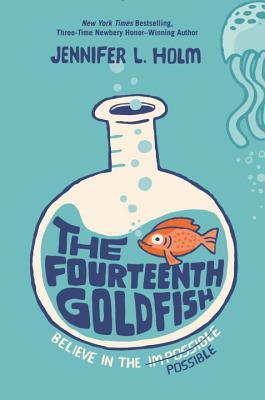
2015 Contenders: The Fourteenth Goldfish, by Jennifer Holm

Science is having a big moment right now. We effing love it! STEM is everywhere (I refuse to add the "a," because Science Technology Engineering Arts and Math is just shorthand for "everything.") Neil deGrasse Tyson is a rock star (of course, my own child has grown so tired of him that she refers to him as Neil deGrasse Buttcheek, but I digress).

In that context, it's a great time for a book like The Fourteenth Goldfish to come along - a book that not only celebrates science as a discipline, but also delves into some interesting questions about scientific ethics.

Ellie has just entered the sixth grade, and big changes are in store. Her former best friend has drifted away into volleyball, her babysitter has quit, and her mother has brought a teenage boy home to live with them. Not just any teenager boy, though: Ellie's scientist grandfather, who has managed to reverse his own aging process with the help of a rare jellyfish. Grandpa/Melvin enrolls in school along with Ellie, and as she teaches him how to navigate sixth grade, he introduces her to the world of science.

Jenni Holm's prose is so buoyant that I was surprised, when I finished the novel, to realize what weighty themes she had addressed. Early on, Ellie learns about some famous scientists - most notably Jonas Salk, Robert Oppenheimer, and Marie Curie. As the plot advances, the dilemmas faced by these figures help to frame the moral decisions that Ellie and Melvin must confront. The "fourteenth goldfish" of the title initially seems like a pointless detour, but by the time Holm reintroduces it at the end of the book, it feels both surprising and inevitable.


It's very satisfying. I love a good ending.

There are some great characters too - teenage grandpa Melvin is a great invention, and supporting characters like Ellie's new friend Raj are vivid as well.

The novel is not without its flaws. Ellie's drama teacher mom is a bit much - I used to be a drama nerd, and my directors never raided the costume closet for their daily attire. And some of Ellie's internal philosophizing feels heavy-handed and ultimately unnecessary, given the way the plot reinforces the themes on its own.

I'm not really sure about the Newbery chances of The Fourteenth Goldfish... It feels, in some ways, similar to Flora and Ulysses, which I thought was too light and quirky to win consensus, and I was wrong on that count. In any case, it's a great title to hand to fans of Cosmos, or to tie in with a STEM (not STEAM!) unit.

Expected publication: August 26th 2014 by Random House Books for Young Readers

Monday, June 10, 2013

2014 Contenders: What We Found in the Sofa and How It Saved the World, by Henry Clark

What We Found in the Sofa and How it Saved the WorldRiver, Freak and Fiona are three unlikely friends united by their outcast status and by the tragedies in their families' pasts. They are also the only kids in town who still live in the neighborhood closest to the mysterious underground coal fire known as Hellsboro. When they find a rare zucchini-colored crayon between the covers of a sofa that appears one day at their bus stop, it launches them into the midst of an intergalactic mystery. Surrounded by teleporting furniture, talking dominos, eccentric neighbors, and axe-wielding grannies, they must rely their own ingenuity and the bonds of friendship to navigate through the many dangers of Hellsboro and save the day.

I had high hopes for this book. For one thing, it has a great title. That and the wry humor of the first couple of chapters set me up for some Daniel Pinkwater-style weirdness and wit. Some of that is present, to be sure. The independent-minded sofa and the sentient Picasso painting / domino are probably worth the price of admission, as are some of the more ridiculous plot devices. Compulsive Completist Disorder? Hista Mime? Flash mobs? Delightful nonsense.

In many ways, though, this is clearly a first novel. The villains are dastardly, the pacing is uneven, and the whole thing wraps up far too neatly. I don't mind a neat ending, actually (huge Dickens fan!), but there wasn't enough groundwork laid for this one. It's nice that Freak's family problems vanish in a puff of money, but alcoholism and domestic violence are usually more entrenched than that. Those are the kinds of flaws I don't expect to see in a serious Newbery contender.

But they are excusable in a darkly funny sci-fi summer read, and that is squarely where I would place Sofa. I'll also be keeping an eye out for Henry Clark's next books - there's lots of talent and potential here. 

Publication in July through Little, Brown (Hachette)

Friday, April 5, 2013

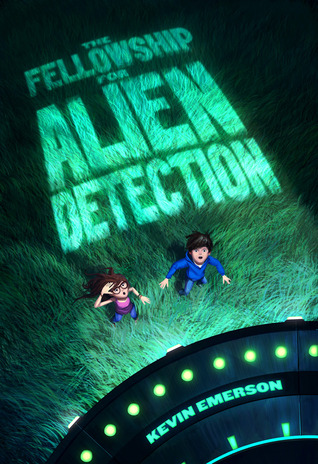
2014 Contenders: The Fellowship for Alien Detection, by Kevin Emerson

Haley is the kind of eighth grader who's already trying to pad her future college applications. She applied for the Fellowship for Alien Detection on a whim, as an alternative to her usual music camps and other enriching activities. Dodger is a shy loner who already feels like a failure at age thirteen. His parents are surprised when he's awarded the Fellowship for Alien Detection, since he's not exactly scholarship material. Both kids have stumbled upon some strange occurrences. Missing time. Missing people. Radio broadcasts from towns that don't exist. When they set out to investigate, from opposite sides of the country, they're hoping for a good story for their field reports, but they have no idea how far the Fellowship will take them.

Ok, first of all: hooray for middle grade science fiction. Double hooray for middle grade science fiction with a strong female protagonist. We don't see enough of it, and I personally know a small army of tween Whovians who think it's about goram time they had some intelligent, age-appropriate sci-fi to read. Bravo, Mr. Emerson.

And this title will be an easy sell to those Whovians. It's heavy on plot, with a spooky, intricate mystery that takes most of its 400 pages to unravel. I'm inclined to look askance at middle grade novels once they pass the 300 page mark, but this one doesn't feel particularly bloated. The skillful pacing spaces out the plot twists and cliffhangers effectively enough to keep the momentum going right up to the end. Plus, it's a standalone. The door is left slightly open for a sequel, but there is a full, self-contained story here, which is refreshing in these days of endless Chronicles of This-and-That. 

This title should definitely be on your summer booktalk roster.

It will, however, probably not show up on the Newbery discussion table. The characters are inconsistently developed. Dodger's dad is complex - both infuriating and oddly sympathetic. Haley's parents and brother, on the other hand, are vague, blurry presences. Some of the settings are well-realized - especially the stark desert landscape - but some are barely noted. The best I can say for the prose style is that it's cinematic... not always in a good way, when we're measuring for literary distinction.

That same fast-paced cinematic prose makes this an excellent summer vacation book, though. I'm going to pass my copy along to a cool, smart, alien-loving eleven-year-old girl.

Published in February by Walden Pond Press

Wednesday, September 12, 2012

2013 Contenders: What Came From the Stars, by Gary D. Schmidt


What Came From the Stars opens in the middle of an epic fantasy conflict, dropping the reader square into an alien, unfamiliar world with zero explanation. It's not particularly easy to follow, but it's clear that there is a group of people called the Valorim, that they're under siege, and that they're losing badly. Before their loss is complete, one of them forges a chain, and imbues it with the Art of the Valorim before sending it off on a journey through space. As it happens, the chain finally alights in the lunchbox of one Tommy Pepper, a sixth-grader in Plymouth, Massachussets.

Tommy is having a lot of problems. His mother has recently died in a car accident, a tragedy for which Tommy blames himself. A greedy real estate developer is angling for his family's home. And his younger sister, Patty, has stopped speaking entirely, communicating only in looks and gestures.

Once Tommy puts the chain on, strange things begin happening. Immediately, he has magical artistic talents. He says words in an unknown language, and begins to confuse his own life and world with that of the Valorim. Bizarre events begin taking place around him, starting relatively benign, but becoming increasingly malevolent. It becomes clear that someone from the other world is very interested in getting the Art back, and they're willing to do anything to obtain it.

As a plot summary, it sounds like it could be interesting indeed. But the execution is terribly muddled, and it simply doesn't cohere in a way that would make the book successful.

Two of the biggest problems were the same ones that bothered me so much about Okay for Now, Schmidt's much-discussed book from last year. One is that the central idea, that art is tremendously powerful, is compressed into a crashingly obvious metaphor -- the MacGuffin is called "the Art," and the discussions about it between the characters read more like philosophical conversations than actual dialogue. The second is that the book is jam-packed with subplot after subplot, only some of which are given adequate time, but all of which are resolved in an unsettlingly upbeat ending.

There are other issues, which I can't discuss without spoilers, so don't read on if you're averse to such things. The structure of the book is confusing to the point of completely frustrating the reader. Although the epilogue(s) help somewhat, it's terribly difficult to figure out what exactly is going on in the fantasy-world sections. It's a deliberate technique, one that does perhaps give the reader a feel for what Tommy may be experiencing, but it errs on the side of being too obtuse. This is especially true once the plot crosses over into the real world. There's a weapon, for instance, called an orlu. Tommy fights with it at one point, and several other people are around to see it. Yet it's never described, other than a statement that it's worn at the shoulder, and I still don't have any idea what it might be.

I also don't understand what's motivating Tommy at times. The plot requires the presence of a creature from the other world, an O'Mondim (which, as these things go, sounds to me less like a monster, and more like a particularly stout brand of Irish ale). Tommy makes one out of sand and more or less accidentally brings it to life, but there seems to be no reason, conscious or otherwise, for him to do it. It has to do with the Art, but how exactly the Art functions seems unclear as well. Why does Tommy forget nearly everything that's happened after the Art returns to the other world? And why, for that matter, does everyone else? And if everyone else has forgotten what's happened, how does Alice Winslow recall enough to write the glossary at the end?

Honestly, I kind of wanted the whole book to turn out to be a sort of poltergeist thing, in which the stress and trauma that Tommy has experienced start manifesting themselves in unusual and unpleasant ways. However, the book doesn't really give the reader the option of reading it that way, as there are physical artifacts from the other world that remain through the ending. You could read it as a metaphor, I guess, but I don't think it holds together enough to really make that practical.

As you may have guessed, I'm not among them, but Gary D. Schmidt has an intensely loyal and devoted following. I don't think even they are going to get behind What Came From the Stars enough to push it to any of the ALA awards, however. It's an interesting idea, but unfortunately, the novel itself is fatally flawed.


Published by Clarion / Houghton Mifflin Harcourt, and out now.