Tuesday, February 28, 2012

2013 Contenders: Wonder, by R. J. Palacio

"Be kind, for everyone you meet is fighting a hard battle," said someone or other (probably Ian McLaren and not Plato.) Whoever put them together, those words kept coming to mind as I read Wonder - and not only for the most obvious reason.

Clearly, Auggie (August) Pullman is fighting a battle. His facial deformities and their associated medical complications have kept him out of school for the first ten years of his life. As the novel opens, he is set to enter fifth grade at a small private school in New York. This is a recipe for disaster, both interpersonal and literary. As many reviewers have noted, it's not easy to write a "kid with a conspicuous medical problem" novel and have it turn out anything but lurid or preachy.

Part of what keeps Wonder from that fate is the broadness and universality of its themes. At first, we see the world through Auggie's eyes - we are immersed in his battles. Then the perspective shifts, and we are in the head of his older sister, Via. Then Auggie's schoolmate, Jack. Then several other characters. With each one, we become aware that though Auggie's problems are the most conspicuous ones, he's not the only one struggling. Everyone is fighting a hard battle. Kindness given and received; courage in the face of social pressure - these themes are woven so tightly into the fabric of the book that it transcends the "problem novel" genre and becomes, like the very best books, a meditation on the nature of humanity.

That makes it sound heavier than it is, though. Palacio makes her point with humor, Magnetic Fields lyrics, and an impressively light touch. Short chapters, direct language, and skillful pacing make the book seem much shorter than its 320 pages. And the dialogue and social interactions ring true. I've taught fifth graders - in a private school, at that - and this is how they talk. This is how they act. It is also, without giving too much away, the way certain private school parents act.

Some people will say that the resolution is too neat, but I think it's appropriate for a middle-grade novel. I think the turning of the social tide is believable, and I think Auggie and Palacio earn their happy endings.

It's early in the year still, but this is at the very top of my Newbery list so far.

Knopf - February 2012.

Friday, February 24, 2012

The Winner's Circle: The Matchlock Gun, by Walter D. Edmonds (1942)

Walter D. Edmonds won the Newbery in 1942, the Lewis Carroll Shelf Award in 1960, and the National Book Award in 1976, but these days, he's mostly remembered because John Ford made a famous film adaptation of his 1936 adult novel, Drums Along the Mohawk. As Rachael noted, Meindert DeJong can sympathize with one's reputation deteriorating over time, but it's still fascinating to me how quickly someone can be relegated to the footnotes of history.

The Matchlock Gun isn't a very well-remembered Newbery, and I've had a hard time trying to figure out what to make of it. It comes billed as a novel, but it's barely a short story; my copy is 50 pages long, and though it does come with a four-page foreword by the author, it also uses somewhere in the neighborhood of 20 pages on illustrations. It's extremely brief, and it simply doesn't have the room for subplots or advanced character development.

The story, which Edmonds assures us is in its essential points a true one, takes place in 1757, "when the French were still leading Indians out of Canada against the settlers." The father of the Van Alstyne family is away on a militia defensive action, and when a group of Indians reaches the house, the only way for the rest of the family to save themselves is for Edward, a 10-year-old boy, to follow his mother's plan and use the titular firearm, a piece obsolete even at the time that is over six feet long and has no trigger.

So it's a war story -- albeit one set during the French and Indian war, which isn't one that's much remembered. My guess is that its theme of implacable invaders attacking the homes of innocent people was one with especial resonance in the immediate aftermath of Pearl Harbor, when it won the Newbery. The story is told, however, in the style of a family legend -- the sort of thing that would usually be preceded by, "Tell us again about the time great-great-grandpa Edward had to fire the matchlock gun." Its focus is so insular, indeed, that only a couple people outside the family even have speaking lines. We're being invited into the Van Alstynes' inner circle here, and so this isn't a neutral look at the events portrayed.

Edmonds was a master prose stylist. His way with metaphors and images is easily the best thing about the book; he uses them to create a sense of family warmth, as well as an atmosphere of creeping dread as the attack becomes increasingly imminent. The book is, however, highly problematic in its depections of both Native Americans and African Americans; Oyate hates it, and though I think it's a bit disingenuous to leave out the fact that the book is set during a war, the examples that they cite in their review are every bit as ugly as they're made out to be. Even given the book's extremely limited scope, its descriptions of its non-white characters are over-the-top unpleasant, and it's impossible for a modern reader to overlook. I know I was made uncomfortable by them as I was reading.

So what are we to make of a book with moments of great beauty that nonetheless contains such distasteful flaws? I don't even know, though I wouldn't recommend this to a child. It represents both the best (love of family, great personal courage) and worst (demonization of anyone "other," complete acceptance of violence) in the psyche, history, and literature of America.

As for its Newbery, the other best-remembered book of the year was probably Little Town on the Prairie. It's been ages since I've read that one, and I know that that particular series isn't unproblematic in its racial characterizations either, but it probably would have been a better choice than The Matchlock Gun. If anyone has a better suggestion though, I'd be more than glad to hear it!

The Mighty Miss Malone, by Christopher Paul Curtis

Christopher Paul Curtis is angry. He's angry about the suffering that Americans experienced during the Great Depression - especially the disproportionate suffering endured by African-Americans and children. He is even angrier about the number of children living in poverty today - "the estimated fifteen million American children who are poor, who go to bed hungry and whose parents struggle to make a dignified living to feed and care for them," as he states in the afterword.

I am angry about those things too. As a librarian, albeit one who doesn't work directly with children, I hear heartbreaking stories every day about the children and families living in my impoverished region of Maryland. As a librarian, I also know that righteous anger can fuel the creative process. It has produced some of my favorite books: Oliver Twist (and most of Dickens, come to that). Jane Eyre. The Absolutely True Diary of a Part-Time Indian. In each of those cases, though, the anger is the energy that fuels a really, really great story.

This is not the case, I'm sorry to say, for The Mighty Miss Malone. 

As I summed it up on Facebook, this is a collection of really good sentences that don't add up to a great novel. The sentence level writing is of Curtis's usual caliber: superb. There are searing, gut-wrenching passages in this book: the overheard conversation about Deza's rotting teeth. The letter from Mrs. Malone's former employer. The description of the poorhouse, the way Deza's teachers treat her, Deza's voice (both inner and outer), etc., etc... All glorious.

Without a strong story to string them together, however, these scenes are nothing more than vignettes, and The Mighty Miss Malone is at its weakest in the area of plot. In the hands of a writer of Curtis's caliber, the transitions shouldn't be so abrupt that I find myself flipping back a few pages to see if I missed something. I kept waiting for the story to lead somewhere - to follow any kind of recognizable plot arc - but it just kept picking up threads of narrative and then letting them fall. I understand that this may have been a deliberate choice, given the fragmented lives of many families during the Depression. Still, there are ways to thematically unify even a fragmented narrative, and it doesn't happen here.

If there is a theme to The Mighty Miss Malone, it is the family motto: "We are a family on a journey to a place called Wonderful." I think Curtis intended to show the reader that love holds a family together even in the direst of circumstances. The problem is that I just didn't believe it in this case, and I don't think that Curtis did either. The entire tone of the novel works against it. By the time the motto is repeated at the end of the book, it is impossible to read it as anything but bitter irony. 

This is Curtis's first novel with a female protagonist, and Deza Malone is a memorable one. I just wish she'd been given a story more worthy of her.

By the way, if, like me, you couldn't remember the scene where Deza Malone appears in Bud, Not Buddy, Richie Partington kindly supplies it in his (much more positive) review.

Wendy Lamb Books, January 2012


Thursday, February 23, 2012

2013 Contenders: Remarkable, by Lizzie K. Foley

It's hard to be average when other people are exceptional. That's not only the subject of Remarkable, Lizzie K. Foley's debut novel, but also the reaction that I had to the book when I'd finished reading it.

Remarkable is a town in which everything and everyone is outstanding in one way or another. Well, everyone except Jane Doe, a ten-year-old with no distinguished traits of any kind, unless you want to count being the only student in town not enrolled at the School for the Remarkably Gifted. But despite her ordinariness, she finds herself being drawn into a series of adventures involving pirates, a missing composer, a bell tower, a weather machine, and a lake monster.

As I read, I found my mind drifting back to a pair of other books: The Extraordinary Adventures of Ordinary Boy, Book 1: The Hero Revealed, William Boniface's 2006 novel, and Whales on Stilts!, M.T. Anderson's 2005 kickoff for his "Pals in Peril" series. Boniface's book was also about a main character with no special abilities in a society where that was highly unusual. However, its comic-book setting was bright and fun, and its title character was willing not only to involve himself in his own story, but to find his own unique skills -- in his case, a keenly observational mind and the ability to make careful deductions. And Anderson's book had a fascinating setting too -- a universe in which children's series fiction of all stripes is quite true -- and a heroine in Lily Gefelty whose uninteresting surface appearance gave way to complexity and discovery of her own gifts as the story went along.

Both of these, to me, stood in contrast to Remarkable. Its fabulistic setting felt oddly generic, and Jane is a frustratingly passive heroine who contributes almost nothing to the denoument of her book. Even her realization of the central plot twists, which seemed to me to come about 50 pages too late, isn't necessary --  Detective Sly and Grandpa have already figured them out as well. In fact, I think the argument can be made that Grandpa is the real hero of the book -- his kindness and sensitivity for the welfare of others shine brighter than anything about Jane, despite the fact that he's even more ordinary than she is.

This isn't to say that Remarkable is a bad book, because it isn't. Several of the supporting characters, including the gleefully chaotic Grimlet twins and the repressed savage Ms. Schnabel, are memorable indeed, and the prose is humorous and tidy. It was fine as far as it went, no question about it. I just couldn't bring myself to love it when I'd read (and could call to mind years after reading) two superior books that took the basic theme and did a much better job with it.

Publication is in April though Dial (Penguin). It's being promoted heavily by the publisher, and I think it's possible it will be a popular hit. I wouldn't Newbery-shortlist it, but I'm curious to see other critical reactions to it.

Friday, February 17, 2012

The Winner's Circle: The Wheel on the School, by Meindert DeJong

Meindert DeJong is kind of an interesting figure in the history of American children's literature. He was the undisputed rock star of children's publishing in the 1950's, winning four Newbery honors, along with the medal itself. In the 60's, he was awarded the Hans Christian Andersen Award, the Lewis Carroll Shelf Award, and the National Book Award. He was clearly in the same echelon as his fellow Harper authors E.B. White and Laura Ingalls Wilder. But whereas the others are still household names, DeJong is now remembered primarily by overly enthusiastic children's librarians. 

What happened? Could the "influential librarians"* of the 1950's have been so wrong?

My own interest in DeJong came as a result of reading Dear Genius: The Letters of Ursula Nordstrom. The legendary editor's letters to DeJong are so full of confidence in his literary abilities that some of her excitement rubbed off on me and I ran straight to my library to find a copy of The Wheel on the School. (There were no holds.)

To glean any reading pleasure from The Wheel on the School, you have to accept one premise going in: having a pair of storks nesting on the top of your one-room schoolhouse would be the best thing that could ever happen to you or your town. So good that it makes you hyperventilate a little bit just thinking about it. So good that it will inspire legless men to leave their backyards and tie themselves to dinghies for the privilege of helping your wish come true.

Despite the odd premise, The Wheel on the School is actually a very good book. The sense of place is so strong that the book probably deserves its Newbery on the strength of setting alone. It's set in a Dutch fishing village similar to the one where DeJong spent his early years, and the descriptions of storms, dikes, and fishing life are obviously drawn from experience. Characters, especially the older inhabitants of the village, are depicted with humor and sensitivity.

The plot is skillfully structured and fast-paced as well - at least for Part One (Operation Get the Wheel). Judith Hartzell wrote, in a 2006 DeJong centennial article for the Horn Book, "This is an action book, built, as the title suggests, in the shape of a wheel. It begins with the hub—Lina. Like spokes running out toward the rim, the six children go on their separate adventures, and bit by bit, through the children, the whole rim of the village comes into play. Near the end, in a celebration-of-community scene, the fathers climb the schoolhouse roof on a stormy day to put the wheel in place."**

Ah, but there's the problem. That scene (Operation Put The Wheel on the School) is not nearly close enough to the end of book for my taste. There are still 70 more pages to go (comprising Operation Get Some Storks). Maybe it's my modern sensibilities, but by the time they finally heaved the wretched birds onto the wheel I was ready to get out my shotgun and start scanning the horizon for wings.

So, despite its strengths, this is probably not a book I'd hand to most kids I meet in 2012. Unless they're really, really excited about storks. Like, Double Rainbow excited. I mean, read this passage:

"Lina sat quietly, looking down at her stork. She had to hold herself very quiet, absolutely still, or she'd burst out and scream and laugh and cry. It was so unbelievable, so wonderful, sitting in school with a stork on her lap. Storks in school, storks in Shora! She bent deep over her stork and cried a little and stroked its long white neck."

Now tell me it doesn't make you think of this:


*A phrase that always makes me laugh. 


**Hartzell, Judith. "Happy Centennial, Meindert Dejong!." Horn Book Magazine 82.2 (2006): 227. MasterFILE Premier. Web. 17 Feb. 2012.

Thursday, February 16, 2012

The Winner's Circle: The View from Saturday, by E.L. Konigsburg (1997)

Fairly or unfairly, I think we often judge a book by a familiar author by different standards than we do one by someone unfamiliar. We may be surprised by greatness or incompetence once, but after that, we come to expect it.

I thought about this a lot as I struggled to figure out exactly how to evaluate The View from Saturday, the 1997 Newbery winner by E.L. Konigsberg. How much of my reaction, I wondered, was based on the knowledge that this was from the hand of the same person who produced From the Mixed-Up Files of Mrs. Basil E. Frankweiler?

That was a book that I read and loved for its inventive setting and clever puzzles. The View from Saturday, by comparison, I found a frustrating climb with very few handholds. Where Claudia Kincaid, the protagonist of the earlier novel, was a believable and resourceful heroine, the four children in The View from Saturday seemed like cardboard cutouts. Nadia, in particular, seemed more like a construct than a character, and as a reader, I never felt like the four sections narrated by the children were told in a child's voice, even allowing for the fact that child narrators in literature often need to display a bit more sophistication than is likely. The adults weren't a lot better -- the way that Mr. Singh shows up at the end to provide some deus ex machina insights seemed to me especially grating.

Similarly, the puzzle in From the Mixed-Up Files was fresh and interesting. In The View from Saturday, the novel's structure itself is a puzzle; it starts in media res, then intercuts the action at the Academic Bowl with stories told by the four children, before moving into flashback and then catching up to its beginning. There are reasons to play with narrative structure -- When You Reach Me is a fantastic example of a book that uses its structure to deepen the sense of mystery. But there was nothing in The View from Saturday that required a nonlinear structure, especially since the mystery at its heart -- why did Mrs. Olinski chose these four children for her team? -- never felt all that compelling to me.

Also, for a book set at an Academic Bowl, it has something of a loose grasp of trivia. The climax of the book hinges on the question, "In what work of fiction would we meet the original Humpty Dumpty, and who wrote it?" Mrs. Olinski's team, unlike their opponents, know that it is Lewis Carroll's Through the Looking-Glass, as opposed to Alice's Adventures in Wonderland. However, the first printed reference to Humpty Dumpty is in Gammer Gurton's Garland, an 1810 collection of songs and poems for children, and the character achieved great popularity through George L. Fox's performances in the Humpty Dumpty pantomimes in the 1860s. Carroll's book may possibly have been the first novel to feature H.D., but it seems unfair to give him credit for creating a character that has its own Roud Folk Song Index number. And if this seems like churlish nitpicking on my part, consider that Julian manages to successfully challenge the judges' ruling and assert that the word "tip" (as in gratuity) is an acronym that has entered the English language as a word (it originally standing for to insure promptness) -- despite the fact that no less an authority than the Oxford English Dictionary had concluded by 1989 that this was a completely false etymology. (It's actually a word that comes into the standard language via rogues' cant, which is at least as interesting.)

Would any of this have bothered me as much if I wasn't expecting greatness out of Konigsburg? It's hard to say. But I don't think it's a particularly good book, and I certainly wouldn't have given it the Newbery, even in a year that didn't produce many "classic" titles.

Monday, February 13, 2012

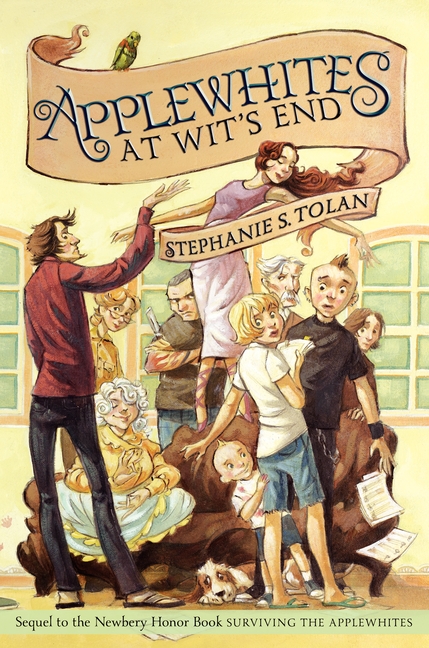
2013 Contenders: Applewhites at Wit's End, by Stephanie S. Tolan

You can think of it as the jumbo-sized version of "let's put on a play and save the old school" -- let's put on a summer camp and save our family homestead! As Applewhites at Wit's End opens, the Applewhite clan -- a three-generation collective of creative types, all but one of whom are family members -- have lost all of their money due to accounting fraud, and are in danger of losing Wit's End, their combination home/studio/playhouse, which they've built from an abandoned motor lodge. In order to raise the required money, they hit on the idea of running a summer camp for creative children, even though none of them have any experience at all in doing so.

It's all a setup for a warmhearted and terrifically funny excursion, seen alternately through the eyes of E.D., a 13-year-old girl who's the only one of the Applewhites without a creative talent, and Jake, a teen with a troubled past whose luck and outlook have changed since being taken in by the Applewhites. The book works as an ensemble comedy, a paean to creativity, and even as a bit of a mystery story. The setting and references are firmly present-day, but in its spirit and tone, it reminded me of a lost classic from the past, something that would sit comfortably on a shelf alongside Pippi Longstocking, Ginger Pye, and The Story Girl. It's the kind of book that I firmly believe I would have loved as a child -- and that, even as an adult, I genuinely enjoyed reading.

The novel is a sequel to Stephanie S. Tolan's 2003 Newbery Honor book Surviving the Applewhites. I haven't read that one, but I didn't find that it mattered. The tongue-in-cheek front matter, which includes a family tree and an introduction to the "cast of characters," served well enough to acquaint me with the Applewhites, and the few plot points from the earlier book that seemed to make a difference were quickly recapped in the text. At no point when reading it did I feel that it didn't stand alone.

As a side note, it occurred to me that, if Mary Higgins Clark or John Grisham take ten years to write a sequel, people are often willing to accept that -- but if a children's author takes ten years, the original audience has grown up, and so needs to some extent to be rebuilt. Perhaps this is one reason that Tolan was so careful to make the book easy to read for someone unfamiliar with the earlier work.

Official publication is in May through HarperCollins Children's Books. I'm putting this one on my Newbery short list. I don't know if the committee will be willing to give the award to a humorous book twice in a row, but I'd be intensely surprised if it didn't at the very least make the Notables list.